

Lunchtime market round-up
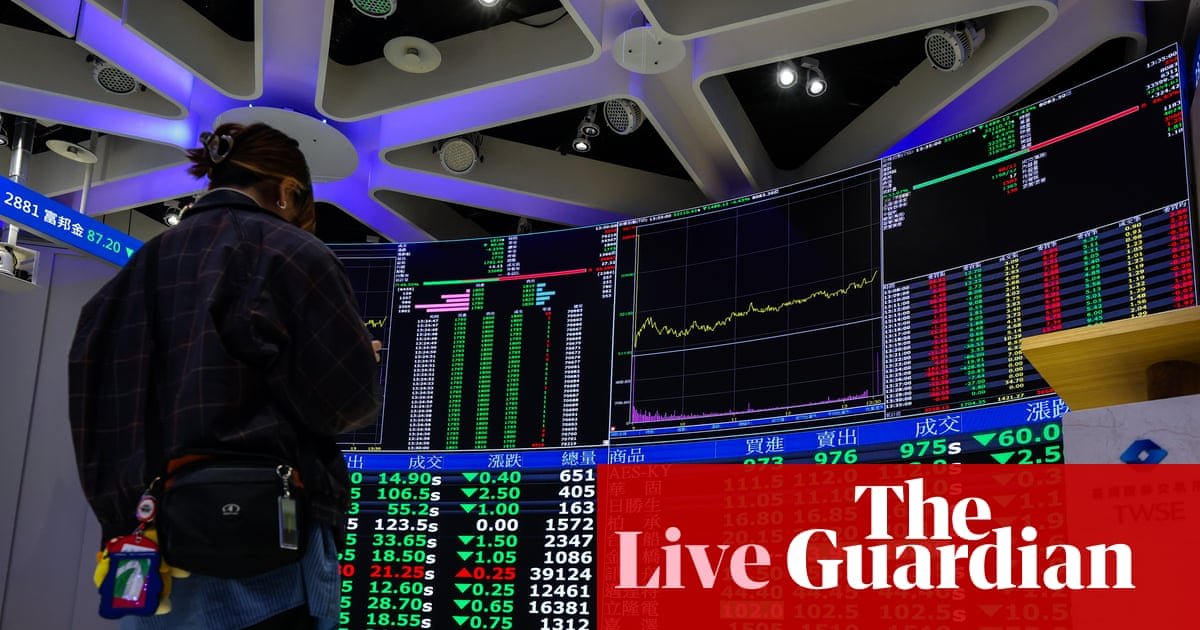
After a volatile morning, European stock markets are still in the red – but off their earlier lows – after steep losses in Asia-Pacific markets overnight.
The oil price is still trading over the $100 mark, on track for its highest close since 2022.
Here’s the situation:
UK’s FTSE 100 share index: down 112 points or -1.1% at 10,172 points
Germany’s DAX share index: down 350 points or -1.5% at 23,241 points
France’s CAC share index: down 152 points or 1.9% at 7,840 points
UK bond prices are still sharply lower; that has lifted the yield, or interest rate, on two-year gilts to 4.14%, up from 3.52% before the crisis began. That shows the markets are lifting their expectations for inflation and interest rates.
The odds of a Bank of England interest rate cut this month have evaporated. There’s a 93.5% chance that that UK’s central bank holds rates on 19 March, and a 6.5% possibility of a hike, according to the money markets.
Daniel Casali, chief investment strategist at UK wealth manager Evelyn Partners, sums up the mood:
double quotation mark“The ramifications of the escalating conflict in the Middle East are increasingly uncertain. Moreover, the US and Israeli military strikes on Iran are now reverberating through energy prices: Brent crude oil has risen more than 50% since the conflict started to US$107 a barrel at the time of writing, its highest level in a year. In turn, Iranian drone and missile strikes on regional oil and gas infrastructure, along with damage to multiple tankers, have further heightened concerns about supply disruptions.
“So far, the price action in financial and currency markets has been volatile rather than disorderly. Nonetheless, the balance of risks is shifting. Upside inflation pressures are building as energy costs rise, while equities face mounting downside risk and bonds are increasingly exposed to renewed inflation momentum. Geopolitical events are inherently unpredictable, which is precisely why we invest in highly diversified portfolios, built to withstand such risks over the long term.”
Share
Updated at 08.26 EDT
Key events
Show key events only
Please turn on JavaScript to use this feature
European Commission: we have sufficient stocks of oil and gas
The Europea Commission has said that member states have sufficient stocks of oil and gas despite the disrupted supply chains due to the war in the Middle East.
EC spokesperson Anna-Kaisa Itkonen told reporters in Brussels:
double quotation mark“We are far less concerned about the security of supply than we are of the high energy prices.”
Itkonen added that EU members had stocks of oil or equivalents to last up to 90 days, and that there was no sign of any emergency situation.
Share
Flurry of mortgage rate hikes, Moneyfacts warns
Mortgage lenders are repricing their products, higher, due to the turmoil in the markets since the Iranian war began.
PA Media reports that mortgage borrowers looking for a new deal will have some “unwelcome news”, a website has warned, as it saw a flurry of lenders reveal hikes to their rates, pushing up average fixed rates for homeowners to choose from.
Financial information website Moneyfacts said that it had seen several lenders adjust pricing on their fixed deals, including First Direct, Coventry Building Society, Yorkshire Building Society and Nottingham Building Society.
Cumberland Building Society was also withdrawing products while it repriced its mortgages, Moneyfacts said.
The hikes came on top of increases made last week, with HSBC UK, NatWest and Nationwide Building Society having made changes.
Share
Lunchtime market round-up
After a volatile morning, European stock markets are still in the red – but off their earlier lows – after steep losses in Asia-Pacific markets overnight.
The oil price is still trading over the $100 mark, on track for its highest close since 2022.
Here’s the situation:
UK’s FTSE 100 share index: down 112 points or -1.1% at 10,172 points
Germany’s DAX share index: down 350 points or -1.5% at 23,241 points
France’s CAC share index: down 152 points or 1.9% at 7,840 points
UK bond prices are still sharply lower; that has lifted the yield, or interest rate, on two-year gilts to 4.14%, up from 3.52% before the crisis began. That shows the markets are lifting their expectations for inflation and interest rates.
The odds of a Bank of England interest rate cut this month have evaporated. There’s a 93.5% chance that that UK’s central bank holds rates on 19 March, and a 6.5% possibility of a hike, according to the money markets.
Daniel Casali, chief investment strategist at UK wealth manager Evelyn Partners, sums up the mood:
double quotation mark“The ramifications of the escalating conflict in the Middle East are increasingly uncertain. Moreover, the US and Israeli military strikes on Iran are now reverberating through energy prices: Brent crude oil has risen more than 50% since the conflict started to US$107 a barrel at the time of writing, its highest level in a year. In turn, Iranian drone and missile strikes on regional oil and gas infrastructure, along with damage to multiple tankers, have further heightened concerns about supply disruptions.
“So far, the price action in financial and currency markets has been volatile rather than disorderly. Nonetheless, the balance of risks is shifting. Upside inflation pressures are building as energy costs rise, while equities face mounting downside risk and bonds are increasingly exposed to renewed inflation momentum. Geopolitical events are inherently unpredictable, which is precisely why we invest in highly diversified portfolios, built to withstand such risks over the long term.”
Share
Updated at 08.26 EDT
“Too early” to expect Bank of England to raise interest rates this year
The sharp jump in oil prices has forced markets to rethink the idea that UK interest rates are on a smooth downward path, says Jonathan Raymond, investment manager at Quilter Cheviot:
double quotation markA sustained move in Brent oil over $100 is effectively an inflationary tax. It raises costs for businesses, squeezes real incomes and risks keeping headline inflation above target for longer.
If that persists, gilt yields and swap rates will remain under upward pressure, which is why we are already seeing mortgage pricing move higher before the Bank has done anything. The Bank is likely to initially look through the shock because it is energy driven, but if the Middle East situation deteriorates further the risk of policy tightening later in 2026 becomes harder to dismiss.
The key question for central bankers is how “persistent” the oil shock becomes.
Raymond adds:
double quotation markIt remains too early to expect the Bank to actively raise rates this year, but every day without progress on Iran increases the economic damage and the risk that higher energy prices feed more firmly into underlying inflation. That is why the market is starting to recognise that inflation is not yet last year’s problem.
Share
The surge in the oil price has pushed the market further into ‘backwardation’ – the situation where the spot price, of a commodity is higher than the prices in the futures market.
So while a barrel of oil is more than $100 now, it costs less than $80 to buy it for delivery in November, or just $70 for October 2027.
The Brent crude forward curve Photograph: LSEG
That implies that the markets expect (or hope) the disruption to Middle East supplies will be temporary, or that the economic damage leads to lower demand for energy in future….
[The opposite of “backwardation” is the exotic sounding ‘Contango” – the situation where financial futures contracts show assets are cheaper today than a later time.]
Share
Updated at 07.47 EDT
Bloomberg: Saudi cutting oil production
Saudi Arabia has started reducing oil production as the near-blockage of the critical Strait of Hormuz starts filling up storage tanks, Bloomberg reports.
They explain:
double quotation markThe move by the kingdom, the world’s biggest oil exporter, follows the United Arab Emirates, Kuwait and Iraq.
The war in the Middle East has all but closed the Strait of Hormuz, the narrow waterway linking the Persian Gulf to the open seas, to maritime traffic following Iranian threats to shipping. That’s clogged up exports from major producing countries, sending oil sharply higher and rippling through the global economy.
Share
Updated at 08.28 EDT
Petrol and diesel prices rise – with more expected
UK motorists are already being hit by the surge in oil prices.
The RAC report that petrol has risen by 5p to 137.5p a litre since the Iran war began on Saturday 28 February. Diesel is up 9p to 151p a litre.
RAC head of policy Simon Williams says they are “unfortunately likely to keep on rising”:
double quotation mark“Unleaded is almost certainly going to reach an average of 140p in the next week or so while diesel looks highly likely to climb to at least 160p a litre. The price of diesel is increasing more quickly now than at any point since the start of the Ukraine conflict. With oil at a sustained $100, petrol could rise towards 150p a litre – a price not seen since June 2024. Diesel could reach almost 180p, which would be a three-year high.
“We encourage drivers to continue filling up as normal but to shop around for the best prices using apps like myRAC as there can be big local differences between forecourts. Driving fuel efficiently by avoiding harsh accelerating and braking and ensuring tyres are inflated to the right pressures can help eke out every last mile and save money.”
Prices at the pump shouldn’t immediately rise when the crude price does, though. It takes time for a barrel of Brent to be refined, and for fuel to be transported to pumps.
Edmund King, AA president, points out prices shouldn’t rise overnight:
double quotation mark“As we predicted last week, the longer this conflict goes on, the more effect it will have on the cost of oil. Anytime Brent Crude passes $100 per barrel raises concern across the markets, for the haulage industry and drivers. One positive is that there are still reserves of oil out there and IEA intervention may release more supplies.
“In the meantime, there will be gradual increases in pump prices, but this shouldn’t happen over night as fuel has been purchased at previous prices. Our suggestion is that drivers should not change their refuelling habits but can consider cutting out some non-essential journeys and changing their driving style to conserve fuel. These measures linked to warmer weather means than drivers can ensure their fuel stretches further.
“There is still a wide disparity of fuel prices at the pumps so drivers can use the AA App or Government’s fuel finder to find the best pump prices close-by.”
Share
Traders lift bets on interest-rate hikes from the European Central Bank
Financial markets are also expecting the European Central Bank to raise eurozone interest rates this year, to fight the inflationary hit from pricier oil.
The money markets are now fully pricing in a quarter-point rise in ECB rates by July this year.
Bloomberg reports that swaps [derivatives that measure investor expectations for interest rates] imply around a 70% probability of two 25-basis-point rate increases by the ECB this year, compared with the one move that was priced on Friday.
Share
Updated at 06.38 EDT
Wall Street’s fabled “fear index” is climbing this morning, as the surge (and then partial reversal) in the oil price spooks investors.
The VIX index, which tracks volatility among asset prices, is up 8% to 31.86 points, its highest level since April 2025 when Donald Trump’s trade war rattled markets.
Share
Thought for the day, from TS Lombard’s Dario Perkins:
an old debate. Oil-price spikes have a nasty habit of marking the end of the cycle. But is that because of the income-squeeze, or the Fed’s response? Or both? pic.twitter.com/IE8tGIRy68
— Dario Perkins (@darioperkins) March 9, 2026
Share
Chancellor Reeves is talking to Bank of England governor every day
UK chancellor Rachel Reeves is speaking to the Bank of England “on a daily basis”, Sir Keir Starmer has said this morning, as he tries to calm fears about the impact of the energy crisis.
Speaking at a community centre in London, the prime minister says:
double quotation markThe job of government is obviously to get ahead, to look around the corner, to work with others, and the chancellor speaks to the governor of the Bank of England on a daily basis, with looking cross-departmental within government, assessing the risks, monitoring and talking to our international partners as well about what more we can do together to reduce the likely impact on people here and businesses here, of course.
But it is important to acknowledge that that work is needed, because people will sense, you will sense I think, that the longer this goes on, the more likely the potential for an impact on our economy, impact into the lives and households of everybody and every business.
And our job is to get ahead of that, to look around the corner, assess the risk, monitor the risks, and work with others in relation to that.
Our Politics Live blog has more details:
Share
US crude oil back below $100!
The US crude oil has now slipped back below the $100 a barrel level, now changing hands at $99.30 a barrel.
That’s still a jump of 7.8% today, but lower than the $119.50 a barrel seen when markets opened overnight.
Brent crude, the international benchmark, is still over $100 though – up 10% at $102.27 a barrel.
That follows this morning’s reports that G7 finance ministers are preparing to discuss the release of emergency oil reserves, to ease fears of shortages.
Investors may have also noted comments from US energy secretary Chris Wright overnight, who said the recent surge in oil prices reflects a temporary “fear premium” tied to the Iran war.
Wright argued that the jump in oil prices was unlikely to persist because global energy supplies remain adequate.
Speaking on CNN’s State of the Union on Sunday, Wright said the conflict’s disruption to energy markets and shipping routes should be short-lived.
double quotation mark“The oil is there.”
“You’re seeing a little bit of fear premium in the marketplace. But the world is not short of oil today or natural gas.”
[Reminder, flows through the strait of Hormuz, which carries 20% of global oil and gas, have pretty much dried up]
Share
