

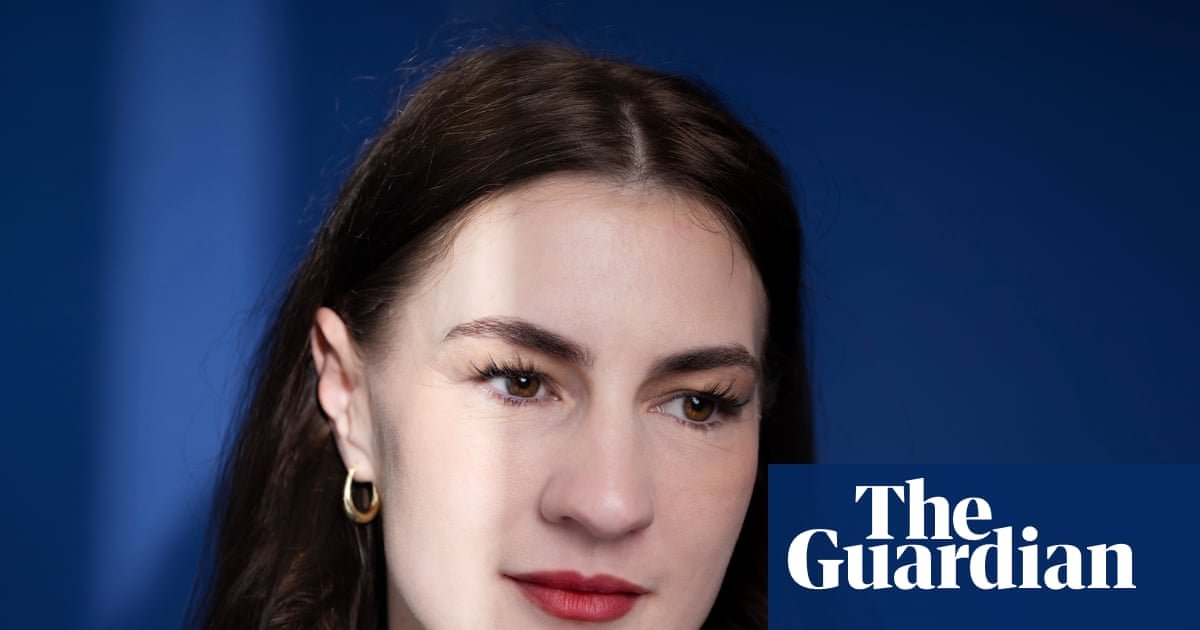
On 9 September 2022, Lucia Osborne-Crowley flew from London to Miami and caught a Greyhound bus north to West Palm Beach. The writer and journalist had arranged to meet Carolyn Andriano, who was abused by Jeffrey Epstein and Ghislaine Maxwell from the age of 14 until she was 17, starting in 2001. Andriano had been a crucial witness in the trial against Maxwell in 2021.
When the two women met, Andriano said she had just been visited by a private investigator – a man in his 60s, who had heard she was talking to someone about a book. In a restaurant that afternoon, Osborne-Crowley was approached by a man in his 60s. What was she writing, he wanted to know. He offered her drugs, cash and a meeting with one of Epstein’s pilots, then put his hands under her skirt. When the manager asked him to leave, he waited in the car park; Osborne-Crowley had to escape through a staff exit.
She had been following the Epstein case for six years by then and had written a book about the Maxwell trial, The Lasting Harm; this was just a taste of what others had experienced. In November 2025, 28 Epstein survivors released a statement saying many of them had received death threats. They all asked for police protection.
With Epstein dead and Maxwell in jail, who was paying these men? “It could be any of the people who are not yet facing charges,” says Osborne-Crowley when we meet. “Firstly, they can afford it. The weekend I was in Miami, there was a person following me, a person following a survivor in South Africa who was in my book, and a person following a survivor in the UK. Just so that we all were aware.” Two women withdrew from The Lasting Harm after receiving threats. “Ghislaine used to tell them: ‘If you ever tell anyone what’s going on here, no matter how far into the future, we will find you and we will stop you.’ And in a lot of ways, that promise was kept.”
‘A group of 12 people decided that this conspiracy was real’ … a court illustration of Maxwell during her trial in 2021. Photograph: Jane Rosenberg/Reuters
Osborne-Crowley, 34, is sitting on my sofa after making a fuss of my cat, in a lunch break between filing court reports for the legal news service Law360. She wears black cowboy boots and keeps her scarf on, apologising in a just-detectable Australian accent (she moved to London from Sydney in 2018) when she needs to answer a work email. It’s a busy week, with a class action against Amazon, a landmark disability claim and the latest round in a lawsuit backed by Ronnie O’Sullivan against snooker’s governing body. But it is the constant stream of Epstein revelations to which she returns, specifically their effect on the women she has come to know as friends.
This is her frustration: that the coverage centres Epstein, Maxwell and Andrew Mountbatten-Windsor and tries to unpack their psychology and connections, finding it easier to talk about political corruption than sexual abuse. The human collateral gets lost, as does the survivors’ agency. “This would never have happened if these women hadn’t campaigned for this act [the US’s Epstein Files Transparency Act]. We don’t need more articles or books saying: ‘Ooh, Jeffrey Epstein, how do we understand him?’ There are a lot of things that need more scrutiny, but it’s not the yachts and the islands and the opulent wealth. This is a story about grooming and the girls who lived through it.”
As well as Andriano, Osborne-Crowley writes in her book about Jane, who was approached by Maxwell and Epstein at a summer camp in 1994, when she was 14. There is Annie Farmer, who was invited to a weekend retreat for bright students at Epstein’s ranch when she was 16, only to find no other children there. Kate, 17, was promised an introduction to a music producer in London. Liz Stein was a 21-year-old personal shopper in a New York department store. Jess Michaels was a 22-year-old dancer when Epstein raped her after a massage, as long ago as 1991.
double quotation markGhislaine used to tell them: ‘If you ever tell anyone what’s going on here, no matter how far into the future, we will find you and we will stop you’
Reading their stories, what strikes you is the similarities – the love-bombing, the identification of weakness, the financial help, the gifts of lingerie, the name-dropping – as well as how that playbook was finessed over time. In 2004, when Andriano got too old for Epstein, he asked her to recruit younger friends from school. “Why would I want to be friends with girls younger than me?” she said at Maxwell’s trial. “That would be so uncool.”
Andriano died in a hotel in May 2023, eight months after Osborne-Crowley’s visit. The autopsy recorded an accidental overdose of methadone and fentanyl. It was a shock to those who knew her. “She’d been clean for so long and I spoke to her the day before,” says Osborne-Crowley. “It didn’t feel like she was about to relapse for the first time in 10 years.”
For the Epstein survivors, the recent release of files has been vindicating and re-traumatising, she says: “It’s so complicated. They feel very validated on some levels.” At the same time, central figures were concealed and survivors’ names left unredacted. “It’s hard to be shocked at this point, but it does feel really shocking that the Department of Justice would do that. And they are very angry that the cover-up is so brazen. The law says that the only things that can be redacted are the names of the victims. So you’ve got the executive branch breaking the law, and in a way that’s sloppy.”
Epstein abused hundreds of women, most of whom prefer to remain anonymous. Does belonging to that group, “the Epstein survivors”, minimise them – an interchangeable mass of Jane Does, as Epstein saw them?
“It’s both good and misinformed,” Osborne-Crowley says. “Good because they have voices and the attention of politicians. But it is frustrating to be treated as though you have the same opinions. Carolyn was 36; Liz is in her 50s. This operation was very different in the 90s than it was in the mid-2000s, so people’s experiences are different. I’ve seen people latch on to that as ‘infighting’. It’s ridiculous, because there’s no world in which it would make sense for them to agree on everything, given how sophisticated this operation was.”
As a child, Osborne-Crowley was a star gymnast. At 12, she represented Australia at the world championships. She did triple somersaults in the air and held a handstand with one arm. The training was relentless: camps where she was woken for a 5am run by Rihanna’s Pon de Replay on full blast; a diet of raw eggs, protein powder and milk. “I had to be strong and powerful and graceful and light, all at the same time,” she writes in her 2019 memoir, I Choose Elena. “I had to smile.” The judges nicknamed her “the smiling girl”.
She was training for her second world championships, at 15, when she was raped by a stranger in Sydney. A man in his 30s marched her into a McDonald’s toilet and she escaped only by smashing a bottle on the floor and startling him. She didn’t go to the police, but gradually dropped out of gymnastics and began to develop chronic pain symptoms, later diagnosed as endometriosis and Crohn’s disease. Over years of treatment, she surfaced memories of being abused by a gymnastics coach – and realised she wasn’t the only one.
“My friends joke that I’m a very all-or-nothing person,” Osborne-Crowley says. “I have the institutional childhood abuse and the violent rape, these things I told nobody about for 10 years. And then I publish an essay and tell everybody, all at once.” In her memoir, she details the physical cost of suppressing this and the science around it – the addictions and autoimmune diseases that are the body’s way of processing trauma.
Covering Maxwell’s trial was a way of making something good come of that knowledge. “It certainly wasn’t therapy. It would have been much easier to do my actual therapy.” She describes the process of writing The Lasting Harm as a steep learning curve, in which more experienced reporters taught her how to pace herself. The Epstein survivors were vital, too. “It’s hard to overstate the role that Jess and Liz played in that. I’ve learned since then I’m not going to be helpful to anyone if I’m not around, literally or emotionally.”
‘It’s hard to overstate the role that Jess [Michaels] and Liz played’ … Liz Stein (right), a survivor of Epstein and Maxwell, speaks before the State of the Union last month. Photograph: Alex Wroblewski/AFP/Getty Images
Was she sometimes suicidal? “Yes. But it’s also about being fully present – you can’t be a good journalist if you can’t be present when someone is telling you the worst thing that happened to them.” Are there things she can’t print that she wishes she hadn’t heard? “No, because those things make me aware of how dangerous [Epstein] was. There are a lot of details people would be shocked by, in terms of the depravity and cruelty. I wish I could communicate that.”
She is now more careful about what she takes on, referring broadcast requests to survivors. She was asked to write a column about the arrests of Mountbatten-Windsor and Peter Mandelson, arguing that women had been failed because they weren’t charged with sex or trafficking crimes. “And I said no, because that doesn’t happen to be my opinion. But also, I’d been speaking to Virginia Giuffre’s family, who were celebrating a huge moment of justice.” (Mountbatten-Windsor has denied Giuffre’s allegations of wrongdoing and the Metropolitan police said in December it would not launch a criminal investigation into the sexual allegations against him, while Mandelson has never been suspected of any sexual offending.) She points out how much easier it is to investigate someone over allegations of misconduct, with its apparent paper trail, and that the questioning of Mountbatten-Windsor’s protection officers suggests the investigation will go wider.
The Epstein-Maxwell network was so extensive and elite that it can read like a conspiracy theory. Were all these people really connected? It doesn’t feel like an accident that, at Hillary Clinton’s congressional hearing last month, two Republicans raised Pizzagate and UFOs, as if to blur fact and fiction. Is there a danger that, in the public imagination, all of this seems too bad to be true?
“We owe it to the victims to stop that part of ourselves that thinks it’s too much,” says Osborne-Crowley. “I have a source who saw a lot of these people on the island, and she’s been saying it for a long time and nobody believed her. Ghislaine Maxwell was convicted of three counts of conspiracy. A group of 12 people decided that this conspiracy was real.”
A frail Bill Clinton told the same congressional committee that he “saw nothing that ever gave me pause”. In the many conversations Osborne-Crowley has had with survivors, no one has made an allegation about the former president. But he was useful to Epstein in other ways. Juliette Bryant, who was trafficked from Cape Town in 2002, has told reporters she first met Epstein when he was having dinner with Clinton, Kevin Spacey and Chris Tucker, an account supported by flight logs and which Clinton has not denied.
‘He was being used as a grooming tool’ … Bill Clinton (in red) with Kevin Spacey and Ghislaine Maxwell. Photograph: AP
“He was being used as a grooming tool,” says Osborne-Crowley. “That’s not to say he knew that was happening, but that’s what Jeffrey was doing. It gave him huge amounts of legitimacy – he was the reason people thought it was safe to be in that group.”
In December, Maxwell played her final card, a habeas corpus petition to have her conviction overturned. It mentioned Osborne-Crowley six times. These were references to Osborne-Crowley’s post-trial interview with the juror Scotty David, in which he spoke about his experience of sexual abuse. In 2022, Maxwell’s lawyers called for a retrial, declaring David unfit because he had not declared this in a pre-trial form, but they were denied. “A retrial would be saying a sex abuse victim can never serve on an impartial jury,” ruled the judge, Alison Nathan. “That is not the law, nor should it be.” Two subsequent appeals have failed.
How did it feel to see herself form part of Maxwell’s last line of attack? “Very strange. She interacted with me quite a lot in the courtroom. She’d wave and wink and once started sketching me. But that whole ordeal was incredibly difficult. I knew the case law on what would disqualify a juror and I knew this wouldn’t amount to that, but it was still horrible.”
A lot has happened since Maxwell was convicted: her lawyers sued her for non-payment of fees, then Maurene Comey, the federal prosecutor in the case (and the daughter of the former FBI director James Comey), was fired last summer by Donald Trump. Soon afterwards, Maxwell was interviewed by Trump’s former lawyer, the deputy attorney general, Todd Blanche. She told him: “The president was never inappropriate with anybody.” A week later, she was transferred to a minimum-security jail. “This is the first time I’ve ever heard of a defendant choosing not to testify in court and then being given carte blanche to tell her story, unchallenged,” says Osborne-Crowley. “She blames Virginia [Giuffre] for recruiting everyone.”
What hasn’t happened in the US is any arrests, even though women have been reporting Epstein to the police since at least 1996. “There are thousands of people who could have intervened. Or they did intervene and the person they reported it to didn’t do anything,” says Osborne-Crowley. “Carolyn and Virginia could still be alive. There will be more people who die before their time because of the toll this trauma takes on a person’s body.”
‘There will be more people who die before their time because of the toll this trauma this takes on a person’s body.’ Photograph: Linda Nylind/The Guardian
Osborne-Crowley is managing her own trauma better these days. She no longer has to flag down taxis so that she can lie on the back seat for 20 minutes, waiting for the painkillers to kick in. She has beaten several addictions and lives in London with her boyfriend and their cat. The coach who she says abused her (who has not faced charges) has stopped contacting her on social media, where his feed is full of photographs of girls who look a lot like her.
Grooming is the same wherever you find it, she says. She remembers sharing her story with one of Epstein’s survivors, half apologetically; it was nothing like her experience and there were no billionaires. “And she said: ‘Look, obviously it makes a lot of things different that Epstein was a billionaire. But it’s not just about the most powerful people in the world. It’s about the people who are the most powerful in your neighbourhood, your school.”
Those people won’t go away, Osborne-Crowley says, but she is hopeful that our understanding of grooming is shifting – that if people can join the dots between, say, Epstein, Harvey Weinstein, Jimmy Savile, the Rotherham and Rochdale gangs, they might stop it when they see it. Meanwhile, the Epstein survivors will push for people to be held accountable and more files to be released.
“They are very motivated, because they can see that it’s working,” she says. “I was speaking to Liz and Jess and they were at the State of the Union in DC. They were guests of one of the congressmen who introduced the Transparency Act. Jess said: ‘If you grow up in America and you ask your parents for something crazy, like really ridiculous, they’ll say: ‘What do you want – an act of Congress?’ But we did it: we created an act of Congress.’”
In the UK, the NSPCC offers support to children on 0800 1111, and adults concerned about a child on 0808 800 5000. The National Association for People Abused in Childhood (Napac) offers support for adult survivors on 0808 801 0331. In the US, call or text the Childhelp abuse hotline on 800-422-4453. In Australia, children, young adults, parents and teachers can contact the Kids Helpline on 1800 55 1800, or Bravehearts on 1800 272 831, and adult survivors can contact Blue Knot Foundation on 1300 657 380. Other sources of help can be found at Child Helplines International
Information and support for anyone affected by rape or sexual abuse issues is available from the following organisations. In the UK, Rape Crisis offers support on 0808 500 2222 in England and Wales, 0808 801 0302 in Scotland, or 0800 0246 991 in Northern Ireland. In the US, Rainn offers support on 800-656-4673. In Australia, support is available at 1800Respect (1800 737 732). Other international helplines can be found at ibiblio.org/rcip/internl.html
In the UK and Ireland, Samaritans can be contacted on freephone 116 123, or email jo@samaritans.org or jo@samaritans.ie. In the US, you can call or text the 988 Suicide & Crisis Lifeline at 988 or chat at 988lifeline.org. In Australia, the crisis support service Lifeline is 13 11 14. Other international helplines can be found at befrienders.org
