

Two friends bought nearly identical homes last year, in the same northern Minnesota neighborhood, for the same price.
But Tara Novak pays more than twice as much for home insurance as Petra Rodriguez. The only difference? Ms. Novak has a lower credit score.
Across the country, people with weaker credit histories are paying far more for home insurance than owners with spotless records.
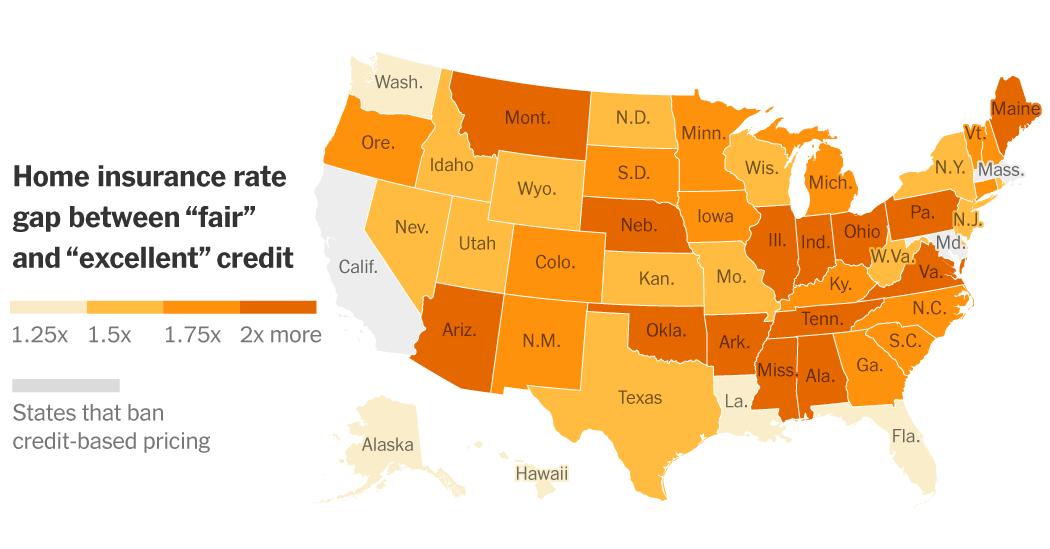
Where the home insurance rate gap between “fair” and “excellent” credit is higher
Home insurance premiums have risen rapidly in recent years, fueled by climate change, building costs and inflation. The price shock has rippled into the real estate market, dragging down home prices in areas vulnerable to disasters and leading insurers to abandon homeowners in risky places.
But these dynamics obscure another problem: The home insurance market has cleaved in two along a boundary defined more by a customer’s personal history than by the risk of a disaster hitting their home.
Americans with weaker credit histories, usually from missed payments or high amounts of debt, now pay significantly more for insurance, regardless of where they live, two new studies have found. While those with poor credit histories often can’t purchase homes at all, people with “fair” scores, which range from around 580 to 669, are paying twice as much in some places as people with “excellent” scores of about 800 or higher. And the gap is growing.
Insurers use a metric based on credit history known as an insurance score to set rates, and the figure tracks closely with a customer’s credit score.
States with the biggest pricing gaps
The penalty for having a “fair” credit history versus an “excellent” one
That can mean owners of identical homes, like Ms. Novak and Ms. Rodriguez, pay wildly different rates to insure them. For most people, it’s now just as expensive to have a credit score of “fair” as it is to live in an area likely to experience a disaster like a hurricane or wildfire. About 29 percent of consumers have credit scores that are categorized as “fair” or “poor.”
“There’s so many reasons people have bad credit,” Ms. Novak said. “It’s not like I’ve ever not paid a bill on time. I’m a stickler on my bills, I’m a stickler on my rent, never been late. This is not fair.”
“The choice to use credit scores in pricing means that those lower-credit home owners in risky areas are effectively subsidizing more affluent high-credit homeowners who also live in risky areas,” said Nick Graetz, assistant professor of sociology at the University for Minnesota, who wrote one of the recent papers. “So in a lot of ways, you can keep your insurance price down if you’re high income, high credit — even if you live on the coast of Florida.”
A handful of states have banned insurers from using credit data because of concerns about fairness and the potential for discrimination against low-income people and people of color, but the majority allow it.
For those with both weaker credit and high disaster risk, the combination can set them up for a downward spiral: disasters tend to be followed by decreases in credit scores as people use credit cards and bank loans to recover. That can lead to higher insurance rates, pushing monthly housing costs further out of reach.
“When a disaster hits, there’s a loss of income that occurs, and then that can impact someone’s credit score because they can’t pay their debt, they can’t pay their rent, they can’t pay their mortgage,” said Lance Triggs, executive vice president at Operation HOPE, a financial literacy nonprofit. “And now they’re faced with higher insurance premiums post-disaster.”
A working paper released today by the National Bureau of Economic Research found that homeowners with the lowest credit scores paid, on average, $550 more in 2024 for home insurance than those with the highest scores.
The findings broadly track with data from Quadrant Information Services analyzed by The New York Times, which found that, on average, lower credit scores meant higher premiums across every state that allowed the practice. Dr. Graetz used the same data set for his research, which he did in collaboration with the Consumer Federation of America and the Climate and Community Institute.
When a windstorm last year hit the home of Audrey Thayer, a city council member in Bemidji, Minn., it ripped the siding off her house and stripped shingles from her roof.
Ms. Thayer’s insurance did not cover all the damage. As she fought her insurer for more money, she opened new credit cards and bank loans to repair her home. Her credit score dropped as she tried to find a new insurance plan.
Ms. Thayer, a member of the White Earth Nation, said she was not aware that her credit score could affect her home insurance rates, even though she teaches about credit ratings at a nearby tribal college. “Most of the folks here do not have good credit,” said Ms. Thayer, whose community is one of the poorest in the state. “I did not know what a credit score was until I was 35 or so.”
In Texas, the advocacy group Texas Appleseed found that some insurers charge people with poor credit up to 12 times as much as people with excellent credit for certain policies, said Ann Baddour, the director of the nonprofit’s Fair Financial Services Project.
Higher costs have serious implications for low-income homeowners who live in the path of hurricanes, said Nadia Erosa, the operations manager at Come Dream Come Build, a nonprofit community housing development organization. After the Brownsville, Texas, region saw intense flooding last spring, some residents turned to companies offering high-interest loans to fund repairs, she said, raising the risk of the disaster-credit spiral.
“Delinquencies are going up because people cannot afford their payment,” she said.
The price of risk
Before they can get a mortgage, homebuyers are usually required by lenders to purchase home insurance.
“Households with insurance have fewer financial burdens, fewer unmet needs, they recover faster, they’re more likely to rebuild,” said Carolyn Kousky, an economist and founder of Insurance for Good, a nonprofit that focuses on finding new approaches to risk management. “Yet the people who need insurance the most are the least able to afford it.”
Insurance companies consider a variety of factors when setting the premium for a property. They might examine the age of the roof, or the area’s vulnerability to hurricanes or wildfires. They factor in how much it would cost to rebuild the house if it were damaged.
Insurers have argued that credit history is also worth considering because people with low scores tend to file more claims than those with excellent scores, an assertion that is backed up by the working paper published in the National Bureau of Economic Research today. This likely happens because people with weaker credit histories tend to have less income, and when their home is damaged, they file insurance claims for smaller fixes that a wealthier homeowner might pay for out of pocket.
Paul Tetrault, senior director at the American Property Casualty Insurance Association, a trade organization, said credit scores are a valid way to price premiums.
But others argue that using credit information to price insurance doesn’t make sense.
Because a homeowner pays for insurance upfront, “it’s not like you’re really extending a loan to the customer where you would be worried about the risk of repayment,” Ms. Kousky said. She points out that insurance companies can opt not to renew a homeowner’s policy if they believe it is too risky — a tactic they have been using with increasing frequency.
The NBER analysis found that homeowners who want to pay less for insurance should pay off debt to raise their credit score rather than replace roofs and make other improvements to avoid damage when disaster strikes.
Others believe that even if credit scores are accurate predictors of future claims, they shouldn’t be used to set premiums because that can perpetuate or worsen disparities. For example, people in their mid-20s who are Black, low-income, or grow up in impoverished regions have significantly lower credit scores than their peers, a July working paper from Opportunity Insights, a not-for-profit organization at Harvard University, found.
“When the government and the financial system mandate that we buy a product, there’s a special obligation to make sure the pricing is fair,” said Doug Heller, director of insurance at the Consumer Federation. “To me that is an absolutely solid reason, just like we don’t allow pricing based on race or income or ethnicity or religion.”
A natural experiment
A handful of states, including California and Massachusetts, have banned or limited the use of credit scores in setting home insurance premiums, despite opposition from the insurance industry.
In Nevada, where a temporary pandemic-related rule prevented insurers from using credit history to increase premiums for existing customers from 2020 to 2024, companies refunded approximately $27 million to nearly 200,000 policyholders, said Drew Pearson, a spokesman for the Nevada Division of Insurance.
Perhaps the clearest example of the effects of these bans comes from Washington State, which banned the use of credit information in setting home insurance premiums starting in June 2021. The rule immediately faced legal challenges, and was in effect for just a few months until it was overturned in court.
But the episode allowed researchers to evaluate the effect of credit factors on insurance premiums. When the rule took effect, people with the lowest credit scores saw a decrease in premiums of about $175 annually while those with the highest scores saw an increase of about $100, the NBER analysis found.
“We could see the dynamics of insurance pricing for the same households over time,” said Benjamin Keys, a professor at the University of Pennsylvania’s Wharton School, who co-authored the paper.
What homeowners paid before and after a ban on credit-based pricing in Washington State
Values compared with premiums paid by homeowners with “medium” credit scores (717 to 756)
In Minnesota, where Tara Novak, Petra Rodriguez and Audrey Thayer live, a state task force looked at ways to lower insurance costs for residents. It recently considered a ban or limit on the use of credit scores to set rates, but did not move forward with a recommendation.
Ms. Rodriguez said she doesn’t think it’s fair that her friend Ms. Novak should have to pay so much more for insurance to live in an identical house.
A credit score doesn’t capture anything about a person’s habits, or what they’re like as a tenant, or even years of on-time rent payments, she said. “It’s not who you are,” she said.
Methodology
Home insurance policy rates were supplied by Quadrant Information Services, an insurance data solutions company. The rates shown are representative of publicly sourced filings and should not be interpreted as bindable quotes. Actual individual premiums may vary.
‘States with the biggest pricing gaps’Rates shown are based on a home insurance policy with $400,000 of dwelling coverage and a $100,000 liability limit on a new home, for a homeowner age 50 or younger. Rates are averaged for all the individual company filings represented in the sample, which add up to a majority of the market share in each state but do not cover all active insurers in the state. Rates are also averaged to the state level from zip code level data.
‘The credit penalty in each state’Each insurance company incorporates credit history information differently, often using proprietary methods, so the scores do not map directly to FICO credit scores.
‘What homeowners paid before and after a ban on credit-based pricing in Washington State’Data shown are based on observations of real home insurance policies and homeowner credit scores from ICE McDash analyzed by the researchers of Blonz, Hossain, Keys, Mulder and Weill (2026). The price comparisons across credit score tiers controlled for variance in disaster risk, insurance policy characteristics, geography, and other year to year fluctuations.
