

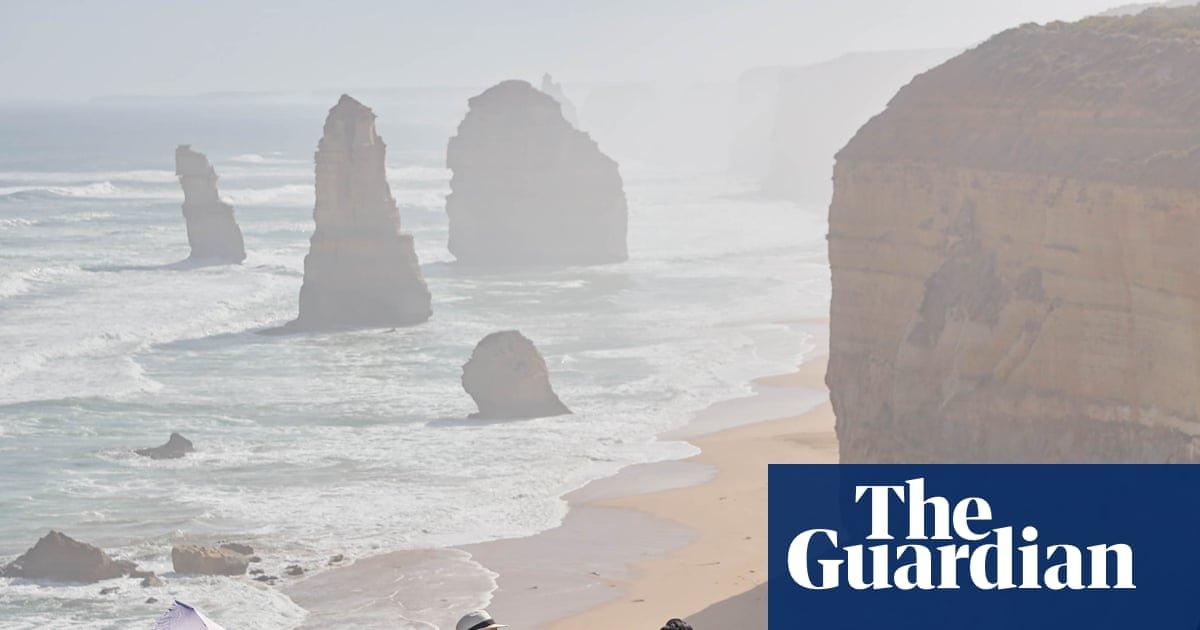
Tourists will soon have to pay an entry fee to see the Twelve Apostles on Victoria’s Great Ocean Road.
The Victorian government will on Monday announce a fee for tourists to visit the $126m Twelve Apostles Visitor Experience Centre, which is due to open at the end of 2026.
While there are now only seven limestone stacks remaining of the original 12 – as erosion has caused several to collapse over time – the natural wonder is incredibly popular with tourists. According to Development Victoria, 2.8 million people visited the Twelve Apostles in 2019, with the figure forecast to reach 4m this year.
The entry cost to see the Twelve Apostles is not yet known and will be decided following a consultation with stakeholders. The government said people who live near the site and members of the Eastern Maar Indigenous community will not be charged.
The Great Ocean Road Parks and Coastal Authority, which will operate the new vistor centre, will also collect the funds. It said the “fees will be consistent with other popular nature-based attractions across the country that have had entry fees for some time”.
Sign up: AU Breaking News email
The state environment minister, Steve Dimopoulos, said the funds would support upgrades to beach access and visitor facilities and maintain the historic landmarks.
The Twelve Apostles rocks formation at Port Campbell national park in Victoria, Australia. Photograph: Veeravong Komalamena/Alamy
“The Twelve Apostles are visited by more than 2 million people each year and the Great Ocean Road is visited by over 6 million people – and we want even more people to come and enjoy it,” he said.
“We’re investing in the future of the Great Ocean Road region and making sure every single cent spent in the region stays there.
“It’s only fair that visitors to the region pay a small fee to visit this world-class destination so that we can maintain it for future generations.”
The Great Ocean Road Parks and Coastal Authority said the funds could also be spent upgrading and improving caravan parks and campgrounds, as well as walkways, bush walks and trails, lookouts and barbecues and tables on the foreshore.
The authority said a visitor booking system will also be introduced to prevent overcrowding and guarantee parking at peak times. It said moving to a booking system would also benefit local businesses, as it would encourage tourists to stay longer and explore the region.
The Corangamite shire council and the Great Ocean Road Regional Tourism Board issued a joint statement in September urging the state government to introduce a user-pays model to visit the site, to coincide with the visitor centre opening.
At the time, they said a charge of between $10 and $20 would help manage crowds and protect the coastal environment.
The introduction of an entry fee was welcomed by Lisa Patroni, the chief executive of the Victoria Tourism Industry Council, who said it was “well overdue” and would make the attraction safer while improving the visitor experience.
“It is an incredible coastline, but it’s also very fragile. Hence, you’ve only got a single lane road and people park along the shoulder, which was never there for cars to park across,” Patroni said.
“You’ve got all this traffic visitation, no footpaths, pedestrians trying to walk from their cars. It’s been fortunate, to be honest, that they haven’t had more incidents.”
Patroni said the fee would also help control visitor numbers. Around the world, she said, natural attractions with high demand typically manage crowds through ticketing, booking systems or parking fees.
“It’s just not how we have traditionally done things in Victoria but it is not new worldwide,” she said.
“Whilst local people might be grappling with the thought of how this is going to work for them, internationally, it will be a blip in the radar because this is what they’re used to.”
The government said fees are currently in place to ensure the preservation of other popular, world-renowned destinations across Australia, including Uluru-Kata Tjuta national park, Kosciuszko national park and Wineglass Bay lookout.
