

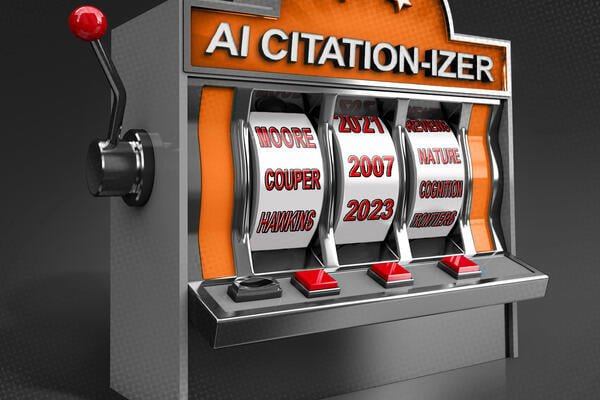
One journal editor who has served in that position for a year says she’s seeing more AI-generated fake citations in submissions than when she started.
Photo illustration by Justin Morrison/Inside Higher Ed | zbruch/iStock/Getty Images
A few weeks ago, an adjunct education professor reached out to Charles Hodges and Stephanie Moore, two frequent research collaborators, asking for a copy of their 2023 paper titled “Instructional presence and learner success in synchronous and asynchronous eLearning.” The professor hoped to share it with students in his course on e-learning.
Hodges and Moore were happy to share their work, but there was one problem: The paper doesn’t exist.
“The guy sent us the whole reference, and we were like, ‘We never wrote that,’” said Moore, an organization, information and learning sciences professor at the University of New Mexico. “If you try and click on the [digital object identifier] link, it goes nowhere.”
The citation looks completely legitimate. It’s formatted using APA style. It references the Online Learning Journal—a real journal in which Moore has published work—as the paper’s publisher. It even includes a fake DOI link, which leads to a “DOI not found” page. For anyone except the two misattributed authors, it would be nearly impossible to tell the paper is fake without further research. But the citation was hallucinated by artificial intelligence.
Hodges, C. B., & Moore, S. (2023). Instructional presence and learner success in synchronous and asynchronous eLearning. Online Learning Journal, 27(2), 41–62. https://doi.org/10.24059/olj.v27i2.1234
Also within the last two months, Hodges, a professor of leadership, technology and human development at Georgia Southern University, was asked to review a book proposal on a topic adjacent to his work.
“The topic of this book wasn’t exactly my area of expertise, but it wasn’t totally outside it, either. The whole time I was thinking, ‘I wonder why they asked me’” to review it, Hodges said. “Then I get to the section where the prospective authors have listed competing or similar books, and they had a book listed that Stephanie and I had edited. It had a year, and it was listed with Springer, which is a major academic publisher. It even had a little summary of what the book was about.”
But like the journal article, the book didn’t exist.
As AI proliferates in academic life, professors are increasingly haunted by phantom citations. York St. John University geography professor Pauline Couper told Inside Higher Ed on Bluesky that she reviewed a grant application that “cited a nonexistent paper, apparently by me.” Gale Sinatra, an education and psychology professor at the University of Southern California, recently asked an AI chatbot for a list of her publications, and it included some real papers and some made-up ones. The fake papers were so convincing she double-checked her own curriculum vitae.
“I seriously had to check,” she said. “So, anyone else would just assume they were accurate.”
The fake citations are becoming a particular problem for academic journals, which have typically checked reference lists during the second or third round of the review process, said Andrea Harkins-Brown, editor in chief of the Journal of Technology and Teacher Education.
“They look very plausible, because that is what large language models are designed to do,” Harkins-Brown said. “Sometimes they’re listing authors that typically publish on that topic. They look like venues where you would expect to see the work, but there’s a mismatch. So it might be the right author, but not the right year.”
It’s a relatively new issue. Hodges, who was the editor of TechTrends from 2014 to 2024, said he didn’t have issues with fake citations, even at the end of his tenure. Harkins-Brown has been editor for about a year, and she already sees more AI-generated citations in submissions than she did when she started.
“We’ve had papers that have been through several rounds of review—I’ve looked at them as the editor and several rounds of reviewers have looked at them. And these phantom references are really hard to spot—we didn’t catch them until we were in the copyediting phase,” Harkins-Brown said.
Moore at UNM is also the editor in chief of the Journal of Computing in Higher Education, published by Springer. Springer screens submissions for integrity, and sometimes submissions will be pulled from the pile before they even reach Moore’s desk. Harkins-Brown’s journal is considering a software that would do something similar.
“Every now and then, we’ll get something where an author is flagged with an integrity issue, and that means that person is engaging in clear, documentable patterns of citing work that doesn’t exist or other ethical issues,” Moore said. “We’ve definitely been seeing an increase in that kind of activity, and Springer implemented [the screening] because of these issues with either AI-generated articles or fake citations and things like that.”
When the editors find a fake citation, Harkins-Brown asks the author to send a copy of the cited paper.
“I always want to assume that maybe they made a mistake, maybe it’s just the wrong year or maybe there’s some plausible reason why I can’t find it,” she said. But most of the time, the authors simply tell her they can’t. “There’s not a lot of back-and-forth conversation,” she said.
This unfortunately leads to good work being ultimately rejected, she said.
“In academia, folks are very focused on … publish or perish,” Harkins-Brown said. “It’s just such a loss to use AI to try to save you a couple hours when it really could become the reason that you’re sacrificing that work.”
