

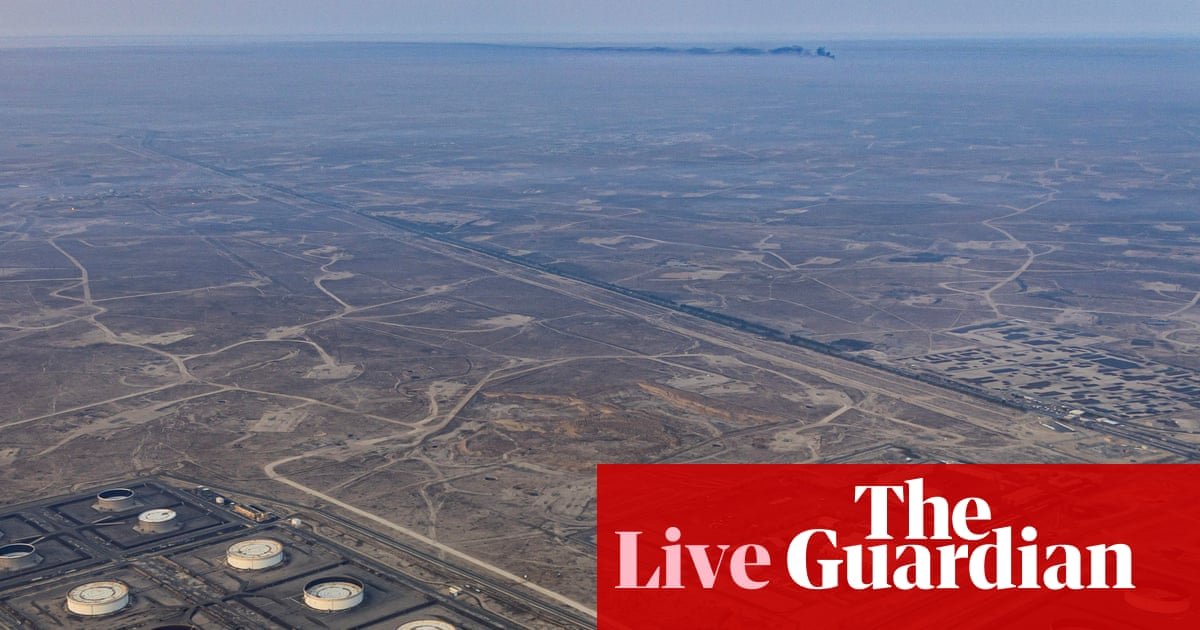
Brent crude hits $90 a barrel as Kuwait ‘starts cutting oil production’
Brent crude has now surged to $90 per barrel for the first time since April 2024, a gain of over 5% today.
This latest rally comes as the Wall Street Journal reports that Kuwait has begun cutting production at some oil fields after running out of room to store its bottled-up crude.
That would suggest the region is entering a broader storage crisis, in which a lack of storage leads to shutdowns, because tankers are reluctant to risk travelling through the strait of Hormuz.
The WSJ says:
double quotation markThe country, a founding member of the Organization of the Petroleum Exporting Countries, is discussing limiting its production and refining capacity further, to just what it needs to cover domestic consumption, the people said. A decision on those broader cutbacks is expected within days, they said.
Breaking: WSJ reporting that Kuwait have started cutting oil production in some fields
If so: Kuwait would be 2nd OPEC+ producer to cut production due to storage tanks filling up
(After Iraq earlier this week)
Brent touches $90 pic.twitter.com/Qw5o7AkS8o
— Joumanna Nasr Bercetche (@JoumannaTV) March 6, 2026
Oil is now firmly on track for its biggest weekly gain since spring 2020.
Share
Updated at 09.15 EST
Key events
Show key events only
Please turn on JavaScript to use this feature
Here’s Lindsay James, investment strategist at Quilter, on the impact that higher oil ang gas prices could have on the UK economy, after Qatar’s energy minister predicted the Iran war will force Gulf countries to stop energy exports ‘within days’:
double quotation mark“The warning from Qatar’s energy minister reflects very real concerns about the risk of prolonged disruption to energy supplies from the Gulf, although a lengthy halt to all Gulf oil and gas production remains an extreme scenario. Nonetheless, the concerns he raises are understandable. With production in Qatar already halted following recent attacks on key facilities, there is clear market anxiety about further damage to infrastructure in the region and the ability of exporters to quickly resume output.
“In the near term, gas markets are likely to feel the strain more acutely than oil. Oil prices have moved higher, but it could be a temporary interruption rather than the kind of long term supply removal that was seen following Russia’s invasion of Ukraine. The real uncertainty is how long the disruption lasts, and whether it’s a matter of days, weeks or potentially longer.
“A major pressure point is the Strait of Hormuz. If the route remains constrained, even partially, it limits the flow of both oil and gas and keeps upward pressure on prices. Market moves generally imply investors expect this to be resolved quite quickly, drawing on recent precedents where disruption was short lived. However, with each passing day, the risk grows that this conflict proves more drawn out than initially expected.
“For households, the pressure will be felt primarily in energy prices rather than a broad inflation shock. UK food inflation, for example, is unlikely to be significantly affected because much of the food imported into the UK does not rely on Gulf shipping routes. The bigger economic risk comes from persistently higher energy costs, which can weigh heavily on growth. At the same time, that lower growth may feed into softer economic activity and a cooling labour market, which could help limit how far energy driven inflation feeds into the wider economy.”
Share
Neil Wilson of Saxo Markets reports that a “broad de-risking” event is underway in the markets, as investors try to protect themselves from Iran developments over the weekend.
He adds:
FTSE 100 wiping out the whole of its February rally to trade around 10,250, about where it finished at the end of Jan
European indices significantly hit trading –1.6% for the day and –6-8% for the week
Selling picked up the pace as President Trump called for unconditional surrender, while a weak US jobs report didn’t help bolster risk appetite.
Share
Today’s jobs report shows that average pay continued to rise, even as firms cut jobs.
Hourly earnings rose by 0.4% month-on-month, and 3.8% year-on-year. Analysts at Unicredit say this suggsts “there is not much slack, if any, in the labour market”.
Share
Kevin Hassett, director of the National Economic Council of the United States, has claimed that today’s weak jobs data is an “outlier”.
He told Bloomberg TV:
double quotation markEvery other indicator is consistent with very strong GDP growth right now.
NEC Director Kevin Hassett responds to jobs drop:
“Every other indicator is consistent with very strong GDP growth right now, and so this really is an outlier number.”pic.twitter.com/3lTmJxsyez
— Red Line News (@RedLineNewsUSA) March 6, 2026Share
Yikes. Almost every major industry group shed jobs in February.
Private sector overall: -86,000
Hospitality -27,000
Healthcare -28,000
Manufacturing -12,000
Tranport/warehouse -11,000
Construction -11,000
Information -11,000
Federal gov’t -10,000
Professional/biz -5,000
Mining… pic.twitter.com/4mA5LJf00P
— Heather Long (@byHeatherLong) March 6, 2026
Share
RAC: Petrol and diesel prices rose this week
Motoring body the RAC reports that fuel prices have risen steadily this week.
RAC Fuel Watch data shows that petrol has now increased by 3.7p to 136.53p a litre since Saturday, while diesel is up by 6p to a 16-month high of 148.35p.
RAC head of policy Simon Williams warns that there will be further price rises unless the oil price drops back:
double quotation markThis has already pushed up the cost of filling a 55-litre family car with petrol by £2 and diesel by nearly £3.30 in less than a week.
“While wholesale costs for any retailer buying in new stock will have gone up, it normally takes two weeks for price changes to work their way through to the forecourt.
Brent crude jumped to $85 on Thursday [now over $91] something we haven’t seen since July 2024. If the price of a barrel stays at this level, or increases, then further forecourt rises will be inevitable. While the rate of increase has been fast, we’re fortunately a long way from the record prices of 2022 when the average price of petrol hit 191.5p and diesel 199p.”
Share
US crude oil price hits two and a half-year high
US crude oil price have also shot higher today.
WTI (West Texas Intermediate) is up almost 10% at $88.82 a barrel, the most expensive level since October 2023.
Kathleen Brooks, research director at XTB, says the oil price “took another leg higher” after Kuwait joined Qatar and said that it was halting energy production.
Brooks adds:
double quotation markDonald Trump also brushed off hopes that mediation was taking place to end this war in the Middle East, instead he said that there would be no end until an ‘unconditional surrender’ of the Iranian regime took place, which seems unlikely in the near term.
This has dashed hopes that the conflict will be averted quickly, and the oil price has continued its push back towards $90, Brent crude is higher by 6% on the day and is now above $90 per barrel, and there is not much to stop it from hitting $100 per barrel in the near term. The relentless rise has also seen WTI crude rose by 9% today. Until the oil price stabilizes it’s hard to see how stock markets and bond prices can recover.
Share
Qatar’s energy minister, Saad al-Kaabi, also forecast that crude prices could soar to $150 a barrel in two to three weeks if tankers and other merchant vessels were unable to pass through the strait of Hormuz.
Colin Walker, head of transport at the Energy and Climate Intelligence Unit, says this would have a serious impact on drivers:
double quotation mark“Such an increase in the price of oil could see a litre of petrol jumping to around £1.90 – a price last seen in 2022 after Russian’s invasion of Ukraine – adding over £500 to the average fuel bill of a British petrol car driver.
Share
European gas price are continuing to rise, threatening to intensify the region’s cost-of-living squeeze.
The UK month-ahead gas prices is now up 3.5% today at 136p a therm, meaning it has almost doubled since the middle of last week (when it traded around 75p a therm).
Share
Brent now over $91 a barrel
Having burst through the $90/barrel mark today, Brent crude now has the $100/barrel mark in its sights.
Brent, the international benchmark, is continuing to climb and hit $91.80 a barrel a few minutes ago, the highest since 12 April 2024.
As well as Kuwait’s decision to start cutting production, traders will have noted a statement from Donald Trump today that “will be no deal with Iran except UNCONDITIONAL SURRENDER!”
Share
Wall Stree slumps after bad jobs report, as oil soars
Photograph: Seth Wenig/AP
Wall Street has opened with heavy losses, as investors react to the surge in the oil price, the ongoing Middle East war, and a bad jobs report.
The Dow Jones industrial average, which tracks 30 large US companies, has fallen by 834 points, or 1.74%, in the first few minutes of trading to 47,119 points.
The broader S&P 500 index is down 1.6%, and the tech-focused Nasdaq index is down 1.65%.
The Russell 2,000 index, which tracks smaller US companies, has lost 2%.
Share
Today’s weak jobs report, and the rising oil price, suggests the US economy is facing the grim combination of rising prices and falling employment.
Scott Helfstein, head of investment strategy at Global X,warns that higher energy prices could lead to more job losses:
double quotation mark“The jobs report was weaker than expected, and this does include the possible drag on employment from higher oil prices. Sharp increases in oil prices typically coincide with labor force reductions.
When oil prices spike by 20%, the U.S. typically losses jobs, and that is the current scenario.”
Share
