

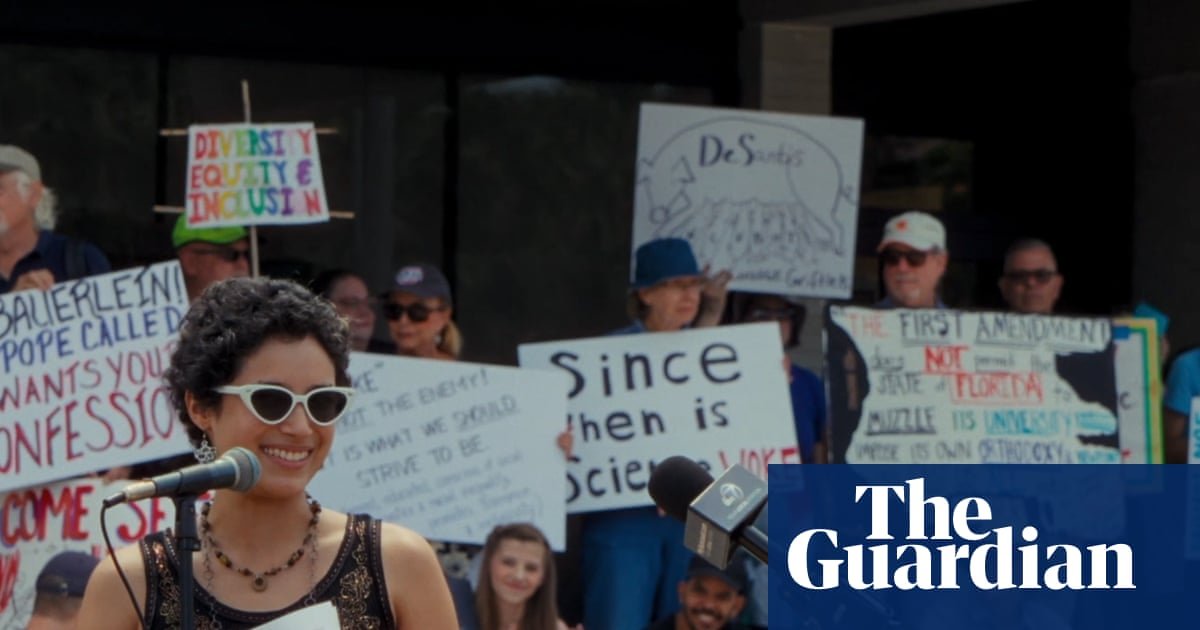
It took a half century to build New College into a sanctuary of independent thought and less than a year to destroy it. In 2023 the beloved Florida liberal arts school became state governor Ron DeSantis’s latest target in his so-called war on woke. DeSantis decimated the school’s trustee board and installed a cabal of rightwing cronies, aiming to transform it into a conservative institution modeled after Michigan’s evangelical Hillsdale College.
Library shelves were stripped, with books from Black and Indigenous authors and the shuttered gender studies department tossed into dumpsters. Frat boys arrived in droves and the campus was transformed into a meathead’s playground where queer couples stopped holding hands for fear of homophobic slurs. In a move ripped from the playbook of a spiteful cartoon villain, the community garden with its koi pond and roosting barn owls was bulldozed to make way for a baseball stadium.
Students found themselves fighting for the soul of the school. “The confusion was palpable,” says former student Gaby Batista, a protest leader and former editor in chief of the campus newspaper the Catalyst. “As a student at a public university, you don’t know your board of trustees. No one anticipates having to learn their names and have their business become so directly involved in your business.”
The gripping new documentary First They Came For My College documents how this tiny school of just 700 students became a battleground in the Trump administration’s assault on higher education. After ousting former board president Patricia Okker in January 2023, DeSantis installed a gruesome line-up of new trustees who aimed to strip the school of “woke ideology” and abolished DEI programs and critical race theory. The new board included characters like openly racist former Florida house speaker Richard Corcoran and Christopher Rufo, a conservative activist who fueled Trump’s attack on diversity.
“I found out about the takeover and was immediately very worried,” says documentary producer and New College album Harry W Hanbury. “These Christian nationalists posed a real threat.” After linking up with director Patrick Bresnan in Orlando in spring, the pair drove to New College’s Sarasota campus. Approaching the Mediterranean-style buildings of the campus, Hanbury was overcome with emotion. “I just started crying,” he said. “New College was like where I was born. To see it taken over by these people who are conquistadors – the junta, as I like to call them – was really painful, but also galvanizing.”
On a Zoom call a few weeks before First They Came To College’s premiere at Missouri’s True/False documentary festival, Bresnan, Hanbury and Batista are sparky conversationalists who light up when talking about New College in its heyday. The school “saved my life”, says Hanbury, who arrived at New College in the late 80s as a “very closeted queer kid” from a military Catholic school. “There was an intense intellectual curiosity which made it so distinctive and set it apart from every other school in Florida, and really in the nation.”
“I knew what I was signing up for,” says Batista about her enrollment. She describes the school as a “queer utopia” and recalls visiting as a prospective student to find that her campus tour guide was a student with shaved eyebrows and eyeliner-drawn stars on their face. “My dad was bewildered, but I was like, ‘This place is fucking awesome.’”
That kind of self-expression was exactly what DeSantis and co wanted to eliminate. When Bresnan and Hanbury arrived in April 2023 they found a campus at war. To build trust with a student body who had already been harangued by “fishy” reporters, Bresnan invested the money that would have normally gone on kitting out a big production team into getting to know them. “I hate having crews, I hate lighting and I hate expensive equipment,” the director says. “I took all of that budget and spent it on taking the kids out to dinner.” The show of faith worked. As Batista puts it: “Once we knew we were on the same wavelength, we were like, ‘Let’s do the damn thing.’”
Bresnan’s ethos included making sure that the students played an active role in shaping the documentary, and handed out camera phones to five students to film protests and planning meetings, as well as introspective moments of downtime. As well as a practical solution to filming across the 110-acre campus, the student camera operators help to collapse the hierarchy between film-maker and subject that is a feature of the documentary genre. “I really saw my role as facilitating their ability to storytell,” says Bresnan.
As well as underlining the film’s community values, the bricolage footage gives the film texture and oomph. iPhone footage is especially impactful, showing DeSantis and team’s surprise arrival on campus, where they are greeted by crowds of angry students chanting “Only Nazis ban books” and “Fascists fuck off”. Seemingly unfazed, DeSantis doubles down in an address at the campus college hall. “We are eliminating DEI,” the governor says before ceremonially signing a bill that banned diversity, equality and inclusion programs in Florida public schools. “If you want to do things like gender ideology, go to Berkley,” he concludes.
“He was spitting in our faces,” says former student Batista. “They were signing one of the worst bills we could possibly see on our campus, that would impact higher education very harshly.” But after months of feeling like they and their values were under attack, it felt good to let their frustrations out. “It was sort of a morale boost for students to get that anger out and just scream a little.”
As there became fewer places to turn for protection (the school’s Title IX office was shuttered), the students looked to each other for community, as well as to let off a little steam. “We have to bring back the queer traditions back,” one student says. They come back roaring with an exuberant drag performance of The Rocky Horror Picture Show and parties with Beyoncé on the soundsystem. Resistance can take many forms.
New College students get ready for Rocky Horror night. Photograph: Patrick Bresnan
First They Came for My College also shows students reckoning with the same questions that Bresnan and Hanbury would like audiences to grapple with. “What are universities for?” asks one student. “Are they businesses to extract wealth from people, or are they places where we not only expand consciousness but also gain skillsets to improve humanity?”
In the three years that the film-makers have been working on the documentary, the attack on higher education has escalated. The Trump administration has now cut billions of dollars of funding to universities who refuse to kowtow to his agenda, leading to dozens of gender studies departments closing and continued pressure to end teaching “divisive concepts” such as race. Last year, a study by the student advocacy group Scholars at Risk said that the Trump administration has turned the US into a “model for how to dismantle” academic freedom. In October, New College became the first college to sign an agreement with Trump committing to uphold “strict definitions of gender”.
“We were the canary in the coalmine,” says Batista. “New College was their little political playground.”
The film-makers see First They Came for My College as a cautionary tale. Even its title has the ominous ring of a historic political siege. “This is fascism,” says Bresnan, unequivocally. “At a certain point, the film became very serious in documenting our country’s turn toward these fascist practices.”
“For me, we will hopefully look back on First They Came For My College like we do on civil rights era films or Vietnam-era films and we say, ‘I can’t believe that’s who we were,’” Bresnan continues. “‘I can’t believe that’s what we did to our greatest professors. I can’t believe that’s what we did to college students.’ What kept me going is the need to finish this document so that we can remember this period and so it doesn’t happen again.”
