

March 5, 2026
4 min read
Add Us On GoogleAdd SciAm
IBM scientists unveil the first ever “half-Möbius” molecule, with the help of quantum computing
A team at IBM Research has assembled a strange new ring-shaped molecule that bends around like a more complicated Möbius strip
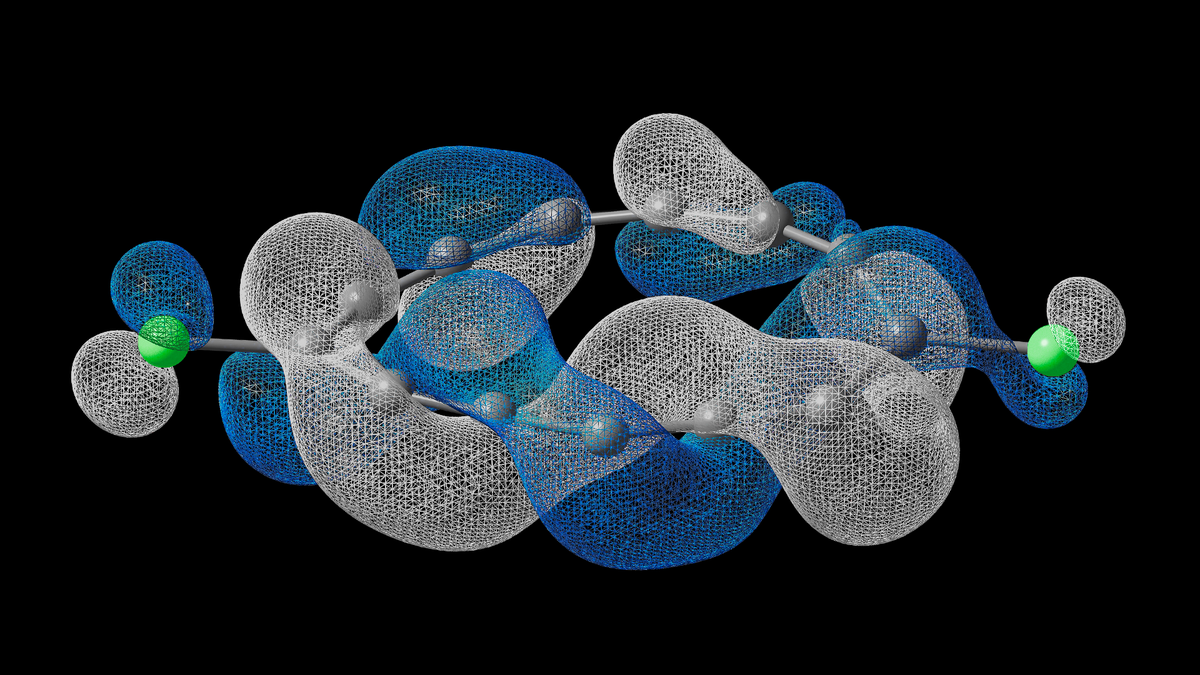
The newly discovered half-Möbius molecule. The cloud of electrons twists about the ring of atoms in a complicated geometry, making weird quantum physics possible.
Scientists have just created a new, strange type of molecule. It’s made of a bunch of atoms bound together in a ring, like many other, simpler molecules. But if you could somehow zoom in on the electrons zipping about the atoms, you’d see that their motion around the ring had become weird and twisty. Those twists form a new structure akin to the famously mind-bending one-sided, one-edged Möbius strip but even more complicated.
The team, based at IBM Research, engineered this molecule by manipulating individual atomic bonds and then imaged it with high-powered microscopy. The researchers also confirmed what they were seeing with the power of IBM’s state-of-the-art quantum computers. Their work was published today in Science. It’s the latest breakthrough in “topological” chemistry, the study of strangely shaped molecules and the bizarre quantum behaviors they exhibit. And it shows how quantum computers can help study and simulate such subatomic mayhem.
Until the new study, no one had even imagined this as a theoretical possibility—and now it’s real. “The fact that such a molecule has not only been theoretically proposed but has actually been synthesized will have a major impact on the field of molecular science,” says Yasutomo Segawa, a researcher at the Institute for Molecular Science in Japan, who was not part of the team’s work.
On supporting science journalism
If you’re enjoying this article, consider supporting our award-winning journalism by subscribing. By purchasing a subscription you are helping to ensure the future of impactful stories about the discoveries and ideas shaping our world today.
To build its aberrant molecule, the IBM team turned to a company pastime. The same lab made atom manipulation famous back in 2013, when scientists there assembled atoms into images to produce a stop-motion movie called A Boy and His Atom. With the same fine-tipped instruments they use to image and manipulate individual atoms, the new study’s researchers can break specific bonds and rip off certain atoms from a molecule. They started with a more complicated molecule and carefully wrestled it into their “half-Möbius” shape.
To understand the half-Möbius, it helps to start by picturing a “full Möbius” molecule. The atoms are arranged in a simple ring. The topology comes in when you look at each atom’s electron cloud, which is made of two “lobes” that stretch up and down and represent where you’re likely to find the atom’s electrons. Each atom’s lobe axis has an orientation that is different from that of its neighbors. As you go around the loop, the orientations of these axes wrap around so that the last atom’s lobes point nearly upside down compared with the first’s.
If you trace out the path of all of the atoms’ top lobes, it will be like an ant walking along a Möbius strip: After one cycle, the insect will land upside down from where it began its trek. After two, the ant will be back to its starting point.
This doesn’t matter much physically. If you flip an atom’s electron cloud upside down, it doesn’t actually change where you’re likely to find any given electron. But an electron that takes this topsy-turvy path and one that doesn’t can “interfere” perceptibly, a bit like tuning into two conflicting radio signals on near-identical channels.
The half-Möbius is even weirder. Here, the electron clouds are cross-shaped, which allows them to twist halfway instead of flipping all the way around.
Instead of imagining a strip, start with a cross-shaped loop. Cut it in one place.
Now twist it by 90 degrees and glue it back together. You’ll end up with something like the image below.
An ant starting on top of the yellow band will only end up back at its starting point after four trips around the circle.
That ant’s trip is similar to an electron’s path around the half-Möbius molecule.
Electron clouds live deep in the quantum realm and are a challenge to image. Even with the best microscopes available, the researchers could only resolve a hazy cloud.
To prove that this cloud was as twisty as they hoped, they turned to a more recent IBM mainstay, the quantum computer. They used it to simulate the electrons whizzing about the molecule that they believed they’d created and produced an image of what it would look like in their microscope. Then they repeated the process for a simpler, untwisted version of the same molecule. With the two images to compare to their observation, it became clear that the molecule was indeed a half-Möbius.
It’s a rarified type of object that can only be assembled with such a confluence of novel technologies. “We made this freakish molecule in these very special conditions,” says Leo Gross, a member of the IBM team. “In nature, they would never be stable.”
The researchers are excited that IBM’s quantum computer is making itself so useful in an actual discovery. They also simulated electrons with a regular, “classical” computer for comparison. But in this case, quantum has its advantages.
The more electrons there are in the calculation, or the more quantum states that you allow them to be in, the more elaborate the computation is—whether it’s classical or quantum. But because IBM’s quantum computer represents the states using quantum bits, called qubits, which can represent a superposition of different quantum possibilities, it can perform bigger calculations at less cost.
So the team was able to scale up the calculation and confirm that, after a certain point, the resulting electron clouds looked more or less the same. Then the researchers could say with confidence that they understood the quantum mechanics of the images that their microscopes had captured.
To Ivano Tavernelli, another of the team’s scientists, it’s an example of how far quantum computing has come. “In about 10 years, we were able to go from two to four qubits up to 100,” he says. “If we can continue like this, I think that would be fun.”
