

March 5, 2026
2 min read
Add Us On GoogleAdd SciAm
Scientists created a digital library full of ants
Using a synchrotron powered CT scanner, the Antscan project created an open-source digital library cataloguing thousands of 3D ant specimens
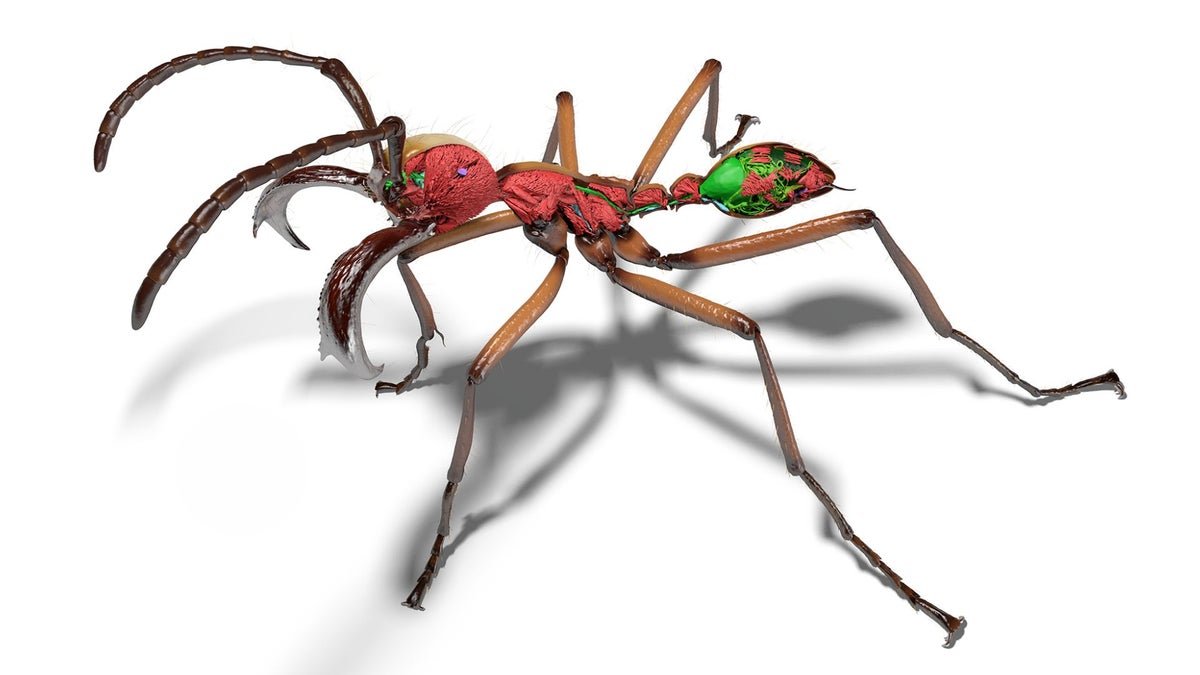
Researchers created 3D renderings of hundreds of ant species, including this Eciton hamatum.
Ants are among the most dynamic of the “little things that run the world,” as the late biologist E. O. Wilson described insects. They build complex communities, travel widely and are ubiquitous. There are more than 20 quadrillion ants out there—so many that it’s difficult to get a handle on just how diverse the behavior and body structure of different ant species can be.
To better understand biodiversity within the ant family, researchers used a particle accelerator to create Antscan, a digital library full of three-dimensional scans and morphological data from 2,193 individual ants. The work, shared in a study published today in Nature Methods, sheds light on ant anatomy and also on how new data and imaging technologies can speed up biodiversity research.
“We’re just at the beginning of even looking at the data,” says one of the study’s senior authors, Evan Economo, a University of Maryland, College Park, entomologist. “There’s many other things you could do with the project, and I’m sure there are really amazing things in there that people will dig out.”
On supporting science journalism
If you’re enjoying this article, consider supporting our award-winning journalism by subscribing. By purchasing a subscription you are helping to ensure the future of impactful stories about the discoveries and ideas shaping our world today.
Before the scans were created, researchers gathered samples of ethanol-preserved ants from museums and personal collections around the world. To capture the wide range of ant traits, they chose individuals from 212 different genera. More than 90 percent of all described ant species belong to one of the genera represented in the study.
Ant specimens preserved in ethanol and scanned by the synchrotron before researchers started to see the 3D results of their work.
Instead of the usual computed tomography (CT) scans used to image specimens, researchers opted for a speedier approach that would yield more detailed images using a type of particle accelerator known as a synchrotron. Synchrotrons—such as the Karlsruhe Institute of Technology Light Source in Germany, which was used by the researchers—accelerate charged particles moving around a curved track. As the particles race around the track, they emit bright x-ray beams that can quickly and deeply penetrate even the smallest objects.
Each scan from the synchrotron took just seconds but generated about 3,000 x-ray images of the ants.
“We were happy that we could process all of the specimens, but it took months until we saw the first results, and that’s when you really start to realize the scale of what you have accomplished,” says Julian Katzke, one of the study’s lead authors and now a postdoctoral fellow at the Smithsonian Institution’s National Museum of Natural History.
The high-powered synchrotron scans give data about ants’ bodily structures–inside and out.
The result was hundreds of in-depth models composed of layers of images that showed the ants’ exoskeletons, muscles, nervous systems and digestive tracts. Even parasites and weird, previously unknown anatomical traits could come out of the publicly available data once the team and other researchers fully analyze them.
And Antscan could serve as a blueprint for similar digitization projects with other insects that could reveal the similar and different traits between them, giving a more complete picture of insect evolution.
“This project is not just about ‘Okay, we’ve got a bunch of ant scans,’” Economo says. “It shows a pathway toward scaling this up to, eventually, all species.”
It’s Time to Stand Up for Science
If you enjoyed this article, I’d like to ask for your support. Scientific American has served as an advocate for science and industry for 180 years, and right now may be the most critical moment in that two-century history.
I’ve been a Scientific American subscriber since I was 12 years old, and it helped shape the way I look at the world. SciAm always educates and delights me, and inspires a sense of awe for our vast, beautiful universe. I hope it does that for you, too.
If you subscribe to Scientific American, you help ensure that our coverage is centered on meaningful research and discovery; that we have the resources to report on the decisions that threaten labs across the U.S.; and that we support both budding and working scientists at a time when the value of science itself too often goes unrecognized.
In return, you get essential news, captivating podcasts, brilliant infographics, can’t-miss newsletters, must-watch videos, challenging games, and the science world’s best writing and reporting. You can even gift someone a subscription.
There has never been a more important time for us to stand up and show why science matters. I hope you’ll support us in that mission.
