

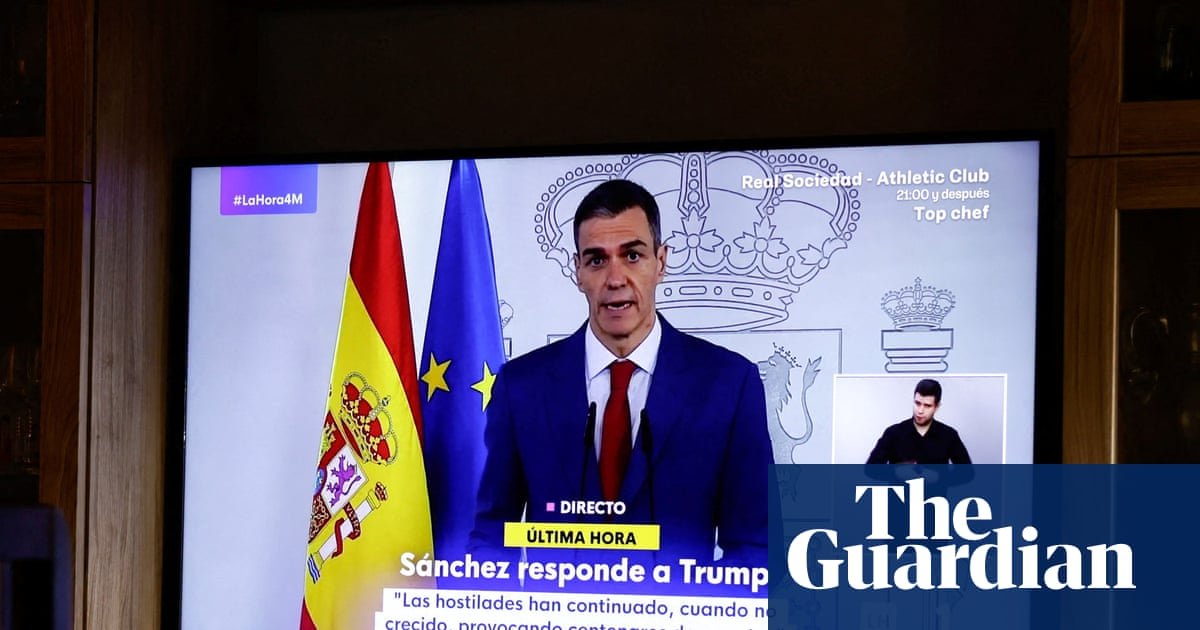
The Spanish prime minister, Pedro Sánchez, has responded to Donald Trump’s extraordinary threat to cut off all trade with Spain over his government’s refusal to facilitate the US’s attacks against Iran, comparing the growing conflict in the Middle East to playing “Russian roulette with the destiny of millions”.
Sánchez, who has been one of the most vociferous European critics of Israel’s conduct in Gaza, said his government’s position on the widening instability could be summed up in three words: “No to war.”
In a section of the speech that appeared to directly address Trump’s threats to end all trade with Spain, the prime minister said his country would “not be complicit in something that is bad for the world – and that is also contrary to our values and interests – simply out of fear of reprisals from someone”.
On Tuesday, Trump had rounded on Madrid for refusing the US permission to use jointly operated bases in southern Spain to continue its attacks in Iran. “Spain has been terrible,” Trump said during a meeting with the German chancellor, Friedrich Merz, adding that he had told the Treasury secretary, Scott Bessent, to “cut off all dealings” with the European country.
In his address on Wednesday, Sánchez called on the US, Israel and Iran to stop their war before it was too late, saying: “You can’t respond to one illegality with another because that’s how humanity’s great disasters begin.”
He added: “You can’t play Russian roulette with the destiny of millions … Nobody knows for sure what will happen now. Even the objectives of those who launched the first attack are unclear. But we must be prepared, as the proponents say, for the possibility that this will be a long war, with numerous casualties and, therefore, with serious economic consequences on a global scale.”
He pointedly invoked the 2003 invasion of Iraq, which was supported by his conservative predecessor José María Aznar, as a warning of the looming dangers. Sánchez said that while that war ostensibly had been intended “to eliminate Saddam Hussein’s weapons of mass destruction, to bring democracy, and to guarantee global security”, it had instead “unleashed the greatest wave of insecurity our continent has suffered since the fall of the Berlin Wall”.
Sánchez said a government’s prime responsibility was to protect and improve the lives of its citizens – and not to use geopolitics to cynical ends or to profit from war. “It is absolutely unacceptable that those leaders who are incapable of fulfilling this duty use the smokescreen of war to hide their failure and, in the process, line the pockets of a select few – the same ones as always; the only ones who profit when the world stops building hospitals and starts building missiles,” he said.
Later on Wednesday, the Spanish government categorically denied any change of heart after the White House press secretary, Karoline Leavitt, suggested to reporters that Madrid now backed the US’s military action.
“I think they heard the president’s message yesterday loud and clear,” Leavitt told a news briefing. “It is my understanding over the past several hours they’ve agreed to cooperate with the US military.”
The claims were emphatically rejected by Madrid.
“The Spanish government’s position on the war in the Middle East, the bombings in Iran, and the use of our bases has not changed one iota,” Spain’s foreign minister, José Manuel Albares, said an interview with Cadena Ser radio on Wednesday night. “Our ‘no to war’ stance remains clear and unequivocal … She may be the White House press secretary, but I’m the foreign minister of Spain and I’m telling her that our position hasn’t changed at all.”
A government spokesperson added: “It is not true. We categorically deny any change. Spain’s position has not changed.”
During his meeting with Merz, Trump had also criticised Spain once again for refusing to accept Nato’s proposal for member states to increase their defence spending to 5% of their GDP. “Everybody was enthusiastic about it – Germany, everybody – and Spain didn’t do it,” Trump said. “And now Spain said we can’t use their bases – and that’s OK. We could use their bases; if we wanted, we could just fly in and use it [sic]. Nobody’s going to tell us not to use it. But we don’t have to. But they were unfriendly.”
The US president also launched a deeply personal attack on the UK prime minister, Keir Starmer, over his refusal to let the US use British bases for the strikes, telling reporters: “This is not Winston Churchill that we’re dealing with.”
Merz said later he had told Trump privately that Spain could not be excluded from a trade agreement reached between Brussels and Washington last year. “I said that Spain is a member of the European Union and we negotiate about tariffs with the United States only together or not at all,” he said. “There is no way to treat Spain particularly badly.”
The European Commission has also robustly defended Spain against Trump’s threat of commercial retaliation.
“Any threat against member state is by definition a threat against the EU,” Stéphane Séjourné, the EU internal market commissioner, said on Wednesday.
He added: “I want to be very clear here, from this point of view, the EU’s competency on trade is actually dealt with by the commission. If you threaten one particular country … we’ve seen that about Greenland. I think we saw that there was a lot of unity.”
Teresa Ribera, a former Spanish deputy prime minister who serves as the EU’s green transition chief, also drew parallels with Trump’s recent talk of seizing Greenland.
“What we’re seeing is very similar to what happened just a month ago with those threats – also in a boastful tone – regarding Greenland,” she told Cadena Ser.
“And the truth is, there was an immediate reaction from our EU partners, from the European Commission, and from the markets. I think that the instability, the tension generated by this way of relating to, or speaking about third parties – whether it’s about Starmer, Macron or Pedro Sánchez – is deeply disruptive, not only for societies, for peace, for cooperation, but also for the economy. And it has immediate consequences for the overall economic activity of everyone.”
