
Close Menu

    Subscribe to Updates

    Get the latest creative news from FooBar about art, design and business.

    What's Hot

    How President Trump’s Image Permeates the White House and Beyond

    How escalating Iran conflict is driving up oil and gas prices – a visual guide | US-Israel war on Iran

    Why humanoid robots are learning everyday tasks faster than expected

    Facebook X (Twitter) Instagram
    Facebook X (Twitter) YouTube LinkedIn
    Naija Global News |
    Tuesday, March 3
    • Business
    • Health
    • Politics
    • Science
    • Sports
    • Education
    • Social Issues
    • Technology
    • More
      • Crime & Justice
      • Environment
      • Entertainment
    Naija Global News |
    You are at:Home»Science»Earth’s oldest crystals suggest an early start for plate tectonics
    Science

    Earth’s oldest crystals suggest an early start for plate tectonics

    onlyplanz_80y6mtBy onlyplanz_80y6mtMarch 3, 2026003 Mins Read
    Share Facebook Twitter Pinterest LinkedIn Tumblr Email
    Earth's oldest crystals suggest an early start for plate tectonics

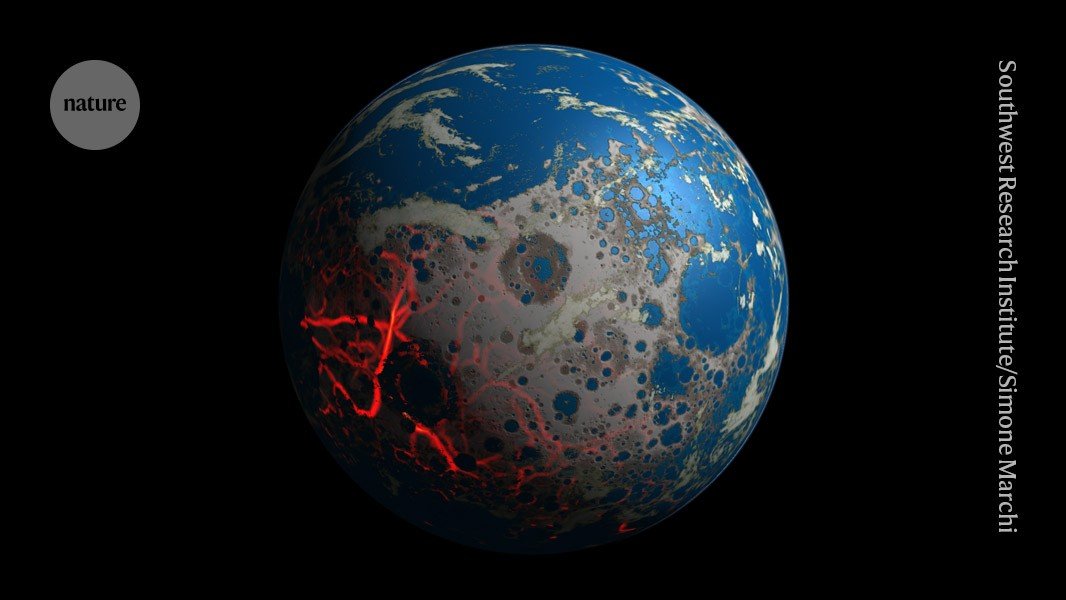
    A scientifically faithful impression of Earth during the Hadean Eon.Credit: Southwest Research Institute/Simone Marchi

    Share
    Facebook Twitter LinkedIn Pinterest Email

    A scientifically faithful impression of Earth during the Hadean Eon.Credit: Southwest Research Institute/Simone Marchi

    Ancient rock crystals from Australia suggest that the early Earth might not have been as different as scientists had thought from the planet that exists today.

    Earth’s earliest history is shrouded in mystery, because the shuffling of tectonic plates has erased many geological clues. One of the few lines of evidence comes from zircon crystals, which preserve chemical information in their durable mineral structures. A zircon study published today finds that the ancient Earth could have contained more oxygen — and possibly more water — than researchers had suspected, and suggests that the movement of tectonic plates was already happening at least 3.3 billion years ago, relatively early in Earth’s 4.5-billion-year-old history1.

    “It’s an important contribution to our understanding of the first billion years on Earth,” says John Valley, a geochemist at the University of Wisconsin–Madison.

    The presence of more oxygen than expected in these ancient rocks suggests that conditions on the planet could have been more conducive to life during this period than previously thought. And if tectonic plates were already moving, this suggests that Earth was already hosting some of the geological processes that shape the planet and that — by recycling crucial chemicals — help to make life possible.

    The work is just one entry in scientists’ long-running effort to untangle what early Earth was like. “These are maybe 3 or 4 puzzle pieces in a 10,000-piece puzzle,” says Shane Houchin, a geologist at the California Institute of Technology in Pasadena and lead author of the paper, which is published in Proceedings of the National Academy of Sciences1.

    On the rocks

    Houchin and his colleagues studied dozens of zircon crystals from the Jack Hills in Western Australia. These are the oldest known fragments of Earth rocks. Some date back to the Hadean Eon, which began when the planet formed and ended around four billion years ago.

    The scientists probed the zircons using a number of techniques, including a sophisticated X-ray analysis of the chemical state of the crystals’ rims with the Advanced Photon Source at the Argonne National Laboratory, near Chicago, Illinois. Uranium in those crystal rims turned out to be more oxidized — meaning it had lost electrons, which could have happened in the presence of oxygen — than anticipated.

    Zircons from Jack Hills, Western Australia, imaged with cathodoluminescence revealed chemical details about the early Earth.Credit: Shane K. Houchin

    Because the zircons formed from molten magma in Earth’s crust, they hold clues to how that magma interacted with the atmosphere. “The gases that are coming out at volcanoes are going to be a function of how oxidized a magma is, and that will affect how much oxygen could actually be in the atmosphere,” Houchin says.

    The paper’s approach is novel, but more work needs to be done to pin down those conclusions, say geochemists Simon Turner at Macquarie University in Sydney, Australia, and Hugh O’Neill at Monash University in Melbourne, Australia. In an e-mail to Nature, they argue that the oxidized uranium in the zircon rims could have come about as a result of other factors, including how gases behaved in the original magma.

    Deep dive

    Crystals early Earths oldest plate start suggest tectonics
    Share. Facebook Twitter Pinterest LinkedIn Tumblr Email
    Previous ArticleScotland becomes first UK country to legalise water cremations | Death and dying
    Next Article Why humanoid robots are learning everyday tasks faster than expected
    onlyplanz_80y6mt
    • Website

    Related Posts

    Face of ancient human ancestor ‘Little Foot’ reconstructed for the first time

    March 3, 2026

    Rare ‘blood moon’ total lunar eclipse to loom over North America, Australia and New Zealand | Science

    March 3, 2026

    meet the female colleagues who inspire these award-winning women in science

    March 2, 2026
    Add A Comment
    Leave A Reply Cancel Reply

    Top Posts

    Watch Lady Gaga’s Perform ‘Vanish Into You’ on ‘Colbert’

    September 9, 20251 Views

    Advertisers flock to Fox seeking an ‘audience of one’ — Donald Trump

    July 13, 20251 Views

    A Setback for Maine’s Free Community College Program

    June 19, 20251 Views
    Stay In Touch
    • Facebook
    • YouTube
    • TikTok
    • WhatsApp
    • Twitter
    • Instagram
    Latest Reviews

    At Chile’s Vera Rubin Observatory, Earth’s Largest Camera Surveys the Sky

    By onlyplanz_80y6mtJune 19, 2025

    SpaceX Starship Explodes Before Test Fire

    By onlyplanz_80y6mtJune 19, 2025

    How the L.A. Port got hit by Trump’s Tariffs

    By onlyplanz_80y6mtJune 19, 2025

    Subscribe to Updates

    Get the latest tech news from FooBar about tech, design and biz.

    Most Popular

    Watch Lady Gaga’s Perform ‘Vanish Into You’ on ‘Colbert’

    September 9, 20251 Views

    Advertisers flock to Fox seeking an ‘audience of one’ — Donald Trump

    July 13, 20251 Views

    A Setback for Maine’s Free Community College Program

    June 19, 20251 Views
    Our Picks

    How President Trump’s Image Permeates the White House and Beyond

    How escalating Iran conflict is driving up oil and gas prices – a visual guide | US-Israel war on Iran

    Why humanoid robots are learning everyday tasks faster than expected

    Recent Posts
    • How President Trump’s Image Permeates the White House and Beyond
    • How escalating Iran conflict is driving up oil and gas prices – a visual guide | US-Israel war on Iran
    • Why humanoid robots are learning everyday tasks faster than expected
    • Earth’s oldest crystals suggest an early start for plate tectonics
    • Scotland becomes first UK country to legalise water cremations | Death and dying
    © 2026 naijaglobalnews. Designed by Pro.
    • About Us
    • Disclaimer
    • Get In Touch
    • Privacy Policy
    • Terms and Conditions

    Type above and press Enter to search. Press Esc to cancel.