

Stay informed with free updates
Simply sign up to the Renewable energy myFT Digest — delivered directly to your inbox.
China’s emissions from energy and industry fell slightly last year after a solar boom helped to meet a larger part of its growing power needs, according to official statistics, continuing a trend begun the year before.
The data released at the weekend showed a 0.3 per cent decline in emissions from energy and industry during 2025. This was against the wider backdrop of a 3.5 per cent rise in total energy consumption.
The figures lay the ground for Beijing’s continued support for renewables and clean tech industries when it signs off its five-year plan at a meeting next week.
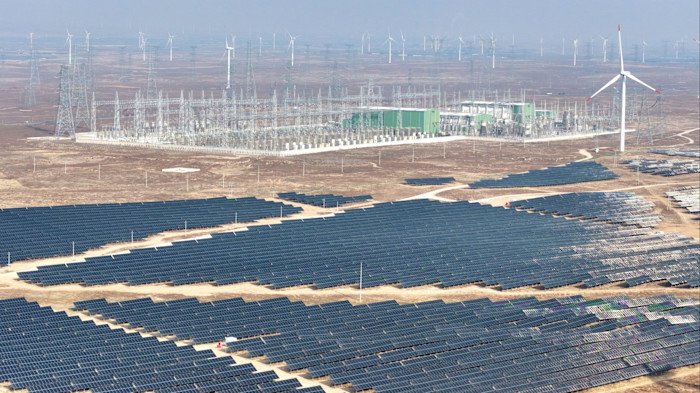
The share of all clean power generation in 2025 reached 40 per cent, rising from 37 per cent the year before, driven mainly by solar, which overtook wind generation. Smaller increases came from hydro and nuclear power.
The data caught the attention of Tesla founder Elon Musk, who posted on X on Sunday that “China is moving rapidly to a solar/electric future with very little need for oil or gas”.
The world’s biggest emitter remains heavily reliant on coal, however, even though the fuel’s share of total energy consumption fell marginally. Total coal consumption was 0.1 per cent higher despite accounting for a slightly lower amount of power generation.
Lauri Myllyvirta, co-founder of the Centre for Research on Energy and Clean Air — who foreshadowed the overall emissions fall in recent research, though with differing inputs — said that coal’s use in the chemical sector was probably reflected in the rise.
On the other hand, fossil fuel energy demands from some other energy-intensive sectors of the economy were lower, with cement production reduced as a result of continued real estate sector weakness.
China seemed to have revised the definition of carbon intensity to include industrial process emissions, he noted. “Because of the fall in cement production, in particular, the revised definition of carbon intensity will give China space to emit a bit more CO₂ while meeting the 2030 climate commitment,” Myllyvirta posted on the Bluesky platform.
China has committed to reaching peak emissions by 2030 and net zero by 2060.
Duo Chan, a lecturer in climate science at the University of Southampton, said the figures were encouraging as they showed China’s large-scale investment in green energy was beginning to translate into measurable outcomes.
“Whilst one year of lower emissions does not mean that the climate challenge is solved, the scale of China’s deployment of renewables can lead us to hope that this may be the start of a sustained decline in its emissions,” he said.
Echoing a view that China will benefit from its rapid electrification in competing with the US, Gareth Redmond-King, of non-profit group Energy and Climate Intelligence Unit, said other major economies should take note.
“We know net zero is the only solution to limiting increasingly dangerous climate change impacts, but we also know net zero represents exceptionally good business, something not lost on China.”
Climate Capital
Where climate change meets business, markets and politics. Explore the FT’s coverage here.
Are you curious about the FT’s environmental sustainability commitments? Find out more about our science-based targets here
