

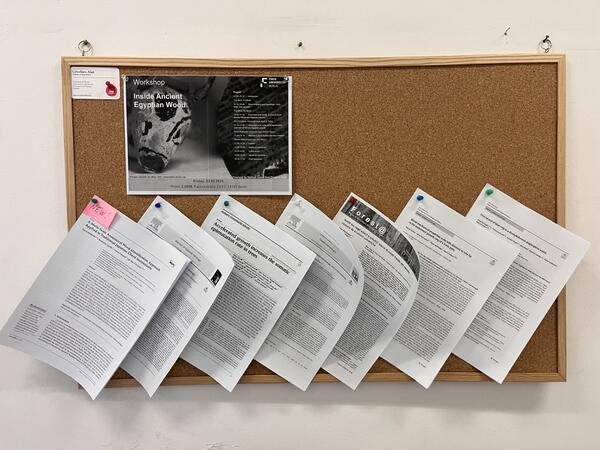
Last year, after finally publishing a paper I had been working on for months, I did something I had never done before: I printed it out, added a QR code linking to the open-access version and taped it to the outside of my office door.
It felt strange at first. Was I showing off? Would anyone care? But within a few days, a student stopped by and said, “Hey, I saw your paper, congrats! I wondered if this could be a theme for my thesis.” That conversation reminded me of why I became a scientist in the first place: to share the joy of discovering new things.
In academia, we often share our achievements online. Social media has become a common place to announce new papers and celebrate milestones. But there’s a difference between digital sharing and physical presence. A tweet can travel far, but it cannot spark a spontaneous conversation in the hallway. Conferences offer in-person engagement, but they are infrequent and often exclusive or too busy. Hanging a paper on your office door? That’s immediate, local and quietly powerful. It is a symbolic gesture that brings your research into the physical space of the university, something rarely done in today’s digital culture.
We also live in an age when our work, mainly publicly funded science, is under increasing scrutiny. While the broader public might not be strolling through university hallways, our colleagues, students and visitors are. Making our research visible to them is a subtle but meaningful act of responsibility. It reminds us that, as scientists, we are not just scholars: We are also stewards of public trust and investment.
Hanging a paper on a door is a small gesture. But it’s a visible one. It says: Here’s what I’ve been working on. This is how your investment in science is paying off. It’s not about boasting; it’s about transparency, accessibility and maybe even a bit of joy.
And yet, this simple gesture can feel surprisingly loaded. Many of us may hesitate. It might come across as self-promotional or draw unwanted judgment. These anxieties run deep in academic culture, where humility is expected and visibility can feel like a risk. But maybe it’s time to challenge that assumption. What if, instead of viewing it as showing off, we saw it as showing up? And if we approach it intentionally, there are ways to make the gesture more inviting than intimidating, ways that could help shift the culture without feeling performative.
Here’s a more innovative way to do it: include a QR code that links to the full text of your paper, a press release or even a short video summary for a general audience. Make it easy for anyone—students, colleagues or visitors—to dive in. Rotate papers quarterly or at least at the end of each semester. Not only does this keep things fresh, but it also turns the ritual into a routine. It becomes just another way to reflect on and share progress. And use the door as a conversation starter. Add a short note beside the paper: “Curious? Let’s talk!”
Science doesn’t need to hide behind paywalls or institutional walls. The more we share, the more we invite engagement, collaboration and understanding. Posting a paper on your door may not change the world, but it might change the hallway. And that’s a start.
So next time you publish, consider skipping the humble silence. Print the paper. Add a QR code. Tape it up. You never know who might stop by.
Alan Crivellaro is a researcher at the Department of Agricultural, Forest and Food Sciences at the University of Torino. His work focuses on plant science and wood anatomy, and he is passionate about interdisciplinary, transparent and bottom-up research practices.
