

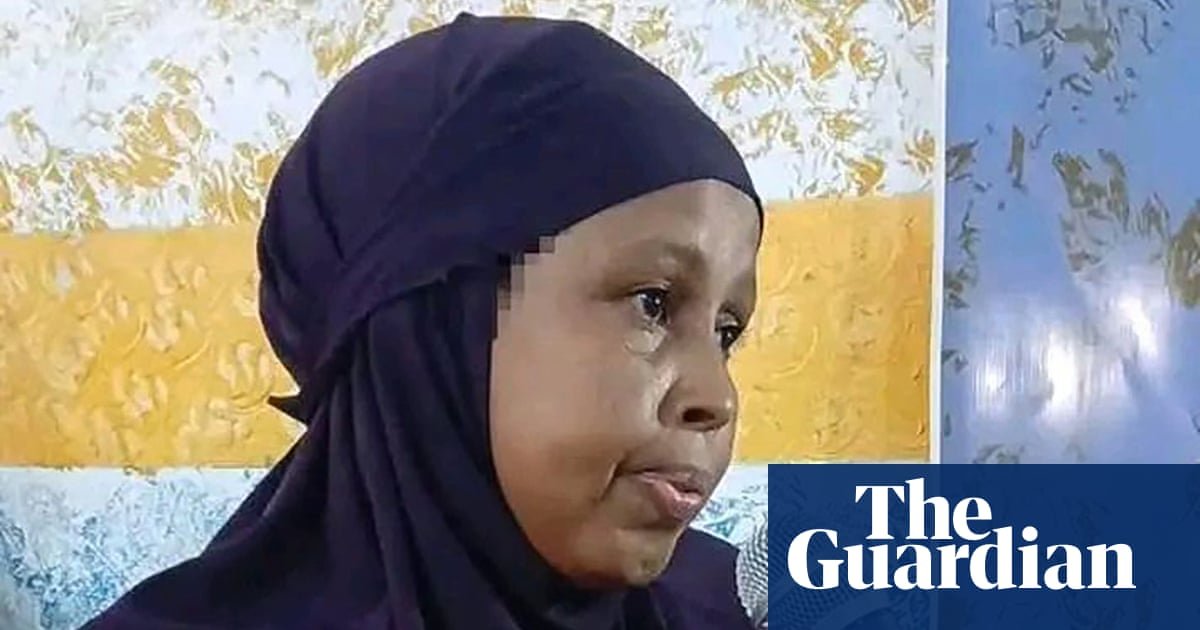
On 12 November last year, Hodan Mohamud Diiriye called her husband to tell him that his 14-year-old great niece, Saabirin Saylaan, who had been living in their house for two months, was unconscious. Together, they took Saabirin to the hospital in Galkayo, in central Somalia, where medical staff pronounced her dead and called the police.
Diiriye, a 34-year-old mother of more than 10 children, was arrested. Less than three months later, on 3 February, she was executed by a firing squad for murder.
The case caused outrage in a country where child abuse often goes unreported. The execution of Diiriye marked one of the rare instances in Somalia where a court handed down the death penalty to a woman, and for child abuse.
While furore around the case has died down now that many perceive justice to have been delivered, activists in the region, as well as Diiriye’s lawyer, question whether she faced a fair trial in a deeply patriarchal country.
“The justice system in Somalia is very poor,” says Guleid Ahmed Jama, a lawyer who has worked in Somalia, and founder of the Human Rights Centre, a watchdog organisation in Somaliland. “It fails because the court system is decentralised and not established by a central government.”
The country has an entrenched clan system where women are not considered members in the same way that men are, and so not afforded the same protections, he says. Homicides are prevalent because of a lack of public order and the presence of militias, but have become somewhat normalised. Often clans settle cases among themselves when a man has committed a crime.
“When Diiriye’s case came up,” says Jama, “because the alleged perpetrator was a woman, it became very, very sensational in the media. When all the public opinion went against her and when there isn’t a proper independent judiciary, that is a very tough situation to be in.”
Rocks and sticks litter the ground following a protest in Galkayo. Photograph: undefined/Abdiqaadir Washington
Diiriye and her husband, Abdiaziz Nur Hashi, 75, took in Saabirin, an orphan, when the older relative she had been living with said she could not look after her any more.
During the course of their investigation, police found dozens of videos on Diiriye’s phone that allegedly showed signs of Saabirin being tortured. These videos were leaked and did the rounds on social media, galvanising public outrage. A postmortem found that Saabirin died by strangulation and her body had marks and bruises on it.
double quotation markThe trial was unlawful. This case was mismanaged … it was handled irresponsiblyAbdiaziz Mohamed Farah, lawyer
When news of her death emerged, members of the wider family staged protests, even blocking access to the hospital mortuary to prevent burial. They were joined by other women who feared the case might be diverted to a traditional dispute-resolution system, which they felt would not deliver adequate justice.
“This case provoked an unprecedented reaction because of its nature,” says Shukri Abdi Ali, head of the Women’s Peace Network in Galkayo, who was part of Saabirin’s extended family. “In our community, we have never witnessed a case like this, where an innocent young girl was subjected to such brutality by a woman. It was something so hard to grasp. Both the victim and the perpetrator were women and the case shocked the nation, as it went against the widely accepted beliefs of women being protectors, caregivers and nurturers.”
Diiriye and Hashi first appeared in court on 20 November. Due to the immense public interest and pressure, proceedings were broadcast live.
According to his lawyer, Hashi was unaware of any abuse because he was rarely at home. Nine days before Saabirin’s death the couple got divorced and Hashi moved out of the home to stay in a hotel.
Diiriye pleaded not guilty, according to her lawyer, Abdiaziz Mohamed Farah. “When she was brought in front of the judge, she said she was mentally unstable and didn’t remember anything she had done,” he says.
Saabirin’s death sparked calls for child protection measures to be properly implemented. Photograph: Courtesy of Radio Gaalkacyo
On 15 December, the court found Diiriye guilty of murder and sentenced her to death. Hashi was sentenced to one year in prison, and a fine of $500 (£370) for negligence. He is now out of prison and living with his children, after paying the fine and the monetary value of his prison sentence.
Farah believes the trial was unlawful. He says Diiriye did not have a lawyer present when she was arrested or questioned by police and that he did not have enough time to adequately prepare for the trial, which was rushed. When he raised the issue of her mental health, the court did not allow for a medical assessment. He says he wanted to call a witness, another domestic worker in the household, but she went missing. He says Diiriye claimed that the person in the videos shown at court was not Saabirin.
“The trial was unlawful,” he says. “It was not in line with international standards. Such cases, especially concerning murder, are not to be handled lightly. This case was mismanaged and instead of giving it the weight and care it needed, it was handled irresponsibly.
“If a person is accused of murder, they have rights and nobody should lose these rights.”
Farah wanted to appeal against the court’s decision, but says his request was ignored because Diiriye had signed a statement saying she did not want to appeal. He says she told him that her family had told her not to appeal because they would pay blood money to the victim’s family in exchange for her life. “This turned out to be false,” says Farah.
He believes Diiriye’s status as a woman did not help her case. “Because she was a woman, she was seen as a lesser citizen and not equal to a man. The authorities knew that if this case was handled in a just manner, she would [not have been sentenced to death].”
In contrast to Diiriye’s fate, Sayid Ali Moalim Daud, who was sentenced to death for the murder of his pregnant wife, Luul Abdiaziz, in January 2024, has not yet been executed. His case went to the supreme court, which upheld the sentence in September 2024.
“People are now asking why he is alive as a result of this case,” says Zakarie Abdirahman of the Coalition of Somali Human Rights Defenders, an organisation dedicated to promoting human rights and protecting defenders across Somalia. “He has exhausted all his appeals in the courts. I think the reason his execution is delayed is because he is from an influential clan.”
He says of Diiriye’s case: “Based on my understanding of the local context, I cannot see why they would execute Diiriye without clear justification. It’s possible she committed the crime, but even then she should not face a rushed execution. A thorough legal process was necessary, all evidence must have been examined, guilt established beyond reasonable doubt, and her mental health also carefully evaluated.”
