

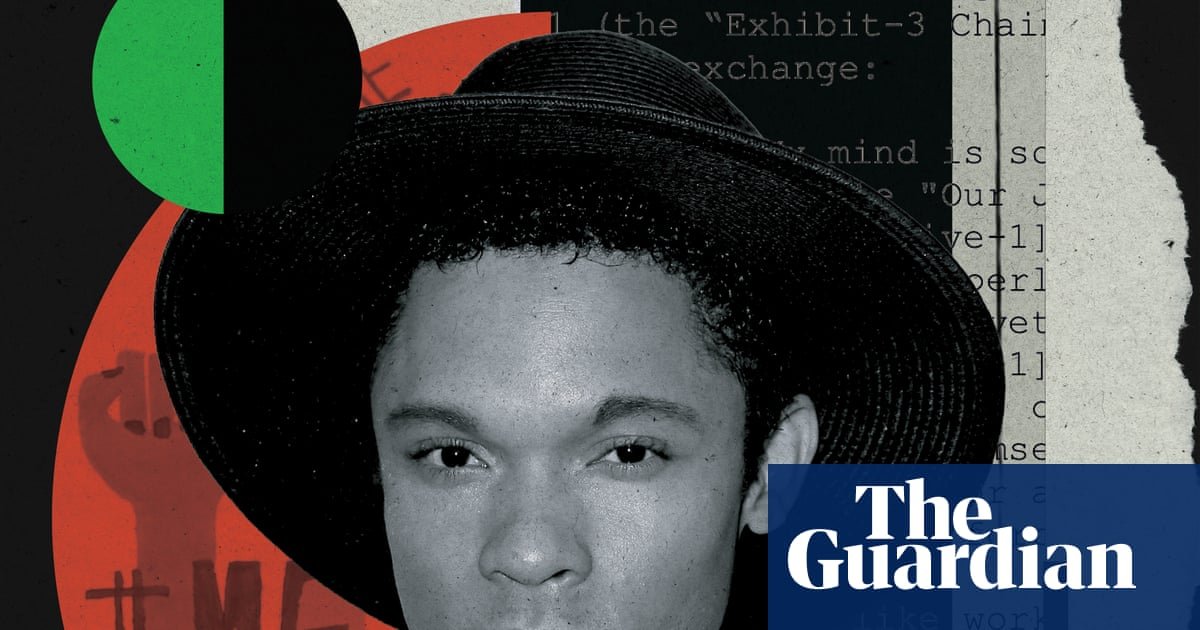
Rovier Carrington, a man who had television producer ambitions and claimed he was a Hollywood heir, launched his winding legal saga in 2018. Composite: Rita Liu/The Guardian/Getty Images
One unseasonably warm afternoon in February 2023, in a very brown New York City courtroom, Rovier Carrington did the inconceivable: he admitted to a lie. On that day, the aspiring screenwriter told a federal judge that he had altered evidence to support his legal claim of being systematically raped and blacklisted by a bevy of Hollywood powerbrokers.
His 11th-hour capitulation came as a shock.
In May 2018, Carrington filed a lawsuit alleging he had been abused by two producers: former entertainment president of MTV and VH1 Brian Graden, who co-created South Park and was partly responsible for VH1’s early 2000s pop-culture encyclopedic rebranding; and Paramount Pictures CEO Brad Grey, whose various companies were behind era-defining movies and television from the 80s on, including The Sopranos, Real Time With Bill Maher and Scary Movie. Grey had died in 2017. Paramount, its parent company Viacom (which also operated MTV and VH1), Brian Graden Media, and Grey’s trust were also named as defendants, with Carrington seeking more than $100m in damages.
Two and a half years and another lawsuit later, the two producers that he had alleged raped him became four with the addition of notorious abuser Harvey Weinstein and Viacom founder and Paramount honcho Sumner Redstone. Carrington would in a future filing claim that Graden had raped him when he was underage. He would come to implicate famous actors as well: Tom Cruise, Bob Saget and Mark Wahlberg, among them.
By the time Carrington filed his first suit, the #MeToo movement was in full swing. After a 2017 New York Times exposé on Weinstein paying off his sexual harassment accusers, a flurry of accusations against major figures such as Kevin Spacey, Charlie Rose, Matt Lauer, Russell Simmons and Danny Masterson had shaken the industry. Institutions like New York’s Metropolitan Opera and Woody Allen’s annual film-making schedule were upended. It seemed that mainstream culture was ready to take abuse seriously, and the filing of Carrington v Graden, et al was widely covered in the press.
But over time, coverage died off until basically only the trades like the Hollywood Reporter and Variety were keeping tabs. When the extremely online #MeToo advocate and Weinstein accuser, actor Rose McGowan entered the chat in December 2020, her plea was urgent: “Why are you @nytimes & @NewYorker hiding this explosive story?” went her tweet. “A different kind of Weinstein victim has come forward. Is it because he’s a young, African American male that you are ignoring him?”
By then, McGowan apparently had not realized that though Carrington had made some of the most explosive claims of the #MeToo era, taking him at his word was a dubious endeavor.
Carrington’s legal ordeal roughly spanned the trajectory of #MeToo – from the days when it seemed that all it took to indict someone in the court of public opinion was an explosive allegation, to the current climate wherein powerful men accused of heinous abuse have seen an overturned conviction (in the case of Weinstein), acquittals on more serious charges (like Sean “Diddy” Combs), and an ultimate ruling in their favor (as with Johnny Depp in Depp v Heard). Though it is in many ways singular and extreme by any measure, Carrington’s story provides an opportunity to survey how the ideals of #MeToo held up.
Johnny Depp gestures to spectators in court after closing arguments at the Fairfax county circuit courthouse in Fairfax, Virginia, on 27 May 2022. Photograph: Steve Helber/AFP/Getty Images
For one thing, the arc of Carrington’s saga challenged the expectation, or at least hope, that many had in the wake of #MeToo: that if you come forward and share your story of sexual harassment or abuse, you will be believed and your bravery will be acknowledged. Carrington’s identity – a young, Black man who has sex with men, who comes from a difficult background – may have only added to the odds that were clearly stacked against him.
double quotation markWhy would I make all of this up?Rovier Carrington
Carrington’s case also tested a legal landscape that was notoriously difficult for victims to navigate: would the courts cast Carrington as an imperfect victim who did not have the support or wherewithal to argue his case, or as a scammer trying to take advantage of a social movement for his own gain? It took more than five years to arrive at an answer. Carrington would come out the other side seemingly as the only #MeToo accuser to date to be criminally charged and convicted for lying in his abuse argument in front of the court.
I have followed Carrington’s case since its 2018 inception, attending court hearings and combing through documents to try to understand Carrington’s narrative, his obstacles and, crucially, why he ended up in prison. For a brief stint, I spoke with Carrington himself about his experience. During one such conversation in September 2018, he posed a question of his own. Calling himself “a boy with no priors”, he wondered aloud: “Why would I make all of this up?”
Tales of Hollywood royalty
Carrington had been trying for years to break into the entertainment industry with not so much as an IMDb credit to show for his effort. He nonetheless projected the image of a well-heeled Hollywood heir, with a father in real estate. In a 2010 sizzle reel for a reality show that would never come to be, The Life of a Trendsetter, he went by the name Trend and claimed to be producing a “major sitcom”. The reel depicted the wispy Carrington shopping for multimillion-dollar houses and empathizing with a friend who had been cut off from her parents’ fortune. “I’m just the boy next door … if you live in Hollywood Hills,” Carrington’s voiceover chirped.
In Carrington’s 2018 suit, he claimed he met the Paramount CEO, Brad Grey, in 2010, around the time of his 22nd birthday, during the production of the pilot for Trendsetter. Its amateurish preview reel had caught the attention of a scout and a deal ensued, Carrington said, though he never provided to the court evidence of a contract.
Carrington alleged that soon after he met Grey, the producer raped him in a private hotel suite during a Golden Globes afterparty in 2011. When Carrington refused cash in exchange for signing a non-disclosure agreement subsequent to the rape, his suit said, he was banned from Paramount and blacklisted “by every producer and studio he approached”.
Carrington alleged that he connected separately with producer Brian Graden through the gay dating site Adam4Adam in September 2014. According to his suit, Graden convinced Carrington to sever his supposed business ties with HBO so that Graden could produce a “dark comedy series” that Carrington had created called Inheritance. Graden coerced Carrington into having sex in exchange for greenlighting it, the lawsuit claimed. Carrington alleged that he had been handed drugged cocktails that allowed Graden to sexually assault him on several occasions.
In April 2015, Carrington alleged he contracted an STI from Graden, and in exchange for Carrington signing a non-disclosure agreement, Graden agreed to produce shows he created, according to his suit. Carrington alleged that Graden stole his idea for Finding Prince Charming, a 2016 gay dating show on Logo that Graden produced, and claimed that the fallout from confronting Graden over the alleged intellectual theft led to more blacklisting.
Besides the allegations of horrifying abuse, the lawsuit also included Carrington’s claim that he was “Hollywood royalty”, alternately naming him the grandson and the great-grandson of the Three Stooges’ Moe Howard.
Carrington had been claiming to be “Hollywood royalty” for roughly the decade that preceded his lawsuit. During the early 2010s, when blogs publishing gossip without factchecking was de rigueur, Carrington made a series of salacious claims about celebrities. Under multiple names, including Tie’Lonzo Rovheir and Trend Rovheir, he alleged that he possessed pictures of himself “sitting and hugged up with Chris Brown, tats and all”, and a sex tape featuring him and Michael Jackson. He teased a memoir that would detail “a dark tale of male escorting, dirt money games, the biggest names” such as Diddy and Michael Jackson. Those posts also mentioned a deal with Paramount for a series that Carrington created.
And on the Carrington Diaries, a now-shuttered website Carrington claimed had half – a – million readers, was a bio that read: “Rovier Carrington is the Great Grandson of Moe Howard who was the Creator of the Three Stooges. With such a famous grandfather it is not surprising that Rovier has so far led a varied and colorful life.”
double quotation mark[Carrington] had pain … I think there’s a rage in thereAnonymous
Carol Rodríguez, a former Olympic sprinter who appeared in the Life of a Trendsetter reel, said that soon after meeting Carrington in 2009, they became close. She compared him to a little brother. She had heard the stories about Carrington’s famous great-grandfather and said she accepted them as fact.
“He was always really nice,” said another friend of Carrington’s, who spoke under the condition of anonymity. “He could be funny. We’d talk about Drag Race. He did know a lot about television production.
“But he had pain,” the friend continued. “I think there’s a rage in there.”
In a September 2018 interview for this story, Carrington said, “I never used my family name to get anywhere,” and claimed it was his lawyers’ idea to include a reference to his alleged great-grandfather in his lawsuit.
He also claimed that the stepfather he had grown up with was abusive, and so he said he wasn’t surprised when he encountered a culture of abuse in Hollywood. When Carrington was a child, his mother obtained a restraining order against a partner in connection with a domestic violence claim, seeming to support Carrington’s recollection of a difficult upbringing.
A strange case
The judge assigned by the southern district of New York (SDNY) to Carrington v Graden, et al compared the case to David and Goliath. This was an understatement. The defense was more a Voltron formation of individual Goliaths. It was stacked with major entertainment attorneys, some of whom have represented A-listers. Carrington, meanwhile, retained the services of the Landau Group; Kevin Landau had recently worked on a $380m “LOLsuit” that was referred to by Vice as “one of the pettiest cases to pass through the halls of justice”.
Carrington v Graden, et al was a strange case, by any standard. It was rife with allegations of rape, which were vehemently denied by the defendants’ counsel, but it hinged on a rather unimpressive antitrust case: Carrington claimed that he had been prevented from competing in the market that was Hollywood by his alleged abusers. The defendants’ legal counsel found the allegation to be absurd and asked for the case to be dismissed. Crucially, they also claimed to have evidence of Carrington fabricating an email in his suit.
Carrington had an idea for a series called Heiristocracy, based “in part” on “true life events that occurred between Carrington and Graden”, which he pitched to screenwriter and director Darren Stein. Carrington’s lawsuit claimed Stein passed on the idea in an email on 24 October 2017: “I enjoyed the vision and the visuals, but after speaking with Brian Graden, I’m focusing on my own projects at the moment.”
But according to Graden’s lawyer and an IT expert brought on to perform discovery on Stein’s and Graden’s email accounts, as well as Stein himself, Stein had never written the words “after speaking with Brian Graden” – the very phrase that seemed to back up Carrington’s claims of blacklisting. Carrington, they alleged, had inserted those words afterward.
In response, Carrington submitted an amended complaint to which he attached even more alleged emails, and accused the billionaire and former executive chair of CBS and Viacom, Sumner Redstone, of blacklisting him (but he did not allege that Redstone sexually abused him – not yet).
Rovier Carrington and Sumner Redstone. Composite: Rita Liu/The Guardian/Getty Images
With that, Carrington went from having one email scrutinized by the court to multiple. This should have been the easy part: a few keystrokes to retrieve them, a few more to paste them into the lawsuit. Certainly, correspondence for which there exists a (digital) paper trail is easier to present to a court than proof of rapes that occurred years prior. But many of the emails included in Carrington’s complaint were forwarded from an account that had since been deactivated, according to Google records.
Of particular note was a newly included email Carrington claimed as evidence that Graden had stolen his idea to make Finding Prince Charming. Carrington’s lawsuit showed that he confronted Graden via email on 7 August 2017, and Graden replied: “well, what’s really tough is that certain ideas are protectable, and some are too generic to be considered legally protectable …” However, per the IT expert, Graden had replied a day later, on 8 August, after Carrington approached Graden for advice, claiming his show idea had been stolen by the Audience network. “We were once friends (in my head), so I’ll like your input,” wrote Carrington to the executive he would sue for rape less than a year later. Graden responded using the language Carrington alleged, though he was referring to Carrington’s claim of Audience theft. “We are always friends, and you can ask me anything,” Graden added, suggesting some degree of friendliness between the two.
Out of about 40 emails quoted in Carrington’s amended complaint, an outside consulting firm only found one in its non-forwarded form, and it was Carrington’s original pitch to Darren Stein, whose authenticity the defense had not disputed.
In response, Carrington filed an affidavit he had previously signed stating: “I have not doctored, fabricated, or altered any of the emails annexed to my Amended Complaint and hereto” – words that would come to haunt him. He also included witness statements about the alleged sex abuse. Although Carrington would reference them in future filings, these statements were never of much concern to the court.
Carrington’s lawyers dropped him, claiming they had not been paid, and he was on his own.
That same month, I spoke with Carrington on the phone. He did not contest the existence of the altered emails, but he denied that those included in his lawsuit were counterfeit. To square these seemingly contradictory claims, he said that Darren Stein had sent him two nearly identical emails in quick succession: one with the clause that mentioned speaking to Graden and one without. “People do it all the time when they clear up something,” he said.
Carrington made a similar claim about the Graden email, alleging without providing evidence that Graden’s lawyers insisted they redo the exchange “to cover up him stealing my show”.
“I was OK with him covering up stealing my show if he produced my show,” Carrington told me.
Carrington’s past life
The day after Carrington filed his lawsuit, Harvey Weinstein was arrested and charged with rape. None of Weinstein’s public accusers up to that point, however, had been men. But, as the court debated his emails, Carrington contacted me via text and claimed that he had been sexually assaulted by Weinstein, as well as Redstone.
I followed up on these claims during our sole phone conversation in September 2018. Carrington insisted he had not sent me any such text messages, and said that my reference to Weinstein was “so far left” that it made him wonder if I was working for “the other side”.
As we spoke, I saw that he was deleting DMs that he had previously sent to me on Instagram. When I asked him why, he told me, “I always remove my messages.” I pointed out that this was reminiscent of the accusation by the defense that he had deleted evidence he had cited in his lawsuit. “No, not really,” he said.
Carrington suggested that someone else had texted me from his phone before settling on another explanation: he had made the claims but they weren’t intended for my eyes. (His message began: “Hello Rich.”) Our conversation ended after he attempted to strike something he had said from the record and I explained “off the record” doesn’t work like that. He hung up, didn’t respond to any further emails after that night and blocked me on Instagram.
Given Carrington’s unwillingness to further provide what could generously be called unreliable narration, I flew out to California to look into his past. According to records from the Burbank city clerk’s office, Antwon Dwayne Smith II was born 14 October 1988, in Bellflower, a south-east suburb of Los Angeles. I found no evidence that the junior Smith, who in 2016 would legally change his name to Rovier Jase Carrington (the name he told me he was given at birth), is related to the Three Stooges’ Moe Howard, or that his family is wealthy. However, in a court filing from 2000, his father said he could not afford child support payments of $390 a month. The address on file for Carrington’s mother in 2018 pointed to a mobile home park on an industrial but quiet block in Compton. A metals distributor sat directly across the street.
Google Street View of 13100 Mulholland Dr, Beverly Hills, California. Photograph: Google Maps
After he began to proceed pro se, Carrington listed different addresses as his own in letters to the court. The first, 13100 Mulholland Dr, Beverly Hills, California, 90210, wasn’t for a residence but a hut-like structure in front of North Beverly Park, part of an exclusive gated community. He told the court the address was a centralized mailroom for Beverly Park residents such as himself. It was over an hour and a world away from the mobile home listed as Carrington’s mother’s address, a steep uphill climb into the upper echelon of Los Angeles society.
I pulled up and asked the security guard on duty if residents of the community could have their mail sent to the hut’s address. He told me they could not.
A ‘stream of lies’
To unravel Carrington’s case, all the defense had to do was contest his evidence: the suspected fraudulent emails he had submitted to show blacklisting. It was like poking a rotting corpse and watching the skin slide off. For months, Carrington blew off a court order to turn in his phone, claiming he returned the iPhone 7 he had used to send the at-issue emails to Apple (the defense pointed out that iPhone 7 wasn’t released until after the emails were exchanged). He missed deadlines. He attempted to have his case moved to a Los Angeles court, and then to have it dismissed without prejudice so he could refile the claims in another context.
Finally, Carrington filed his own interpretation of the discovery performed on the emails. It began with a flourish: “The Defendants have finally showed their true colors.” Carrington then attempted to tie up his mound of loose ends by purporting to show that the defense had hacked his computer and was responsible for the suspicious email account activity. And for the first time, the court heard Carrington accusing Graden of raping him while he was underage. (Graden’s lawyer denied all allegations made by Carrington.) “It takes a lot of courage to come forward with a lawsuit like this,” Carrington wrote in his conclusion.
A few months later, Carrington emailed the court to pile on more allegations of abuse, claiming that he had discovered videos on Graden’s phone and computer depicting Graden and his lawyer assaulting Carrington and other young men while they were “blacked-out”. The email also detailed an account of Carrington being allegedly raped by Weinstein in April 2011, his second on-the-record accusation (the first being when he texted me, which he had later denied doing).
By this point, Carrington had alleged he had been raped at least eight times by three bigwigs, one lawyer and two unidentified men. He said he had been drugged at least four times via drinks Graden had given him over the span of about 10 years. If the allegations were true, Carrington would soon be a casualty of a staggering miscarriage of justice.
But the court was not moved, and in October 2019, a hearing on terminating sanctions was held in New York. Previously, the Los Angeles-based Carrington had attended hearings in his case via teleconference. On the morning of, he didn’t even phone in. All this buildup – a 17-month maze of hearings and filings – for a no-show.
The hearing proceeded without him or his new lawyer, Greg Loomis. The defense was united in the belief that Carrington’s alleged tampering of evidence would make it impossible to conduct a fair trial on the blacklisting claims and demanded Carrington be penalized by the court.
“He’s just lying,” said Viacom and Paramount’s lawyer. “He’s lying and lying.”
Without Carrington there to question, Judge Katherine Polk Failla, who walked a tightrope of patient and stern, acknowledged that the case had been hijacked by Carrington’s “fabricated” evidence and foot-dragging, as well as his “stream of lies” to her, in effect pulling focus from his sexual assault allegations. She dismissed the case with prejudice, meaning Carrington could not bring his case back to court – it was done with, once and for all. Failla described the sanction as “harsh” repeatedly.
Failla told the defense to tally up their legal fees, noting: “I do not know that you will ever see this money.” This would put Carrington on the hook for $607,994.09.
“Mr Carrington, in his opposition, makes a point of reminding me of the seriousness of the allegations and of expressing a concern in this MeToo era that if I were to do as defense counsel and defendants have requested, that I would be silencing a victim of egregious sexual assault,” Failla said in the conclusion of her decision. “I do agree that the Court exists as a place for protection of victims of crimes, but I have a larger mandate that extends beyond any one litigation, of any one plaintiff, to ensure that this Court is not used for the perpetration of fraud.
“And so I’ll never know how much of Mr Carrington’s complaint was true and how much wasn’t,” she said with regret, or maybe exasperation.
Carrington goes public
The same day Carrington was supposed to be in New York, a restraining order by Carrington against Graden was filed in Los Angeles superior court. Carrington claimed that Graden had called him multiple times threatening rape and murder – by Graden or associates of Graden – if he didn’t drop his case. He said he had received ominous messages like: “You will be found dead in a pool of blood. No one wins against Viacom.” Carrington reported the threats to the police, according to his lawyer Loomis, and turned over screenshots of his call logs.
In a mini-replay of Carrington’s last case, Loomis dropped him and Graden’s lawyer claimed fraud. It seemed Carrington was either telling the truth and so horribly disenfranchised that the defense was able to ensnare him in lies, or he had lodged himself in a kind of a loop, trying to make a strategy that had failed to work.
Indeed, the defense – which deemed the allegations “absurd and completely baseless” –provided phone records and alibis from Graden’s employees to refute Carrington’s claims, as well as forensic evidence that the calls were probably caused by “number spoofing”. Carrington filed to dismiss the restraining order, and his case was dismissed with prejudice, with Carrington liable for $79,000 to be paid directly to Graden’s lawyer.
Back in New York, Judge Failla had seen enough: she issued an order finding Carrington a vexatious litigant and prohibiting him from filing future lawsuits with the same or similar allegations against the defendants of his original SDNY case without prior authorization.
Forensic psychologist Adam Coffey, who has studied vexatious litigants and in 2017 co-authored the academic journal article I’ll See You in Court … Again: Psychopathology and Hyperlitigious Litigants, said that people who are deemed vexatious litigants often base their initial filings on truth (or at least a kernel of it). Perhaps their original goal was to bring awareness to a perceived injustice via the validation of the court system. But then, Coffey said, as lawsuits pile up, any unwillingness by courts to entertain their claims is seen as “an even more legitimate harm”.
The problems can compound if there’s already conspiratorial thinking afoot and the court takes away their right to sue, which “serves to reinforce the belief in that conspiracy”, Coffey said.
It would probably be glib to say that Carrington had one more trick up his sleeve, but his next move might as well have been punctuated with: “Abracadabra.” Less than two months later, yet another new lawyer acting on Carrington’s behalf, G Scott Sobel, filed an 82-page lawsuit, Rovier Carrington v Harvey Weinstein, et al, in California. Failla was accused of bribery in the text and named as a defendant. Weinstein, Graden and his production company, Grey’s trust, Viacom and Paramount, and all of the lawyers of the defendants of the SDNY case were also sued. Redstone, who had died that summer, was accused of sexual assault. Carrington also accused Graden’s lawyer without evidence of calling him the N-word multiple times outside the Los Angeles courthouse, as well as raping him and “other teenage boys, all while the victims were unconscious”.
The new lawsuit laid out a conspiracy that allowed a “sex cult of the Hollywood elite” to “destroy Carrington’s meritorious case by denying him any legal process whatsoever”. It accused his first suit’s defense team of conducting “improper discovery” and fabricating email evidence. Contrary to the court’s findings after a grueling 17-month stretch of hearings, Carrington again claimed that the defense had perpetrated fraud on the court, not he.
Carrington’s initial lawsuit had coincided with the rise of the #MeToo movement in Hollywood; this one, coming a few months after the Black Lives Matter uprising in the summer of 2020, pegged it to that moment: it noted that “in 2020”, systemic racial bias was an “accepted fact” and sought not merely “Justice that Carrington deserves personally, but … the Justice that America is crying out for” in the form of $500m in damages.
double quotation markI think Mr Carrington thinks he’s running this trial and running this case and he’s notValerie E Caproni
Days later, Carrington’s first appearance on Storm Monroe’s show was uploaded to the YouTuber’s channel.
In front of a beige background and wearing a large hat tilted dramatically, Carrington told more than 300,000 viewers his unconventional tale of alleged rape in Hollywood. He said he had contemplated suicide and claimed, without evidence, Tom Cruise told him he wanted “what Brad [Grey] had”. He told tales of sex parties attended by men accused of sex crimes (Bryan Singer, Kevin Spacey) and already out boldfaced names (Clive Davis, Tyler Posey).
Soon after, Failla hit Carrington with another order, this time threatening arrest and jail time for ignoring her sanctions; Carrington filed to dismiss Rovier Carrington v Harvey Weinstein, et al. That legal attempt snuffed out, he resumed telling his story on Monroe’s show.
In his second appearance, Carrington claimed the defendants had “falsified everything” and that they had admitted to paying Failla $3m “in cash to rule the way that she did”. He claimed without evidence that Graden’s lawyer had threatened him with death. He made unsubstantiated claims that part-time sitcom dad, part-time foul-mouthed comic Bob Saget had attempted to force him into oral sex at the Polo Lounge, that Def Jam executive Russell Simmons had grabbed his penis and butt, and that actor Mark Wahlberg had groped him. (In the lawsuit naming Weinstein, Carrington had mentioned meeting Wahlberg, whom he described as “always respectful”.)
Carrington said he had dismissed his second case because he had been born with a blood defect that could result in death if he contracted Covid in jail, a concern that reflected the ongoing pandemic, and accused Failla of fraud. He added that his case wasn’t “fully dismissed”, even though it was.
Carrington repeatedly expressed frustration with how his case was handled – or, not handled – by the press: “[It] should have been one of the biggest cases in Hollywood.”
Within months, he was in the custody of US marshals.
‘That was not true’
In September of 2021, Failla’s “nuclear option” hit Carrington like a bomb: she referred his case to the US attorney’s office, which arrested Carrington in LA on a criminal charge of perjury, lying to the court.
Katherine Polk Failla and Rovier Carrington. Composite: Rita Liu/The Guardian/Getty Images/Ballotpedia
Carrington posted $25,000 bail and pleaded not guilty. When he requested a remote hearing the day before he was scheduled to appear in a New York courtroom, claiming there were no flights available from California, the judge assigned to his case, Valerie E Caproni, responded with a list of flights she looked up herself. Carrington didn’t book any of them. A visibly angered Caproni issued a bench warrant for Carrington’s arrest – his second. (Neither Failla nor Caproni responded to a request for comment by the Guardian.)
When the plaintiff turned defendant finally showed up in front of her the following summer, he was in chains. His head was buzzed down to the scalp and he wore a prison-issued bright yellow jumpsuit. His eyes darted nervously. His court-appointed lawyer, Tamara Giwa, would tell the judge that the time he spent in jail had been “a wake-up call”.
Caproni observed: “I think Mr Carrington thinks he’s running this trial and running this case and he’s not.” She set his bail for $50,000, which he posted, and ordered him to pay Giwa.
“May I say something?” Carrington called out toward the end of the hearing. His voice trembled as he apologized for the circumstances that led to his second arrest. He referenced “medical things going on”. “I am a responsible person and you will not have any more issues with me,” he said.
The court, however, continued to have issues with him. “You are on thin ice with this court!” Caproni bellowed at a hearing the next month, to which Carrington showed up in pink pants and a pinker sweater (it was very Easter). This hearing confirmed Carrington’s lack of material wealth: he claimed he had just “$2,000 to $3,000” available to him, and his lawyer said he was living off financial assistance from family members.
And then: a 180. After doubling and tripling and quadrupling down in multiple alarming claims, Carrington had seemed sooner to rearrange his molecular structure than be backed against a wall. But on that sad excuse for a winter’s day in February 2023, a month before his trial date, he filed to change his plea to guilty on count two, false declarations before the court. The exact declaration that he now acknowledged as false was from the signed affidavit attached to his original case, in which he attested he had not “doctored, fabricated, or altered” any of the submitted emails.
“That was not true,” Carrington told Caproni. Yes, the emails in his lawsuit had been altered. Yes, he knew what he was doing and that it was against the law. Yes, this guilty plea was of his own free will.
double quotation markPeople don’t put themselves through this lightly, because even if you were victimized, this is a horrible experienceJuliet A Williams
And so it seemed that Carrington’s nearly five-year legal ordeal, begun in #MeToo’s tidal wave of accountability, was coming to a close. Sandwiched as it was between the 2022 verdict in a civil trial in favor of Johnny Depp, the 2024 overturning of Weinstein’s rape conviction, and accused abuser Donald Trump’s re-election, this happened at a particularly vulnerable time for #MeToo. Whereas a few years prior, survivors’ voices were amplified to the point of seemingly canceling someone upon sounding, the pendulum has swung to a backlash against survivors, with many readily, loudly disbelieving their stories.
According to Juliet A Williams, a gender studies professor at UCLA and socio-legal scholar, Carrington’s court battle could be read as a refutation of the oft-floated suspicion that people are willing to hop aboard the #MeToo bus for the sake of some easy court-ordered money.
“One of the most offensive things about the backlash against #MeToo is this idea that every Tom, Dick and Harry is just going to sue for attention and a big payout,” Williams said. “People don’t put themselves through this lightly, because even if you were victimized, this is a horrible experience, let alone if possibly you’re just doing it for some nefarious motive.”
Another reading takes into account Carrington’s potential opportunism. “If this [was] a scam, #MeToo’s position is: we can account for people like that, because they will not prevail in court,” Williams said.
“I think it is totally important to take examples like this and reinforce that this is a rule-of-law movement,” she continued. “This is not a court-of-public-opinion movement.”
But much was left hanging in the air about Carrington’s allegations of sexual assault. Maybe Carrington, with his unfounded biography and unsupported claims of foiled deals with major media companies, made up the whole thing. Or maybe not. Maybe Carrington really was raped and exploited by powerful Hollywood suits, and by virtue of his disenfranchisement could not get people to take him seriously. Maybe there was a simpler, truer version of the story, and the twisted tale told by the unsubstantiated emails amounted to “gilding the lily”, in Failla’s words. To be clear, liars can be raped. But Carrington’s narrative inconsistencies and manipulations challenged the court’s ability to contend with such complexity.
If Carrington had never been a victim, as the defense argued, then whatever cynical reasons he might have had for filing such an explosive lawsuit – money, fame, launching that elusive Hollywood career – had failed to manifest.
Caproni set Carrington’s sentencing for 1 June. And that was that: Carrington walked into the courtroom that day as a bona fide liar and walked out … a little bit less of one.
As he left the courthouse with his lawyer, the now 34-year-old Carrington crossed Centre Street slightly hunched, seemingly absently holding himself up from behind, his right arm clutched in his left hand behind his back. From that angle, he looked like such a small man.
#imback
Actually, that was not that. Four days before his sentencing, Carrington lobbed a Hail Mary: a lawsuit in which he accused his lawyers of submitting the amended complaint with the problematic emails without his review; alleged his guilty plea had been made “under duress”; and perhaps most detrimentally, accused Caproni, the judge who held Carrington’s fate in her hands, of being in cahoots with Failla. (Sobel, Carrington’s lawyer who filed the suit, said in a comment to the Guardian he believed the “Hollywood moguls and their attorneys defrauded” Carrington and that the courts were “entirely complicit”. He said Carrington was “railroaded into his plea”. “If there ever was a miscarriage of justice, you’re looking at it,” Sobel said.)
double quotation markMedically, there’s really no reasoning with someone who’s delusionalAdam Coffey
Caproni sent Carrington back to jail; his court-appointed lawyer, Giwa, quit.
It was during this period that underlying questions about Carrington’s mental health background, initially redacted, were addressed. According to court filings, Carrington met twice with a court-appointed psychologist, who described him as “emotionally overwhelmed” when discussing his case. “He exhibited symptoms of a depression and anxiety,” she reported, adding that it “appeared likely that he had distorted or delusional thinking”. She said schizophrenia and “other psychotic disorder” should be considered. After meeting with Carrington twice more, she noted some psychological improvement – but said he “continued to express suspicious beliefs that might stem from distortions of reality” – and deemed him fit to proceed with sentencing.
Coffey, the forensic psychologist, was careful to note that vexatious litigation, which Carrington had been found of, is “not always” related to mental illness, though he did point out that the American Psychiatric Association’s DSM-5 does mention “repeated attempts to obtain satisfaction by legal or legislative action” in its description of persecutory delusion, a type of delusional disorder. He compared a delusional belief system to a rock hitting a windshield, creating a small crack at first but then branching out over time. “Things get caught up in the system of beliefs, and it seems entirely true to the person while they are untreated,” Coffey said. “Medically, there’s really no reasoning with someone who’s delusional.”
When Carrington’s sentencing finally rolled around in January 2024, his new lawyer did what he could to argue Carrington should not receive prison time. He described Carrington as traumatized from childhood abuse, with subsequent difficulty trusting authority, and also cited Carrington’s claim of being raped by his cellmate. “Who knows the facts?” Caproni responded.
Carrington had shifted from victim to perpetrator. If this amounted to indelicate or even unfair treatment, he had given the court reason to come to this conclusion. Carrington’s behavior was enough to frustrate anyone who wanted to believe him, as someone who had made extremely disturbing claims against powerful men. Admitting that he had falsified evidence was to take on the mantle of #MeToo worst-case scenario: he tacitly admitted he had lied for his own benefit.
Caproni monologued for what must have been 20 minutes. She called Carrington an “inveterate liar”, blasted his “multiyear stalking crusade”, and mused that perhaps it was all performed in pursuit of his “15 minutes of fame”. She also referenced a victim statement from a defendant in Carrington’s original SDNY lawsuit that could only have been from Brian Graden, as Brad Grey had died before it was filed. The judge relayed the “horrendous toll” of Carrington’s legal “scheme”, including more than $1m in legal fees. It was surreal to hear the defendants of that first suit, accused rapists, repeatedly be referred to as “victims” five and a half years later in a criminal trial. How the tables had turned.
In a statement to the Guardian, Graden’s lawyer said: “Unfortunately, anyone can make an allegation and it can have a terrible impact upon someone’s name and reputation and work and emotional stability, and you usually can’t prove it false until trial. In this case, we were fortunate that we had forensic evidence to establish the fraud Carrington was committing on the court and on my client.” Regarding said client, he added: “I’m very proud of Brian for sticking up for the truth, because a lot of people get these accusations and settle before a case ever gets investigated or tried.”
Back in court, Caproni said that Carrington’s antics had harmed the justice system by sucking up valuable resources, and harmed sexual assault victims by perpetuating the idea that they were not to be trusted. She sentenced Carrington to four years in prison and three years of supervised release – a pointedly long sentence given the range agreed on by the case’s parties was 18 to 24 months – and, among things, ordered his emails be scrutinized should the probation office detect anything suspicious. She required him to undergo outpatient mental health treatment that “must focus on his penchant to lie repeatedly”. She fined him $10,000, on top of the $686,994.09 he already owed from his previous cases. By the end of Caproni’s speech, Carrington looked slumped in his tan prison jumpsuit.
Before Caproni unleashed, Carrington addressed the judge, his voice wavering. “I accept responsibility,” he said, describing his ordeal as “disconcerting”. He apologized and pledged to make better decisions. “I’ve lost, found, and improved Rovier Carrington throughout this experience,” he said.
In August, Carrington was transferred into home confinement or a halfway house on account of good behavior and time served. In January, he was released. On his Instagram profile, where Carrington claims he is the godson of a visionary cable TV executive who died in 2024, is a boomerang video of him touching his chest then pointing at the camera lens. It has a caption: “You think you know. Until I Speak. You don’t… #roviercarrington #beverlypark #imback.”
