

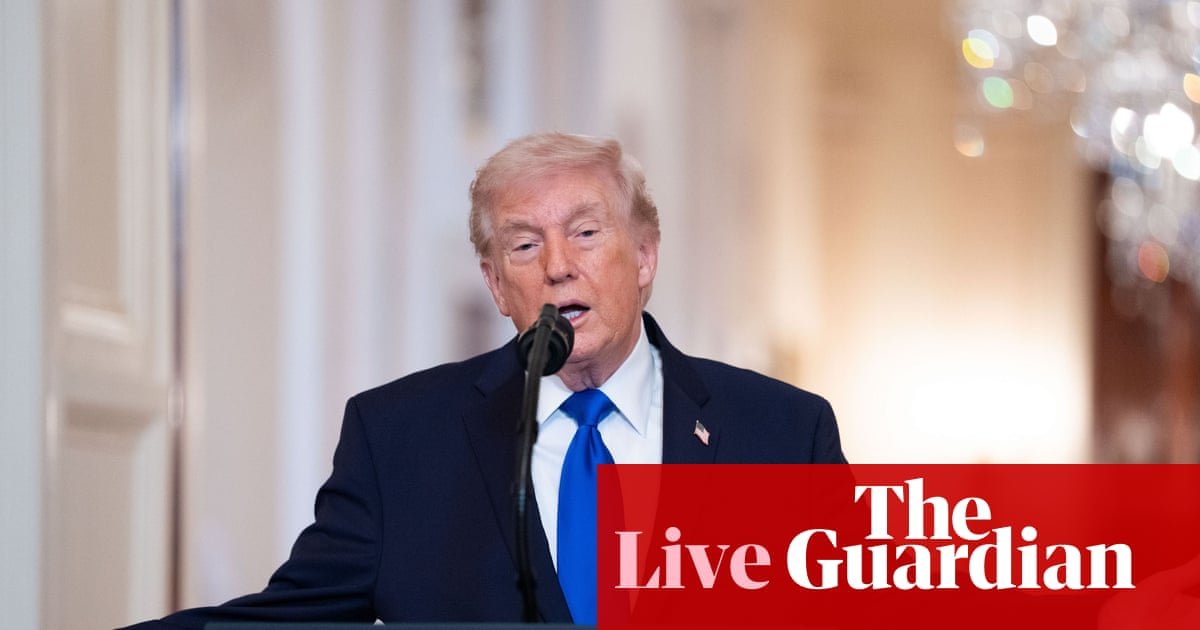
Introduction: Trump’s new tariffs kick in at 10%
Good morning, and welcome to our rolling coverage of business, the financial markets and the world economy.
President Donald Trump’s new tariffs have come into effect today at a rate of 10%, after the US supreme court blocked many of his import taxes on Friday.
The president signed an executive order last Friday authorising the 10% tariffs just hours after the supreme court ruling. He later threatened to raise the rate to 15%, but did not officially do so by Tuesday 12.01am time in Washington, when the 10% levy came into effect.
However, Bloomberg is reporting that officials in the White House are working on a formal order that will increase the rate to 15%.
It comes after Trump declared this week that he can use tariffs in a “much more powerful and obnoxious way”.
The new tariffs, which Trump is applying under Section 122 of the 1974 Trade Act, have triggered uncertainty with a number of US trading partners, including the UK (which negotiated a 10% rate with the US last year) and the EU.
On Monday the EU paused the process of ratification of the deal it had struck with the US last July for the second time in a month, after it froze and unfroze the deal in the wake of Trump’s Greenland threats. The deal was for 15% blanket tariffs on EU imports that were inclusive of previous levies.
Meanwhile in the UK, a spokesperson for Keir Starmer, when asked whether retaliatory tariffs were an option, said:
double quotation markNo one wants to see a trade war. No one wants to see a situation that’s escalated. But as I say, nothing is off the table at this stage.
The agenda
5am GMT: EU car registrations
11am GMT: CBI Distributive trades for Feb
2pm GMT: Case-Shiller US home price index
2.15pm GMT: Bank of England governor to discuss MPC decision to hold interest rates at 3.75% with the Treasury Committee
Share
Key events
Show key events only
Please turn on JavaScript to use this feature
Pill adds that changes to minimum wage and national insurance have had a particular effect on the employment of young people.
double quotation markI also would agree that some of the deeper structural changes, the fact that many sort of entry level jobs are being affected by AI, I think that is something that perhaps is difficult to manage.
The surveys that we see thus far talk about a lot of UK companies, taking up AI as a way of trying to improve productivity. As yet they don’t report that resulted in a large reduction in their willingness or ability to employ labour. But of course, on a forward basis, I think that remains an open question.
I also think…there are these issues, about the echo or long lasting effects coming out of Covid.
So, particularly…having your first job is an important part of being able to enter the labour market and be productive. The more difficult that is, can have very long lasting effects. And they do cross with things like health issues, mental health issues and so forth.”
Share
Huw Pill, who is the chief economist at the bank, touches on the state of the labour market.
double quotation markI think there has been an element of shedding labour that perhaps had been hoarded, in the period, following the end of the furlough, where the labour market was very tight and the difficulties in recruitment were intense.
Bailey adds that evidence that some of this “labour hoarding” is unwinding.
There is a reduction of labour, and companies appear to be not hiring.
double quotation markWe are not seeing a particular uptick in redundancies.
…What we are hearing when we go around the country, is just not hiring.
…There is an element to responding to the cost of employment.
Share
Inflation at 2% “pretty much baked in” for the spring, Bailey says
Bailey says that the Bank’s expectations of 2% inflation in the late spring “is pretty much baked in”.
double quotation markIf you look at the latest number, it was pretty much exactly where we thought to was going to be.
…If you look under the lid, goods price is a bit weaker…. I think we are seeing some trade effects coming through. I think we’re probably seeing some trade effects coming through from goods pricing from China…Food prices were off a bit more than we expected. But services prices…didn’t come off as much as we thought they would.
Share
Megan Greene, who is a member of the monetary policy committee (MPC) and has voted consistently for hold on interest rates, says she has three concerns that she would want to see addressed before she votes for a cut.
double quotation markEmbedded in our central forecast is a nifty handoff where we hit our inflation target sooner and wager growth and inflation expectations come off just as the impact on fiscal policy on inflation sort of flips
…I am little bit worried about that handoff not going as planned.
She says she would like to see further indications of wage growth continuing to come off, as well as inflation expectations for businesses and households.
Share
The governor of the Bank of England, Andrew Bailey, is now appearing in front of the Treasury Committee to talk about the Bank’s decision to hold interest rates at 3.75%.
Bailey says that the bank is now expecting inflation to come back to around the 2% target “sooner than we were expecting”.
It is now “very reasonable” to expect that it will be around the target in the April number that is released in May, he says.
UK inflation slowed to 3% in January.
Share
Matt Britzman, senior equity analyst at the broker Hargreaves Lansdown, says the Meta/AMD deal indicates the AI arms race has “shifted up another gear”.
double quotation markComing hot on the heels of Meta’s recent Nvidia agreement, the message couldn’t be clearer: AI infrastructure is priority number one. Meta is locking in supply, diversifying away from a single vendor, and doing whatever it takes to make sure its AI ambitions aren’t bottlenecked by chips.
For AMD, this is a vote of confidence in its next-generation AI hardware – but having to give up a 10% stake suggests it could be struggling to generate organic demand.
That said, delivering solutions at this scale is a new test. Designing competitive chips is one thing; manufacturing, deploying and supporting them in volumes this large is another.
…Zooming out, this deal underlines just how dominant Nvidia still is… AMD had to sweeten the agreement with a potential equity option – something you simply don’t see Nvidia needing to do to secure demand. Nvidia remains the clear top dog in AI chips, with unmatched scale, software, and customer pull. AMD is making progress and carving out a role, but with Nvidia’s results due tomorrow, we’re expecting Jensen Huang to once again remind the market who’s in charge.”
Meta 🤝 AMD
Today we’re announcing a multi-year agreement with @AMD to integrate their latest Instinct GPUs into our global infrastructure. With approximately 6GW of planned data center capacity dedicated to this deployment, we’re scaling our compute capacity to accelerate the… pic.twitter.com/a6lNWsfRci
— AI at Meta (@AIatMeta) February 24, 2026Share
Updated at 09.42 EST
Meta strikes multi-billion dollar chip deal with AMD
A general view of the office building of AMD is in Pudong, Shanghai, on February 9, 2026 Photograph: Ying Tang/NurPhoto/Shutterstock
Meta has agreed a multi-billion dollar chip deal with Advanced Micro Devices, in which it could also buy a 10% stake in the business.
The company, which owns Facebook, Instagram and WhatsApp, has agreed to buy $60bn of artificial intelligence chips from AMD.
It is the latest blockbuster deal in the AI space, as companies pour billions of dollars into developing their AI tech. Meta has separately struck a deal with AMD’s larger rival Nvidia to buy millions of AI chips.
AMD will supply six gigawatts’ worth of chips to Meta, starting with one gigawatt of the company’s forthcoming MI450 flagship hardware in the second half of this year, AMD chief executive Lisa Su said.
Meta also plans to buy central processors (CPUs), including a variant that will be customised for the social media platform’s needs.
The custom CPU will be tuned to deliver powerful performance while keeping energy consumption as low as possible, Su said. The deal will include two generations of AMD’s CPUs.
Su said:
double quotation markSo no question Mark [Zuckerberg] is very, very ambitious in what he wants to accomplish, and we want to use every aspect of our technology to really help Meta to accomplish that.
…Meta is making a big bet on AMD.
Meta also gets a performance-based warrant as part of the deal, giving it the option to acquire up to 160 million AMD shares in tranches at an exercise price of $0.01 as it buys processors.
Shares in AMD are poised to jump when the US market opens, with the stock up 10% in pre-market trading.
Share
Updated at 09.17 EST
The stock market looks pretty stable for now – the UK’s FTSE 100 is now only down by 0.07%, and the Stoxx Europe 600 is up slightly by 0.1%.
Futures for the US stock market were up 0.4%. Investors will be watching the US market open closely in a couple of hours, after a gloomy report on AI risks triggered a sell-off in software stocks yesterday.
The report, which was published over the weekend by the research firm Citrini, imagined a world in 2028 in which rapid advances in machine intelligence boost productivity, but could spark human job losses, weigh on consumer spending and hit stock indexes.
Shares in the tech giant IBM also suffered yesterday, although that was off the back of AI startup Anthropic saying its Claude Code tool can help modernise Cobol, an old programming language that runs on IBM computers.
Share
UK bank stocks wobble amid credit concerns
Some of Britain’s biggest banks have been the worst performers in the FTSE 100 today: shares in Lloyds Banking Group, NatWest and Barclays are all down between 1.5-2%.
There are concerns growing around the health of the credit market, especially after Jamie Dimon, the chief executive of the American bank JPMorgan, said that there was a risk of bad loans in the banking system.
When asked about fierce competition in the financial industry, Dimon said that he was starting to see parallels with the era before the 2008 financial crisis.
He told investors:
double quotation markUnfortunately, we did see this in ’05, ’06 and ’07, almost the same thing — the rising tide was lifting all boats, everyone was making a lot of money.
Adding that while JPMorgan was not willing to make riskier loans to boost net interest income, he said:
double quotation markI see a couple people doing some dumb things. They’re just doing dumb things to create NII.
Kathleen Brooks, of the broker XTB, said that these fears are now being echoed across the Atlantic, but it could well be an over-reaction.
double quotation markFears about credit quality are also weighing on banks in Europe and is it is dragging the index lower. HSBC, Barclays, Lloyds and NatWest are all sharply lower today, as Dimon’s fears echo across the Atlantic. Intesa San Paolo, ING Group and Allianz are also weighing heavily on the European index. We will need to see if this sell off continues, or if a recovery in US banks helps to calm credit fears in Europe.
…It is worth noting that the default rate across European corporates was very low at 4.4% at the end of 2025, this is expected to fall this year. There were only $3.9bn of defaults in European high yield debt last year, and only $9bn in defaults in leveraged European loans.
While this could change this year, it is hopeful that it comes off a low base. Trying to guess a credit collapse might make good headlines, but it may not become a reality, and the markets could be overreacting to what Dimon had to say.
Share
Updated at 07.33 EST
UK retail sales dampened by the rain
Heather StewartPeople shopping in the rain at Longsight Market on February 11, 2026 in Manchester, United Kingdom. Photograph: Christopher Furlong/Getty Images
February’s relentlessly soggy weather depressed UK retail spending, the CBI has suggested, with volumes falling sharply, according to its monthly distributive trades survey.
The main balance on the survey slipped to -43 from -17 last month.
The CBI’s economist Martin Sartorius said:
double quotation markRetail sales volumes fell at a sharp pace in the year to February, with some firms reporting that the wet weather discouraged shoppers from visiting stores.
Online shopping was up, the CBI found – but not enough to drag the overall balance into positive territory. The forward-looking indicators in the survey were more optimistic, however, with expected sales volumes for March standing at -17: the strongest reading in six months.
Rachel Reeves will deliver her spring forecast next week, and is hoping interest rate cuts from the Bank of England, and cheaper energy bills, will help to boost consumer confidence in the coming months.
Share
Updated at 07.07 EST
China will decide on tariff retaliation in ‘due course’
China has said it will decide whether to retaliate to Trump’s latest tariffs in “due course”, a commerce ministry official said on Tuesday.
The spokesperson told Reuters:
double quotation markChina has consistently opposed all forms of unilateral tariff measures and urges the US side to cancel unilateral tariffs and refrain from further imposing such tariffs.
China was one of the biggest beneficiaries of the Supreme Court ruling last week against Trump’s initial raft of tariffs. Last year Beijing had retaliated against the US trade policy with multiple counter tariffs on American goods, including levies on some agricultural commodities and in energy.
Trump is expected to travel to China from 31 March to 2 April for talks with Chinese President Xi Jinping.
Share
Oil prices hit seven-month highs ahead of US-Iran talks
Priya Bharadia
Aircraft on the deck of the USS Gerald R Ford at Souda Bay in Crete, Greece, on Tuesday. Photograph: Stelios Misinas/Reuters
Oil prices have reached seven-month highs, as traders reacted to heightened tensions between the US and Iran ahead of nuclear talks this week.
US crude futures rose to $67.28 a barrel on Monday, while Brent crude touched its highest level since 31 July at $72.50 a barrel. Prices fell back late in the session, but were up again on Tuesday morning, approaching Monday’s highs.
James Hosie, a research analyst at Shore Capital, said oil markets were:
double quotation markrationally trying to price in a risk premium for oil prices, given the disruption a conflict could have on global supplies”.
The risk of possible military escalation in the Middle East is gaining traction, and thus, traders appear to hedge against worst-case scenarios,” said Priyanka Sachdeva, a senior market analyst at Phillip Nova. She added that the current prices were “largely driven by anticipation rather than actual supply loss”.
Washington and Tehran are set to hold a third round of nuclear talks in Geneva this Thursday.
Share
Updated at 07.08 EST
