

February 24, 2026
3 min read
Add Us On GoogleAdd SciAm
See the rosy glow of Uranus in its full 3D glory
Fresh observations from the James Webb Space Telescope show how vivid auroras surge through Uranus’s tilted magnetic field
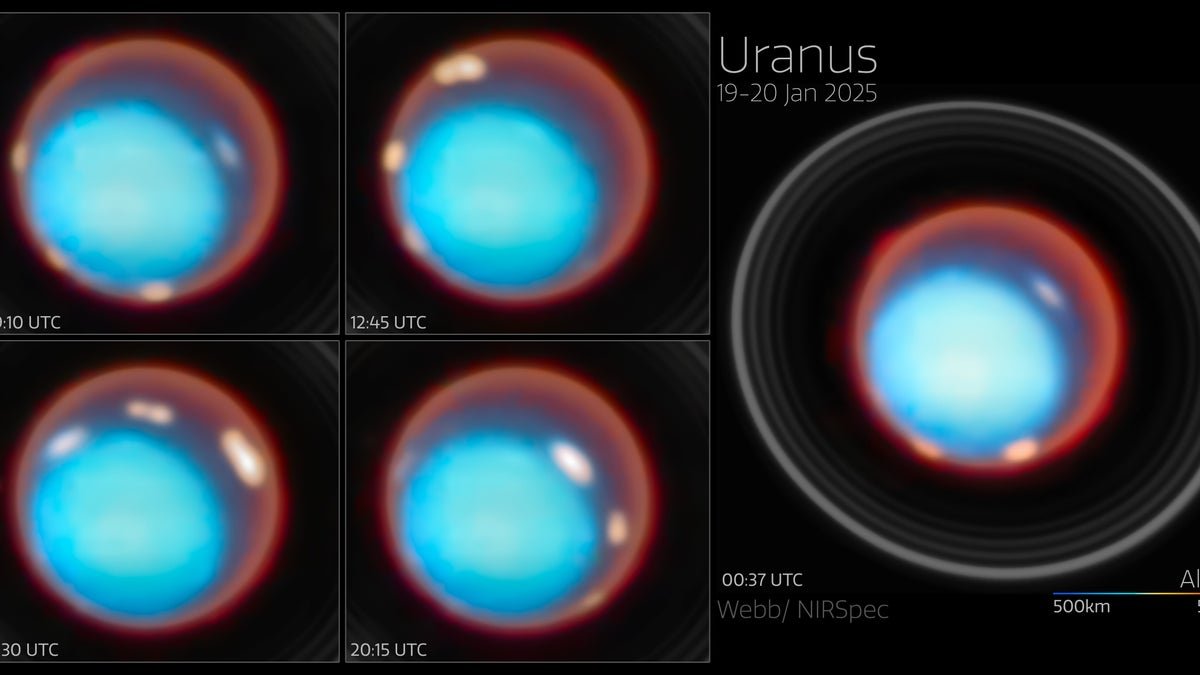
Multiple views of Uranus, as seen by the James Webb Space Telescope’s NIRSpec instrument during a 15-hour period in late January 2025. The ice giant’s auroras appear as rosy splotches, and help track temperatures and dynamics in the planet’s upper atmosphere.
ESA/Webb, NASA, CSA, STScI, P. Tiranti, H. Melin, M. Zamani (ESA/Webb)
Among the solar system’s planets, Uranus is criminally overlooked. Much like its outer solar system neighbor, Neptune, this “ice giant” world is so far from the sun (and so visually bland) that we have only ever sent a single spacecraft, NASA’s Voyager 2, its way —and that was more than 40 years ago.
That lone flyby, accomplished in late January of 1986, scarcely probed the planet’s depths. And it occurred just after a solar storm squashed Uranus’s magnetic field, limiting what scientists could learn about it from Voyager 2’s observations.
Yet despite Uranus’s drab appearance, it may be crucial for solving multiple planetary puzzles. It’s one of two major planets orbiting the sun that rotate in a retrograde (clockwise) motion—and it’s the only one with such an extreme axial tilt, in which its axis of rotation is almost perpendicular to its orbital motion. In other words, Uranus moves around our star like a spinning top that is tilted over and that twirls backward. This celestial skew likely came from Uranus being pummeled by a huge planetary collision early in solar system history, and gives the ice giant strange seasons that span 42 Earth years. This may also have helped create Uranus’s lopsided, chaotic magnetic field, which is misaligned with the planet’s center and spin.
On supporting science journalism
If you’re enjoying this article, consider supporting our award-winning journalism by subscribing. By purchasing a subscription you are helping to ensure the future of impactful stories about the discoveries and ideas shaping our world today.
Yet as weird as Uranus is in some ways, in other respects it appears more typical: Most planetary systems astronomers have found around other stars are stuffed with so many worlds that resemble Uranus in size and mass that this category of planet is probably the most common in the Milky Way. So, if we want to understand how planets form and evolve, whether here or throughout the galaxy, we likely need to better understand Uranus.
That is why new observations of the ice giant by NASA’s James Webb Space Telescope (JWST) offer much more than pretty pictures. Performed by an international team and led by Paola Tiranti, a planetary science Ph.D. student at Northumbria University in England, the observations were published in Geophysical Research Letters on February 19. Previous JWST observations of the planet have unveiled a new moon, charted the world’s subtle rings, and more.
Capturing nearly a full Uranian day, the new JWST data map the temperature and density of charged particles moving through the ice giant’s ionosphere, a high region of the atmosphere where auroras form and interact with the solar wind, as well as Uranus’s bizarre magnetic field. The data—which specifically trace the abundance of H3+, an ion made of three hydrogen nuclei—constitute the best-yet three-dimensional map of the planet’s upper atmosphere.
“With Webb’s sensitivity, we can trace how energy moves upward through the planet’s atmosphere and even see the influence of its lopsided magnetic field,” Tiranti said in a statement.
JWST has a good view of how Uranus’s auroras sweep across and through lower atmospheric layers, she added. “Webb has now shown us how deeply those effects reach into the atmosphere. By revealing Uranus’s vertical structure in such detail, Webb is helping us understand the energy balance of the ice giants. This is a crucial step towards characterizing giant planets beyond our solar system.”
One mystery that the observations confirmed but unfortunately did not solve concerns Uranus’s peculiarly plummeting temperature. For decades, scientists have found that the ice giant’s upper atmosphere is unexpectedly cooling—and these latest measurements show that trend is still going. JWST saw an average temperature of about 150 degrees Celsius in Uranus’s upper atmosphere—lower than the values seen in previous observations.
The planet’s auroras appear as rosy, glowing patches that extend above the visible edges of Uranus’s atmosphere in the JWST images, which also capture the ice giant’s delicate ring system and the bright clouds around its polar cap. But in these images Uranus’s rings and clouds are mostly just eye candy, says Heidi Hammel, a JWST interdisciplinary scientist at the Association of Universities for Research in Astronomy, who was not involved with the work. The auroras are the real scientific stars.
“These auroral detections are hugely important because they are a direct manifestation of the planet’s internal magnetic field,” Hammel says. “We really have no other way to probing the magnetic field remotely without a spacecraft in situ.”
U.S. astronomers still hope to send another spacecraft to Uranus in coming years, but tight federal budgets—and the difficult timing required for an energy-efficient interplanetary voyage—may put such a mission uncomfortably far in the future. For now, scientists may have to settle for JWST’s remote-but-stunning views.
It’s Time to Stand Up for Science
If you enjoyed this article, I’d like to ask for your support. Scientific American has served as an advocate for science and industry for 180 years, and right now may be the most critical moment in that two-century history.
I’ve been a Scientific American subscriber since I was 12 years old, and it helped shape the way I look at the world. SciAm always educates and delights me, and inspires a sense of awe for our vast, beautiful universe. I hope it does that for you, too.
If you subscribe to Scientific American, you help ensure that our coverage is centered on meaningful research and discovery; that we have the resources to report on the decisions that threaten labs across the U.S.; and that we support both budding and working scientists at a time when the value of science itself too often goes unrecognized.
In return, you get essential news, captivating podcasts, brilliant infographics, can’t-miss newsletters, must-watch videos, challenging games, and the science world’s best writing and reporting. You can even gift someone a subscription.
There has never been a more important time for us to stand up and show why science matters. I hope you’ll support us in that mission.
