

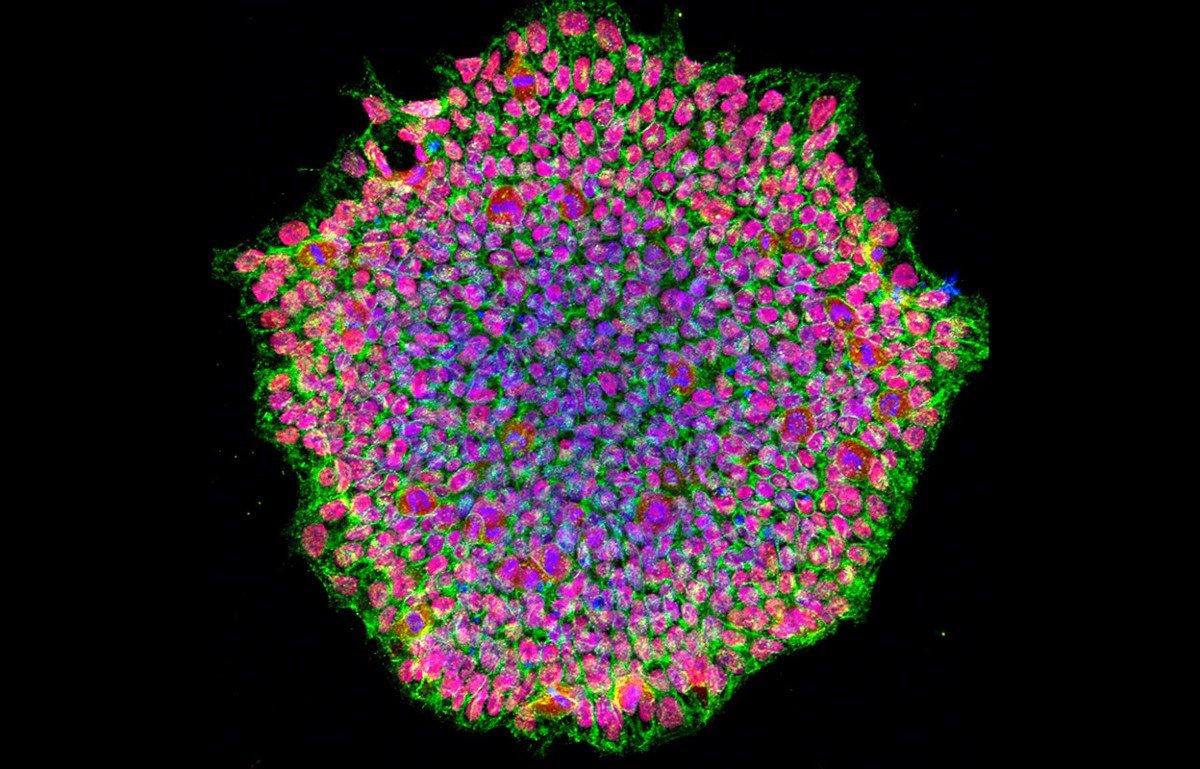
The treatments involve reprogramming mature cells into induced pluripotent stem cells, then progenitor cells.Credit: National Eye Institute/NIH/Science Photo Library
Japan’s health ministry has endorsed issuing conditional approval for two first-of-a kind medicines. But some researchers say that the therapies — made from reprogrammed stem cells and called Amchepry and ReHeart — are not yet ready for prime time.
“This is a risky regulatory experiment,” says Paul Knoepfler, a stem-cell researcher at the University of California, Davis.
Amchepry, made by Sumitomo Pharma and Racthera, both in Tokyo, for the treatment of Parkinson’s disease, has been tested in seven people. ReHeart, made by Cuorips in Tokyo for severe heart failure, has been tested in eight people. But bigger trials are needed to ensure that these drugs are safe and effective, Knoepfler says.
“The data that I’ve seen on these looks encouraging, but it feels like early days to be talking about commercialization of such products,” he says.
Reprogrammed cells
Regenerative-medicine researchers have long aimed to use stem cells to grow replacement cells for treating a range of diseases.
These hopes were given a boost in 2006, when Shinya Yamanaka and Kazutoshi Takahashi at Kyoto University unveiled a simple recipe1 for reprogramming mature cells into induced pluripotent stem (iPS) cells. The technique provided a new source of cells that can be transformed into other cell types. Yamanaka shared a 2012 Nobel prize for his role in the work.
Japan’s big bet on stem-cell therapies might soon pay off with breakthrough therapies
Researchers at Sumitomo and Racthera used this approach to develop a treatment for Parkinson’s disease, a neurodegenerative condition that is caused by a loss of dopamine-producing neurons in the brain. The treatment involves collecting blood cells from volunteers, reprogramming them into iPS cells and then coaxing the reprogrammed cells into becoming dopamine-making progenitor cells. Neurosurgeons then tested the technique by transplanting these cells into the brains of people with Parkinson’s disease.
Amchepry has now been tested in a small phase I/II trial, which is designed mainly to assess safety. No serious side effects occurred, investigators reported in 20252. At least four participants showed decreases in some symptoms, such as tremors.
ReHeart is also made from volunteer-derived iPS cells, but these are instead differentiated into heart muscle cells and then grown into coin-shaped patches of up to 100 million cells. These are transplanted onto the hearts of people with a type of heart disease called ischaemic cardiomyopathy to promote cardiovascular repair.
In a small phase I trial, ReHeart seemed safe, investigators reported last year to The American Association for Thoracic Surgery (AATS), and showed signs of helping some participants to become more physically active.
Shifting responsibilities
For Hiroshi Kawaguchi, an orthopaedic surgeon at Nadogaya Hospital in Chiba, Japan, the clinical data for both drugs are “very weak”. Neither trial was big enough to assess the risks of these therapies, he says. The trials also lacked control groups, precluding firm conclusions about how much benefit they provide — if any.
When researchers presented the ReHeart data to the AATS, an audience member voiced similar concerns. “You need to have a double-blind controlled trial to convince everyone,” he said.
Don’t rush promising stem-cell therapies
In Japan, however, regenerative medicines that have been through exploratory clinical trials can secure “conditional and time-limited” approvals. A panel of specialists for the health ministry has recommended both drugs for this type of approval, which is expected to be granted as early as March.
Drug developers, insurers and health-care providers will then work out a price for the products, which will be paid by insurers and recipients. The companies can then sell their drugs for seven years to a limited number of people, during which time they will continue to track how people respond to better assess safety and efficacy.
