

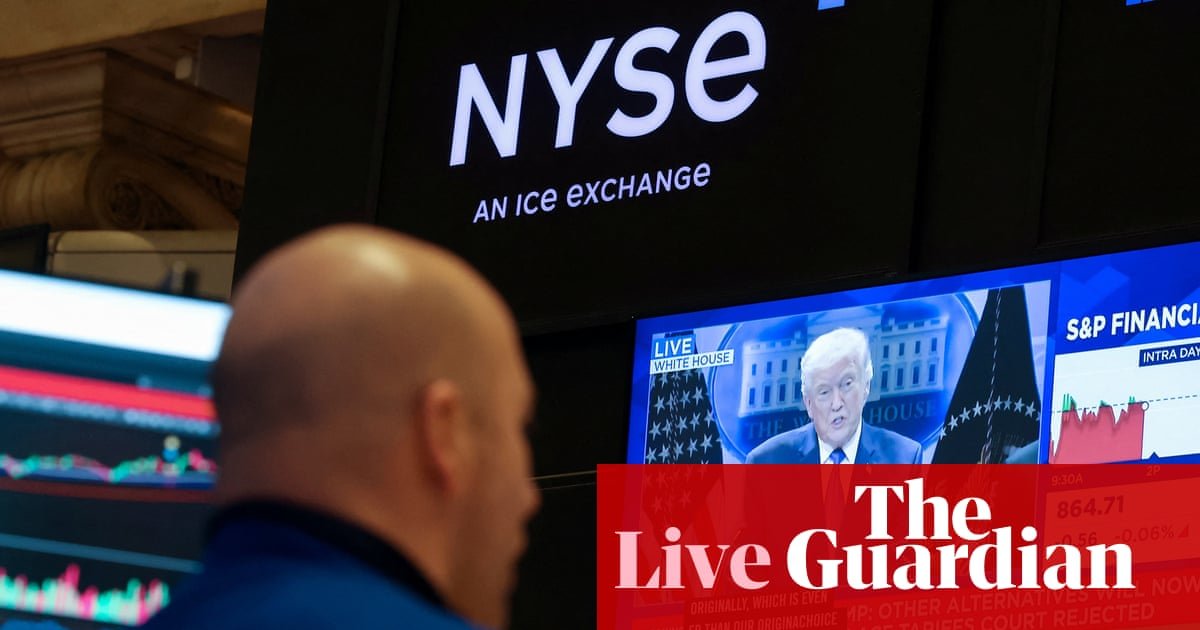
Trump threatens ‘more powerful and obnoxious’ tariffs
Donald Trump has declared that he can use tariffs in a ‘much more powerful and obnoxious way’ than he has thus far.
Posting on his Truth Social network, the US president again attacked the supreme court for ruling against his sweeping global tariffs last Friday – calling them ‘incompetent’.
He also claims the justices have ‘‘accidentally and unwittingly’ expanded his presidential powers on tariffs.
Trump writes:
double quotation markThe supreme court (will be using lower case letters for a while based on a complete lack of respect!*) of the United States accidentally and unwittingly gave me, as President of the United States, far more powers and strength than I had prior to their ridiculous, dumb, and very internationally divisive ruling.
For one thing, I can use Licenses to do absolutely “terrible” things to foreign countries, especially those countries that have been RIPPING US OFF for many decades, but incomprehensibly, according to the ruling, can’t charge them a License fee – BUT ALL LICENSES CHARGE FEES, why can’t the United States do so? You do a license to get a fee! The opinion doesn’t explain that, but I know the answer! The court has also approved all other Tariffs, of which there are many, and they can all be used in a much more powerful and obnoxious way, with legal certainty, than the Tariffs as initially used.
Our incompetent supreme court did a great job for the wrong people, and for that they should be ashamed of themselves (but not the Great Three!).
[That’s a reference to the minority of three justices who backed Trump in last week’s ruling].
* – or perhaps he’s now following the Guardian style guide
Share
Updated at 08.16 EST
Key events
Show key events only
Please turn on JavaScript to use this feature
Manufacturers seek urgent clarity over tariff situation
The confusion over whether the UK will face Trump’s new 15% tariff is particularly worrying for British manufacturers who have already sent goods to America.
Richard Rumbelow, director of international business at Make UK, says these firms ‘urgenty’ need clarity:
double quotation mark“Many UK exporters will be concerned at the further prospect of trade disruption to goods entering the US market. Stability, certainty and clarity are key cornerstones for global trade policy and for UK businesses who plan, invest and conduct trade with partners across the global economy, and particularly with customers in the United States. It’s now important UK exporters work with their US importers to maintain their trading relationships by working through customs guidance as it emerges
“Given many companies will have goods at sea clarity is now urgently required on how UK exports will be treated on arrival into the United States, with the imperative being to protect the benefits of the bi-lateral trade framework that was concluded with the United States last year. It is vital Government continues to seek gradual reductions in tariffs and other opportunities and seeks a strengthening of trade relations from the current position.”
Share
Tom Knowles
Artificial intelligence is unlikely to affect UK unemployment rates in the long run, a policymaker at the Bank of England has suggested.
Alan Taylor, a member of the Monetary Policy Committee (MPC), which sets interest rates in the UK, said he can’t see AI creating mass unemployment for now.
At an event at Deutsche Bank in London, Taylor said:
double quotation mark“History is full of people saying ‘This new technology is going to lead to unemployment.’ And yet, over the course of history, unemployment has always returned to its normal level.”
“There are changes in the composition of the labour force but we haven’t yet seen that kind of structural shift, which is not to say it can’t happen, but we haven’t seen it yet.”
Taylor, who was one of four out of nine members of the MPC to vote for cutting interest rates this month, said the increase in youth unemployment, which rose to an 11-year high in January excluding Covid, was cyclical and unlikely to last long-term.
He said:
double quotation mark“It always goes up in cyclical ways. When the economy weakens and when unemployment is rising, usually youth unemployment rises faster. That’s true across the world. So for me, it’s mostly cyclical. I believe that as the economy normalises, that will start to normalise again.”.
Taylor reiterated his previous public comments that inflation is returning to the Bank’s 2% target faster than previously forecast, with wage growth also now slowing. “Things are normalising at a pretty healthy clip,” he said, suggesting he will vote to cut rates again at the MPC’s next meeting in March.
He said the MPC could make two to three more interest rate cuts to get the economy back to a normal level. But he expressed concern that services inflation had not declined as quickly as expected in recent months. Services inflation slowed to 4.4% in January from 4.5% previously, according to the latest data, well below the Bank’s forecast of 4.1%.
“I’m looking for services price inflation to continue to normalise along with wages as the year unfolds,” Taylor said.
Share
Back in Europe, Germany’s stock market is still being weighed down by trade war uncertainty.
The DAX is down 0.4% so far today. Other markets are looking cheerier, though – Italy’s FTSE MIB has gained 1%.
Share
Yen’s purchasing power hits 53-year low
Phillip Inman
We discuss the fate of the dollar all the time, but what about the trajectory of the dollar, asks senior economics writer Phillip Inman?
Japanese newspapers have spotted that figures from the Geneva-based Bank of International Settlements – the information and advice centre for the world’s central bankers – has published figures showing the the yen’s purchasing power has sunk to a 53-year low against a basket of major currencies. That’s the lowest level since 1973 and the era of fixed currencies.
You might say it is how the world’s third largest economy has maintained its prowess as a major manufacturing exporter in the face of stiff competition from China, Vietnam and Taiwan. And that is not by being more productive, but by consistently devaluing the currency to make exports cheaper.
The figures, which were published by the BIS on Friday, document a fall in real effective exchange rate, which peaked in April 1995 at 193.95.
Nikkei Asia reports that the current real effective exchange rate has since fallen to roughly a third of that level. It shows that the yen has weakened against a wide range of currencies, including the U.S. dollar and euro, as well as the Chinese yuan and Thai baht.
One major factor is the prolonged slump in the Japanese economy, known as the “lost decades,” following the collapse of the bubble economy.
By keeping interest rates at ultra low levels relative to other major economies, Japan’s central bank has encouraged global investors to hold assets in any other currency than the yen.
It causes huge issues inside Japan because imports are more expensive and because travelling to foreign countries is more expensive when the yen’s value is low.
But the low yen has allowed businesses to maintain their status as exporting powerhouses, giving them the profits they need to pay staff well and reward shareholders.
During her short tenure as prime minister, Sanae Takaichi, whose party won a historic landslide in a lower house election this month, has seen the yen slip further, most likely in response to her plans for a spending blitz, mostly with borrowed money.
She could be blamed by the public for higher domestic prices before she has even begun to tackle issues like low foreign investment, which would usually capitalise on a rock-bottom currency value.
Donald Trump wants the yen to rise in value, making the dollar cheaper, and aiding US exports. The Bank of Japan has said it will raise interest rates to make the yen more attractive to investors and push up its value. However, many economists in Japan are nervous about the effect on small and medium-sized businesses, which has become dependent on cheap debt after 40 years of ultra low borrowing costs.
Share
Updated at 08.12 EST
Trump threatens ‘more powerful and obnoxious’ tariffs
Donald Trump has declared that he can use tariffs in a ‘much more powerful and obnoxious way’ than he has thus far.
Posting on his Truth Social network, the US president again attacked the supreme court for ruling against his sweeping global tariffs last Friday – calling them ‘incompetent’.
He also claims the justices have ‘‘accidentally and unwittingly’ expanded his presidential powers on tariffs.
Trump writes:
double quotation markThe supreme court (will be using lower case letters for a while based on a complete lack of respect!*) of the United States accidentally and unwittingly gave me, as President of the United States, far more powers and strength than I had prior to their ridiculous, dumb, and very internationally divisive ruling.
For one thing, I can use Licenses to do absolutely “terrible” things to foreign countries, especially those countries that have been RIPPING US OFF for many decades, but incomprehensibly, according to the ruling, can’t charge them a License fee – BUT ALL LICENSES CHARGE FEES, why can’t the United States do so? You do a license to get a fee! The opinion doesn’t explain that, but I know the answer! The court has also approved all other Tariffs, of which there are many, and they can all be used in a much more powerful and obnoxious way, with legal certainty, than the Tariffs as initially used.
Our incompetent supreme court did a great job for the wrong people, and for that they should be ashamed of themselves (but not the Great Three!).
[That’s a reference to the minority of three justices who backed Trump in last week’s ruling].
* – or perhaps he’s now following the Guardian style guide
Share
Updated at 08.16 EST
UK does not expect new Trump tariff to impact its US deal, PM spokesman says
Over in Westminster, prime minister Keir Starmer’s spokesman has said Britain does not expect US President Donald Trump’s new global tariff of 15% to impact the “majority” of the UK-US economic deal.
The spokesman said Britain’s trade minister, Peter Kyle, had spoken with Jamieson Greer, the U.S trade representative, and the government expects discussions between British and U.S. officials to continue this week, Reuters reports.
Share
Bank of England’s Taylor: high US tariffs appear to be here to stay
Bank of England policymaker Alan Taylor has warned that high US import tariffs appear to be here to stay.
The full impact is likely to take “many years” to be felt, Taylor added.
Speaking at an event organised by Deutsche Bank today, Taylor said:
double quotation mark“I think the fundamental thing to realise is those tariffs are here to stay at some kind of number that is a lot – an order of magnitude – bigger than it was two years ago.
“So I think we should expect this shock to play out also over many years.”
Share
Adding to the confusion, there’s also uncertainty whether the new 15% tariffs are legal.
That’s because Trump is using section 122 of the Trade Act of 1974, which gives the president the power to impose surcharges and import restrictions to tackle international payments problems.
But some experts are questioning how the US can have a balance-of-payments problems in an era of floating exchange rates.
Gita Gopinath, the former first deputy managing director of the International Monetary Fund, declared yesterday that the US does not have a fundamental international payments problem:
Wearing my (former) IMF hat I will say that the US does not have a fundamental international payments problem.
— Gita Gopinath (@GitaGopinath) February 22, 2026
A balance of payments (BoP) problem arises when a country loses market access or is close to losing market access. As long as there is plenty of demand for US debt and equities, which is the case, the US does not have a ‘payments’ problem. It can finance its trade deficits…
— Gita Gopinath (@GitaGopinath) February 23, 2026
Atakan Bakiskan, economist at Berenberg, has written about this issue:
double quotation markAre the new tariffs even legal? The new Section 122 tariffs may also face court challenges, as the current US trade deficit may not meet the condition of “large and serious balance-of-payments” deficits that grant the president authority to impose tariffs to address “fundamental international payments problems.”
First of all, isn’t the balance of payments always equal to zero as an accounting identity under a flexible exchange rate regime? Second, what qualifies as “large and serious”? No president has ever invoked Section 122 before, so any legal challenge will likely take time to resolve.
Share
EU seeking ‘additional clarity’ from US over tariffs
Lisa O’Carroll
The EU has said “additional clarity” is required from the US as to whether the tariff agreement it struck last July in Scotland still stands, after Donald Trump announced a new global tariff of 15% on Saturday.
‘We are very clear what needs to happen here. The US needs to tell us precisely what is going on. Our intention is to continue implementing the aspects of the agreement we made with the US,” said trade spokesman Olof Gill.
Gill added:
double quotation mark“Additional clarity is required. And I think it’s very fair to say that full clarity on what these new developments mean for the EU US trade relationship is the absolute minimum that is required in order for us as the EU to make a clear eyed assessment and decide on next steps.”
ShareLisa O’Carroll
The German chancellor Friedrich Merz has said he expects Donald Trump to respect the tariff deal struck last July at his Scottish golf course.
As confusion reigns across the globe as to whether the new 15% tariff rate, announced by the US on Saturday, would be implemented for the UK, the EU and others, Merz’s spokesperson said:
double quotation mark“We expect the US to follow the Supreme Court of the US decision with clear policies.”
The EU on Sunday called on the US to honour the July agreement. “A deal is a deal” it said.
The new 15% tariff rate Trump says he will impose from tomorrow flows from powers in the 1974 Trade Act, a different legal framework to the reciprocal tariffs Trump imposed unilaterally last year on dozens of countries.
They can only hold for 150 days and must then get congressional approval.
Share
ING: Asia should benefit from tariff changes
Asia should emerge as a beneficiary of the US tariff reset, as the removal of the IEEPA tariffs by the supreme court lowers effective tariff rates for key exporters like India, China, and Vietnam, says ING analyst Deepali Bhargava.
Bhargava says China stands to gain meaningfully from the removal of IEEPA tariffs, while the supreme court ruling arguably improves India’s negotiating position as it hammers out an interim trade deal with the US.
Vietnam, meanwhile, could be the region’s biggest winner, as the move to a flat 15% tariff will make an even more favourable production base for US-bound goods.
While Japan and South Korea gain little on tariffs alone, their strategic trade and investment deals with the US should continue as planned, Bhargava adds.
Photograph: INGShare
Updated at 06.15 EST
Lisa O’Carroll
The European Parliament is set to pause the process of ratification of the trade deal with Donald Trump later this afternoon, the lead negotiator of the conservative group of MEPs has said.
The parliament has already paused the deal once, over Trump’s threat to Greenland, but unpaused earlier this month with a vote of all MEPs expected in March to formally ratify the agreement.
Bernd Lange, chair of the International Trade Committee of the European Parliament, has convened an extraordinary meeting on Monday following the supreme court ruling in the US striking down the tariffs as illegal.
Zeljana Zovko, the lead trade negotiator in the European People’s Party group on the US deal told Bloomberg that “we have no other option” but to delay the approval process to seek to clarity on the situation.
Share
Updated at 06.05 EST
How Trump’s 15% tariff could disrupt UK supply chains
Potential shockwaves from Donald Trump’s global 15% U.S. tariff could disrupt UK supply chains overnight, warns Dr Jonathan Owens, senior lecturer in operations management and global supply chain expert at the University of Salford.
double quotation markIf implemented, a 15% tariff policy under Donald Trump could send immediate shockwaves through UK supply chains, despite the measures being imposed by the United States. The UK is tightly woven into global trade networks, and many British firms either export directly to the U.S. or supply critical components that feed into American markets. A sudden cost barrier of this scale would not be contained within U.S. borders and could ripple quickly across the Atlantic.
In the short term, higher U.S. import costs would likely suppress demand for UK goods, particularly in strategically vital sectors such as automotive manufacturing, aerospace, machinery, and pharmaceuticals. British suppliers embedded in transatlantic production lines could face abrupt order cancellations, forcing production cuts and leaving warehouses with unsold inventory. For smaller firms operating on thin margins, such disruption could quickly escalate into a cash-flow crisis.
The indirect fallout could be equally destabilising, Owens continues:
double quotation markCountries hit by falling U.S. demand may flood European markets with surplus goods, intensifying price competition and squeezing UK manufacturers. At the same time, currency volatility could surge, driving up hedging costs and injecting further unpredictability into procurement and pricing strategies.
Logistics networks would not escape unscathed, as shipping routes could be rapidly reconfigured as firms scramble to avoid tariff exposure. This could lead to port congestion, delivery delays, and rising freight costs.
While the long-term consequences would depend on political negotiations, the immediate impact would be clear: heightened uncertainty, mounting cost pressures, and a period of acute supply chain turbulence as UK businesses fight to remain resilient.
However, this could ultimately prove to be little more than a burst of political theatre, generating headlines rather than lasting economic damage. If the policy were short-lived, disruption to UK supply chains might be sharp but brief.
Share
