

February 19, 2026
1 min read
Add Us On GoogleAdd SciAm
China is reportedly testing a new airborne wind turbine
This gravity-defying machine appears to work much like a ground-based wind turbine—but in the air
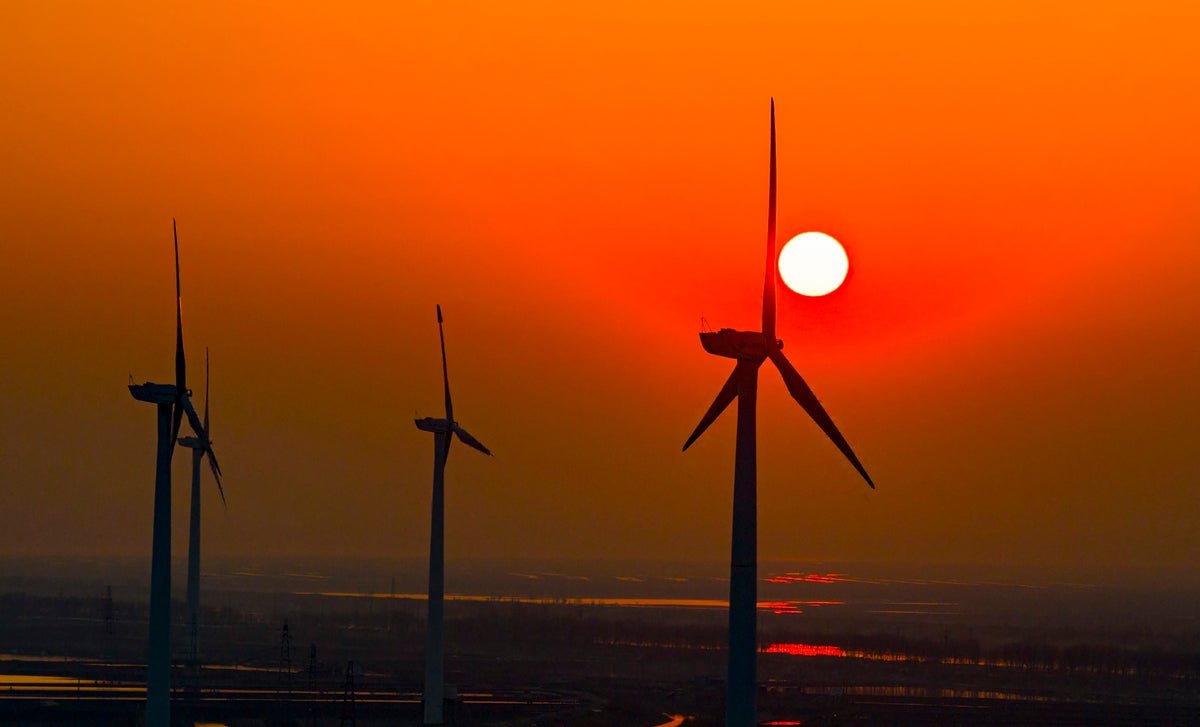
Wind turbines in the city of Yancheng in the Chinese province of Jiangsu.
CFOTO/Future Publishing via Getty Images
The future of renewable energy might be in the sky. Researchers in China have reportedly tested a new, gravity-defying wind turbine system that they say could generate power from the airspace above cities.
The turbine is called the S2000 Stratosphere Airborne Wind Energy System, or SAWES. Held up by what is essentially a helium blimp, the machine reportedly generated 385 kilowatts of electricity from 2,000 meters (more than 6,500 feet) above the city of Yibin in China’s province of Sichuan, according to a recent Euronews report.
You can see it in action in the video below.
On supporting science journalism
If you’re enjoying this article, consider supporting our award-winning journalism by subscribing. By purchasing a subscription you are helping to ensure the future of impactful stories about the discoveries and ideas shaping our world today.
“Traditional wind turbines operate by rotating their blades when wind strikes them, thereby generating electricity,” said Weng Hanke, co-founder and chief technology officer of the turbine’s maker, Beijing Linyi Yunchuan Energy Technology, to Euronews. “This generator functions similarly, except that power generation occurs not at ground level but in the air.” As the blades spin, cables carry electricity to the ground.
Researchers reportedly conducted similar tests last September, and the machine is still a prototype. Although China is the world’s largest emitter of carbon dioxide, the country is also the global leader in renewable energy, especially wind and solar.
It’s Time to Stand Up for Science
If you enjoyed this article, I’d like to ask for your support. Scientific American has served as an advocate for science and industry for 180 years, and right now may be the most critical moment in that two-century history.
I’ve been a Scientific American subscriber since I was 12 years old, and it helped shape the way I look at the world. SciAm always educates and delights me, and inspires a sense of awe for our vast, beautiful universe. I hope it does that for you, too.
If you subscribe to Scientific American, you help ensure that our coverage is centered on meaningful research and discovery; that we have the resources to report on the decisions that threaten labs across the U.S.; and that we support both budding and working scientists at a time when the value of science itself too often goes unrecognized.
In return, you get essential news, captivating podcasts, brilliant infographics, can’t-miss newsletters, must-watch videos, challenging games, and the science world’s best writing and reporting. You can even gift someone a subscription.
There has never been a more important time for us to stand up and show why science matters. I hope you’ll support us in that mission.
