

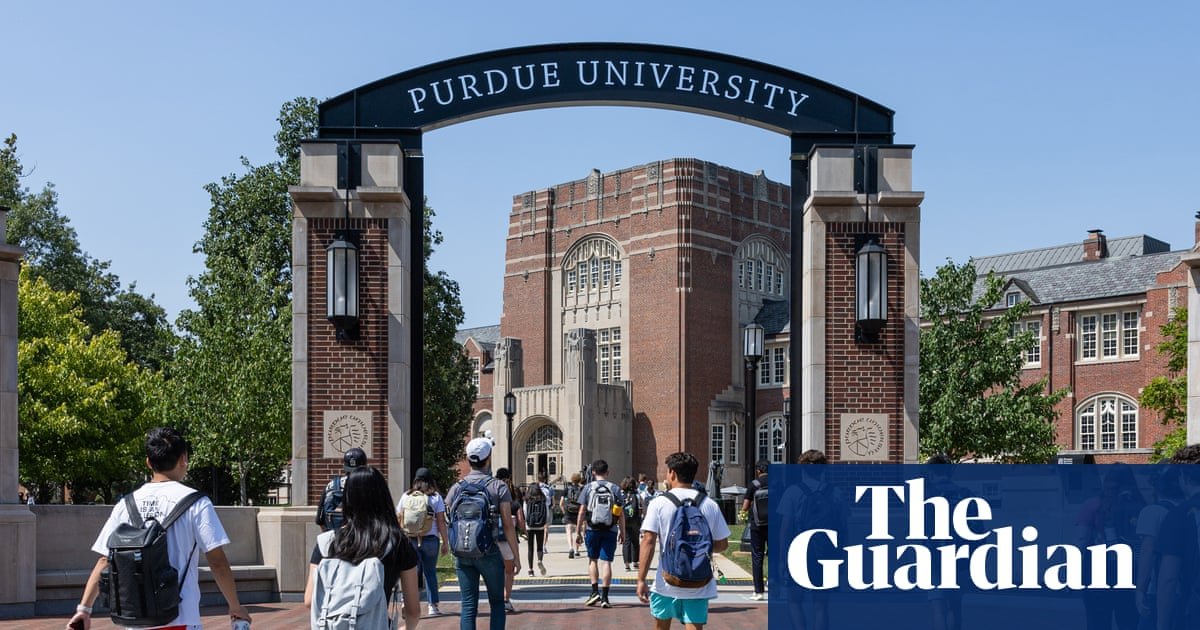
Several universities have scrapped partnerships with Chinese institutions in recent months as a direct result of pressure from US legislators. But no university appears to have gone as far as Purdue University in Indiana.
Students and faculty at the public university say that an unofficial policy is in effect to automatically reject students from China and a number of other countries altogether.
The alleged shift in admissions practices at Purdue followed a letter sent last year to six universities by the US House’s select committee on the Chinese Communist party (CCP), demanding they turn over data about Chinese students, a population they say jeopardizes national security.
“Our nation’s universities, long regarded as the global standard for excellence and innovation, are increasingly used as conduits for foreign adversaries to illegally gain access to critical research and advanced technology,” the committee wrote, adding that the admission of large number of Chinese students into science, technology, engineering and mathematics programs came “potentially at the expense of qualified Americans”.
Students, faculty and alumni are organizing against what they say is a blanket but unwritten policy to block the admission of students from China and other countries the US has designated as “adversary nations” – including Russia, Iran, Venezuela, Cuba and North Korea. The Lafayette Journal & Courier first reported on the alleged ban in December.
In a letter addressed to Purdue leadership, which was publicized Friday and shared exclusively with the Guardian, dozens of signatories argue that the university “soft banning students based on their nationality erodes higher education’s core values of meritocracy, equality and academic freedom”. They called on Purdue to clarify any instructions it has given graduate admissions committees and to restore offers to scores of international students they say the university rescinded last year.
Purdue denies such a policy exists. Erin Murphy, a spokesperson for the university, wrote in a statement to the Guardian that “there is no ban” – but did not address questions about the letter’s allegations and rescinded offers.
Graduate admissions decisions are typically made by individual departments. The university signs off on offers, a step that in the past amounted to a formality. But last year, several foreign students reported receiving offers and funding from various departments at Purdue only to have them rescinded several weeks later with no explanation. In some cases, they had already turned down other offers and signed leases in Lafayette.
“I was shocked,” said one student from China. “I thought maybe they sent the rejection to the wrong guy.”
The student, who asked that he and the department not to be named as he continues to work independently with a Purdue faculty member, said that he had turned down offers from three other universities. He said the supervisor was equally blind-sided by Purdue’s decision. “He couldn’t do anything,” the student said. “They refused to provide an explanation – it was like a black box.”
Purdue’s alleged ban would be among the most severe manifestations of the Trump administration’s campaign against international students. Last year, the administration abruptly canceled the visas of thousands of students – many of them Chinese – and froze billions of dollars in research funding. That landscape has contributed to plunging enrollments of foreign students at US universities and boosted rival institutions overseas in what experts warn will permanently degrade the global standing of US scientific research.
Another student, who also asked not to be named, received an offer from Purdue’s chemistry department last March, but the university rescinded it without elaboration in May. Several months later, the student, who also turned down other offers in the US and remains in China, learned from a faculty member that “there was an internal requirement not to admit Chinese students”, the student said. “There was no written document provided. It was communicated verbally.”
Other schools also responded to the warning from legislators. Last summer, the University of Illinois Urbana-Champaign (UIUC), which like Purdue had received the letter from the committee on the CCP, told members of the committee that it would “wind down” a series of partnerships with Chinese universities, according to public records obtained by students there and shared with the Guardian. A spokesperson for the university said the decision followed “a review of international programs within the context of the current policy environment affecting US higher education”.
The University of Illinois Urbana-Champaign (pictured) said that it would ‘wind down’ a series of partnerships with Chinese universities. Photograph: Jeff Greenberg/Universal Images Group/Getty Images
In December, Columbia University quietly called off an exchange program with China which the congressional committee had claimed was funded by a “CCP-linked” organization seeking to “advance Beijing’s interests in the United States”, the Guardian has learned.
Nathan Blade-Smith, a master’s student at Columbia’s School of International and Public Affairs who was supposed to travel to China through the program, said that the university kept students in limbo for weeks before canceling funding less than a month before the trip was to take place. Blade-Smith, who studies US-China relations, cautioned that the worsening climate for academic exchanges between the countries risks leaving “no opportunity for a next generation of China experts to have intimate experience with the country”.
An escalation against Chinese scholars
In June of last year, Purdue adopted a new policy restricting staff and faculty’s dealings with US-designated “adversary nations”, characterizing it as a response to state and federal laws. The policy says nothing about banning students from those countries.
Any shift in policy appears to remain informal. “They more or less demanded that we don’t extend offers or we don’t consider Chinese students,” one faculty member who oversees graduate admissions told the Lafayette Journal & Courier. “Because there’s nothing in writing, there’s no policy I can point to,” another faculty member told the newspaper. Purdue has since warned faculty against speaking with the media.
The Federation of Asian Professor Associations, a national alliance of faculty associations, called the alleged ban “unethical” and questioned whether it might violate Title VI of the 1964 Civil Rights Act, which prohibits publicly funded institutions from discriminating on the basis of race, color or national origin.
“Substituting categorical admissions exclusions for individualized compliance measures reflects not principled legal judgment but institutional risk-avoidance driven by political calculation,” the group wrote in a December statement.
The University of Maryland, the University of Southern California, Stanford and Carnegie Mellon also received the congressional letter, though none of them appear to have taken actions against students.
The congressional letters targeting individual universities are an escalation of policies targeting Chinese scholars in recent years.
Proclamation 10043, a directive issued by Trump during his first term, barred hundreds of students the administration said have ties to the Chinese military from obtaining visas. And in 2018, Trump’s justice department announced the China Initiative, which sought to identify Chinese spies at US universities but which critics said resulted in racial profiling and harmed technological competitiveness. The Biden administration shut down the initiative in 2022 but Proclamation 10043 remains in effect.
“What’s happening at Purdue isn’t isolated,” said Valentina Dallona, political director of Justice Is Global, a group that advocates for progressive US-China relations. “National security fears are eclipsing decades of academic collaboration.”
Rose Ying, a graduate student organizer at the University of Maryland, said that the targeting of Chinese scholars has created a palpable chill. “People have been very, very cautious about traveling, about saying or doing anything,” she added. “They don’t want to get stopped at the border”.
A Chinese graduate student at the UIUC, who asked for anonymity to avoid attracting scrutiny, said that in private chats, many Chinese students were advising prospective applicants back home to seek opportunities in Europe, Canada and Australia instead of the US, or choosing to stay in China.
“As graduate workers, we are not paid a lot but we do a whole lot of work,” she said. “Our work benefits American industry and science.”
