

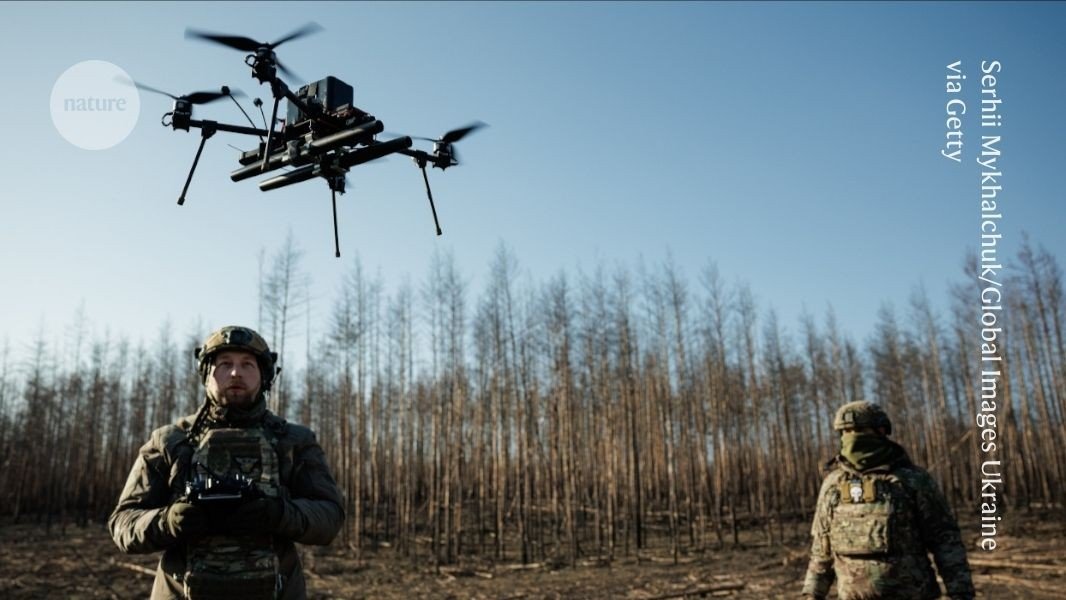
Ukrainian soldiers test drones in Donetsk, Febuary 2025.Credit: Serhii Mykhalchuk/Global Images Ukraine via Getty
Military budgets are growing, especially in larger economies. In 2024, global military spending totalled U$2.7 trillion1, a 9.4% increase in real terms over the previous year, according to the Stockholm International Peace Research Institute (SIPRI), a think tank specializing in conflict, peace and weapons. Just two countries, China and the United States, accounted for almost half of the total.
At their two-day summit in June 2025, all but one of the 32 North Atlantic Treaty Organization (NATO) member countries agreed to spend 5% of gross domestic product (GDP) on defence and security by 2035, in response to “profound security threats and challenges” — chiefly perceived threats from Russia and from terrorism. If achieved, this would be an enormous escalation in spending. UK military expenditure of 5% of GDP would amount to half of what the country spends on its National Health Service2 (NHS).
But nations have considerable leeway to decide what falls under this umbrella, which can include research and development (R&D) funding. Spain, for example, which opted out of the 5% target, has called for a broader view of defence spending, to encompass areas such as quantum computing.
What research might be lost after the NIH’s cuts? Nature trained a bot to find out
What impact, if any, will defence-spending pledges have on research budgets? Some scholars who work on science funding, defence and peace, such as Lucy Suchman, a technology-focused sociologist at Lancaster University, UK, say that certain scientific fields could benefit (such as artificial intelligence) but others lose out (such as climate science) as funding priorities shift increasingly towards militarization.
One study of 183 countries between 1989 and 2022 found that higher defence spending was associated with fewer trademark applications and fewer people working on R&D3. In many countries, increased government spending on defence exists alongside lowered spending on other research. In the Organisation for Economic Co-operation and Development (OECD) countries, public R&D spending on health declined by 11.5% from 2020 to 2024, while spending on defence R&D rose by 17%4. Government spending in the OECD on ‘general advancement of knowledge’ has also started to decline.
Nature’s careers team spoke to more than ten researchers working on science, peace and defence. They highlighted five interrelated themes that demonstrate changes to science — and to the careers researchers might expect to have — that could ensue in a more militarized world.
More nationalism, less collaboration
Evidence suggests that admitting more international graduate students leads to economic benefits, yet Canada, the United States, the United Kingdom and Australia are among those countries making it harder for international students to secure visas. China and the United States generate more influential research when they collaborate than when they do not, yet this collaboration is declining5. Overall, immigration controls, data-access restrictions and a focus on security are creating a more restricted environment for science.
On the basis of current trends, science is likely to become more constrained by ideas of national self-interest and scientific self-sufficiency, against a backdrop of increased military spending. “There’s been a rise of nationalism, and scientific cooperation has been influenced by that,” says Caroline Wagner, a public-policy researcher at Ohio State University in Columbus.
Nevia Vera, an international-relations researcher at the National University of the Center of Buenos Aires Province in Tandil, Argentina, dates this trend to 2018, when the United States launched its China Initiative to counter potential espionage in US laboratories and businesses. That year, China surpassed the United States as the largest source of peer-reviewed articles5, and publications authored jointly by Chinese and US authors started to decline from a peak of 16% of the total number from both countries. Sino–US co-authored papers in the main Web of Science databases dropped by more than 10% between 2018 and 2024, according to Li Tang, a science-policy researcher at Fudan University in Shanghai, China.
But the collaborations haven’t ended entirely, which echoes previous ups and downs in international research. In 1984, Bill Foster started working as a physicist at the Fermi National Accelerator Laboratory near Chicago, Illinois. Even during the cold war, Foster says, there were Russian physicists working well alongside US ones — even though “you always knew that there was a KGB person”, he adds. “You could tell: he was the guy … who didn’t really know the physics.”
A NATO summit with Ukrainian leader Volodymyr Zelenskyy in the Hague, Netherlands, June 2025.Credit: Emmi Korhonen/Sipa US/Alamy Live News
Foster was elected to the US House of Representatives as a Democrat in 2013 and has co-sponsored a bipartisan bill in Congress that would allow some Russians working in science, technology, engineering and mathematics (STEM) to gain permanent residence in the United States. He argues that this “will simultaneously kick the legs out from under Russian President Vladimir Putin’s war effort — to lose some of the best and brightest” Russians — and “do something that will be of permanent value to the United States”.
The future of research collaborations involving Russia
Sylvia Schwaag Serger, an economic historian at Lund University in Sweden, thinks that it would take years, if not decades, to reverse the overall decline in international research collaborations. But she also speculates that international research career moves could lose some of their lustre in the longer term. “Whereas before, international experience often was generally considered positive,” she notices that in some countries, “researchers are reconsidering whether it’s actually helping their career”, she says.
Regional realignment
Although overall collaboration between scientists of different nations might decrease, some expect this to be more of a splintering effect, with researchers collaborating increasingly within regional blocs or geopolitical alliances. There is already growing collaboration in Europe, in Asia and among OECD countries, according to Schwaag Serger.
How the invasion of Ukraine is affecting Russian expat researchers
For instance, while their country’s relationship with the United States has cooled in the past few years, Chinese researchers have increased their collaborations with colleagues in Africa, Asia and Latin America.
But overall, Tang emphasizes, “the decreasing collaboration between scientists in China and the US is not being compensated for by increased collaboration between China and other countries, such as India and Russia”.
Most countries have limited scope to manoeuvre around the big military spenders (the biggest spenders among which are the United States, China, Russia, Germany and India1). Vera calls these countries’ influence “the trends of great powers”. Although the geopolitical situation is more complex now than during the cold war, scientists in many nations could again feel pressed to align with one set of countries or another.
More scientific inequality
Also widening is the technology gap between countries. A report by United Nations secretary-general António Guterres details how the R&D benefits of military spending tend to pool in a few countries6, disadvantaging low-income nations where the military spends little on R&D. “Technology advances so quickly that countries cannot catch up” to scientific superpowers such as the United States, the European Union and China, Vera thinks. Some AI researchers have warned that this type of technological–military competition could spill over into conflict7.
Although the United States and China will remain interested in parts of Latin America and Africa for minerals crucial to technological transition and rearmament, Vera worries about these relationships being extractive rather than genuine partnerships. The United States has embraced a transactional approach to security assistance, for instance, by supporting peace and security efforts in the Democratic Republic of the Congo in exchange for influence over mineral resources.
US brain drain: the scientists seeking jobs abroad amid Trump’s assault on research
