

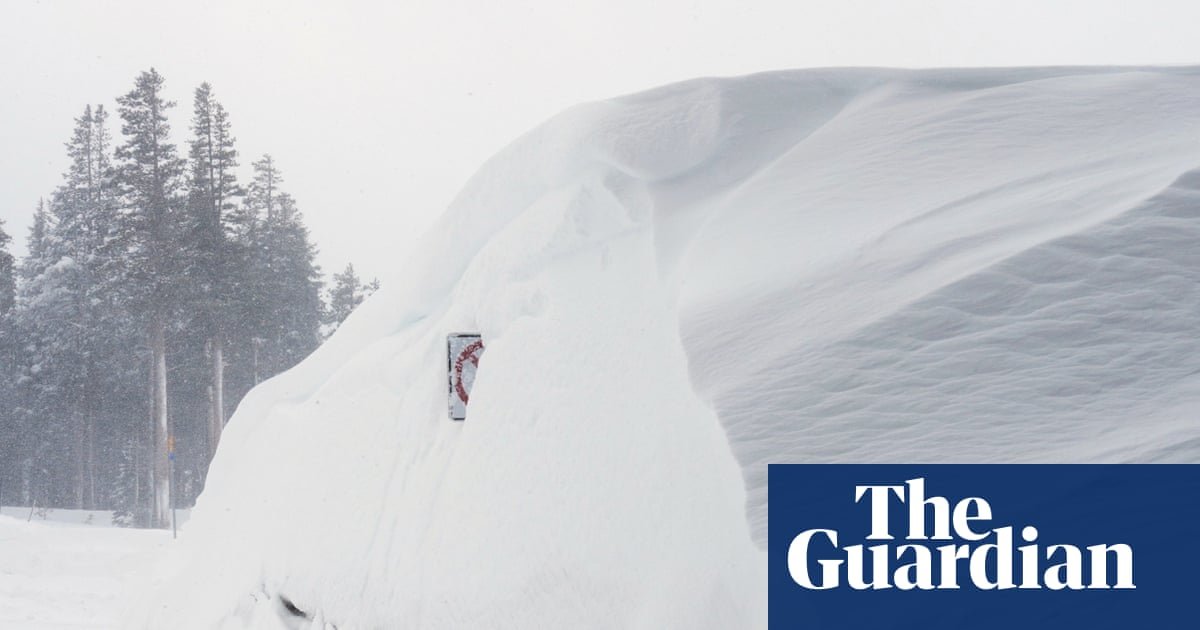
Avalanche risks remain high in the Sierra Nevada mountains of northern California this week, following the deadliest snowslide the region has seen in modern times.
The climate crisis has set the stage for more dangerous conditions, with sharper swings between dry periods and severe storms, according to experts, who have long warned that extremes will amplify as the world warms.
High temperatures have caused a record-low snowpack in the region, and the snow drought that has caused concern across the western US this winter has left the slopes lacking thick frozen layers fresh snow can adhere to. Strong storms pummeled the Sierra this week, blanketing the previously barren peaks. UC Berkeley’s Central Sierra Snow Lab measured more than 92in in snowfall in the past seven days.
While the return of winter weather was welcome news for water managers who have been anxiously eyeing low totals, it prompted more strong warnings from avalanche forecasters.
“Another round of snow and strong winds will occur today, continuing to load our existing snowpack. Large to very large avalanches remain a very real concern,” the Sierra Avalanche Center, a nonprofit partner of the US Forest Service, said in a forecast published on Thursday.
Because of the warm weather in January and February, snow density in these mountains is also a lot lower than it would typically be, meaning rocks, downed trees and other hazards are closer to the surface where they can more easily lie hidden. Avalanche warnings were set at level four out of five – a designation for high potential for large avalanches in many areas with a high likelihood of both natural and human caused slides.
Since 1 December, there have been more than 8,500 daily high temperature records broken or tied in the US west, according to National Oceanic and Atmospheric Administration (Noaa) data.
Much of the precipitation that would normally fall as snow and stay in the mountains for months is instead falling as rain, which runs off more quickly, Daniel Swain, a climate scientist at the University of California’s Water Resources Institute, said in a discussion of the conditions shared online.
The snow was so low prior to this storm surge that patches of brown could be seen even at higher elevations. Then came an “extreme rate of accumulation”, Swain said. Calling it “Sierra Cement”, the term used for heavy, dense, wet snow common to the area, he described how up to 4ft covered the barren areas in a 24- to 36-hour period.
The sudden drop of this thick powder landed on an icy layer created during the drier months, creating a “boundary between the snow layers”, Swain said. “This fits the pattern of major avalanche events we have seen in this part of California in the past.”
These factors created the severe avalanche risks on Tuesday, when the a group of 15 backcountry skiers started their trip. While officials have not yet identified what specifically caused the avalanche, forecasters had warned slides would easily be triggered.
The new snow did not have time to bond to the earlier layer before the avalanche came down, according to Craig Clements, a meteorology professor at San Jose State University.
When weather is dry and clear, as it had been in the Sierra Nevada since January, snow crystals change and can become angular or round over time, Clements said. Heavy new snow is different and doesn’t bond to the snowpack, forming something known as a “storm slab” over the weaker layer of snow.
“Because it’s on a mountain, it will slide” when it’s triggered by any change in the tension above or below, sometimes naturally, but also because of people traversing through the area, Clements said.
The death toll of eight backcountry skiers so far in Tuesday’s avalanche makes it among the deadliest in US history. One skier is still unaccounted for while six others were rescued after being stranded for some time. The avalanche now ranks as the deadliest single such event in the US in 45 years.
“The human toll is immeasurable,” forecasters at the center wrote of the tragedy, calling it “a major blow to our community”.
The Associated Press contributed reporting
