

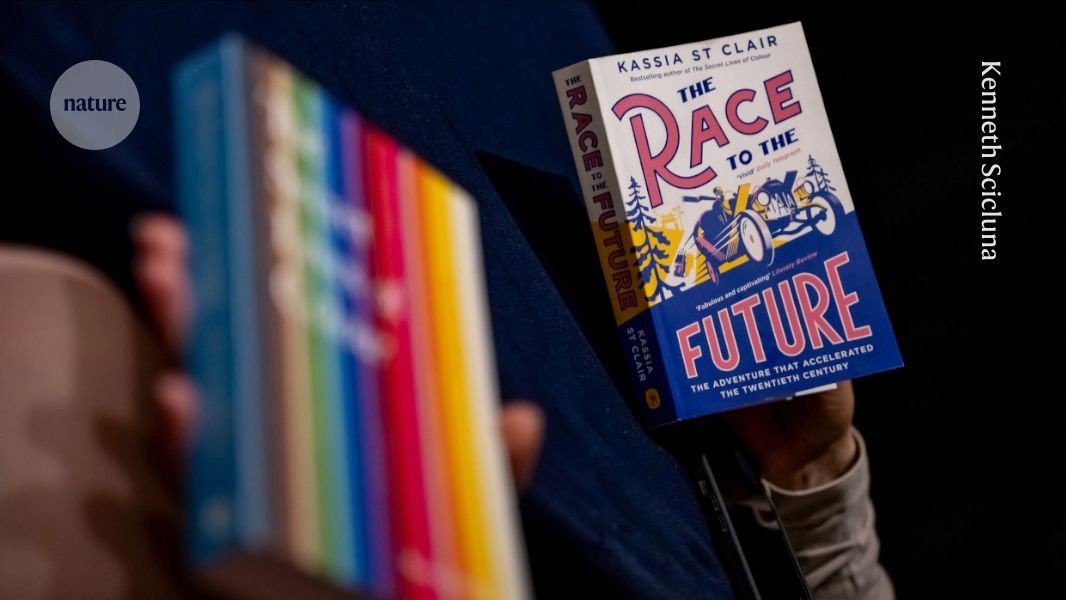
Following the advice of popular-science authors might help you to explain your research more effectively in interviews.Credit: Kenneth Scicluna
The theoretical physicist Richard Feynman was renowned for his ability to explain complex concepts to a non-expert audience. He was at times, however, less adept when communicating with writers, as the science historian Robert Crease found out when he interviewed the Nobel laureate in the mid-1980s. Feynman, apparently offended by Crease’s “dumb” questioning, stormed out of the room and down the hallways of the California Institute of Technology in Pasadena, shouting “you’re trying to make something difficult and complicated out of something that’s simple and beautiful!”
Thankfully, most interactions between scientists and writers are much more convivial, according to those who regularly interview researchers for books or articles. However, Crease’s experience illustrates how the priorities of a science writer, who is looking to tell an engaging story, can clash with a scientist’s allegiance to undiluted truth. There is also a knowledge gap to navigate — especially if the interviewer does not have a background in science. This requires the researcher to explain their work in terms that are accurate but comprehensible, and to have patience if they’re not immediately understood.
To learn about some of the challenges, insights and dynamics that arise during science-writing interviews, Nature’s Careers team spoke to five authors of popular-science books. They share their thoughts on speaking to researchers, explain how scientists differ from other experts and offer advice on how to be a valuable interviewee.
KASSIA ST CLAIR: Answer follow-up questions
Author of The Secret Lives of Colour, The Golden Thread: How Fabric Changed History and The Race to the Future: The Adventure that Accelerated the Twentieth Century.
I’ve been lucky enough to interview scientists in various fields during my writing career and I consider it a real perk of my job. For The Secret Lives of Colour, I spoke to researchers who were developing new pigments, for The Golden Thread, I talked to arachnid experts and for The Race to the Future, I asked scientists about how disease spread through cities in the nineteenth century.
Don’t talk science, play science: translate your data into music to improve its reach
First and foremost, a good interviewee is passionate about their work and wants to communicate it to a wider audience. Then, I think it helps if the scientist can imagine that they’re explaining their work to a stranger at a wedding; in other words, understanding that the person they’re speaking to is interested but not a fellow expert. This requires them to be patient and use reasonably simple terms. Be mindful of appearing patronizing, although I’ve never been patronized by any scientist, unlike some of the artists who I’ve interviewed.
It’s always helpful if researchers are able to answer follow-up questions after our interview, just so I can make sure that I’ve got the right facts and any specific terminology correct. However, I always make it clear that I’m independent and so, ultimately, I have the final say. It’s about mutual respect: I wouldn’t try to tell them how to do their research and they shouldn’t expect to dictate how I convey meaning to readers.
It’s important to remember that you’re both working towards the same thing: reflecting the scientist and their research in a way that is accurate and informative, but that is also going to appeal to as many people as possible. That might mean not giving the most finely grained description or explanation, which, frankly, might end up being dry. For the audience that I’m trying to reach, it’s crucial that what I write is readable, entertaining and gripping.
JAMES NESTOR: Keep it simple
Author of Breath: The New Science of a Lost Art and Deep: Freediving, Renegade Science and What the Ocean Tells Us About Ourselves.
James Nestor advises researchers against using complex language to describe their work.Credit: Photo by Mark Mahaney
I begin the research process by talking to leaders in the field. I’ll pick three or four experts from opposite ends of a spectrum and ask them the same general questions. For example, when I was writing Breath, I interviewed several doctors who argued that simple breathing exercises could significantly reduce and sometimes completely resolve asthma symptoms, whereas others assured me that how we breathed didn’t matter. The truth was in the middle; it almost always is.
When two years of academic work vanished with a single click
I consider myself a translator more than a writer. I translate multisyllabic jargon into English. I’ve found that researchers will often try to demonstrate their expertise by using unnecessarily complex words when they could be stating things much more simply. So my main advice to interviewees is to keep it clear and simple. Scientists can benefit from it, too, because if they can’t concisely explain what they’re working on and how it might affect other people’s lives, then I don’t think they truly understand it.
I also want scientists to help me understand where the knowledge gaps in a subject are, so I appreciate it when they admit they aren’t sure of something. Saying “we haven’t done enough research” or “that’s a point that we’re going to pursue in the next few years” isn’t a weakness, it’s a way of building trust with the interviewer and the general audience. You already know enough, which is why you were sought out to be interviewed. Be honest with yourself and your audience, and you’ll appear wiser than your words.
HELEN GORDON: In-person meetings are gold
Author of The Meteorites: Encounters with Outer Space and Deep Time and Notes from Deep Time: A Journey Through Our Past and Future Worlds.
Helen Gordon has written about deep time.Credit: Jonathan D. Paul
I try to create scientists as characters on the page, almost like a novel, which I find much easier when I interview someone in person, rather than online. I want to see the researcher, but I also want to see where they work. And that’s not only if they’ve got a fancy laboratory — their office can also be really interesting. What books do they have? Is it tidy? Is it messy? I’m always fascinated by details of the process, the nuts and bolts.
For my book The Meteorites, I visited a scientist who spoke about how beautiful it was to look at rust through a scanning electron microscope and how she could get lost staring at it. That experience made her more compelling to write about because it was, for me, an unexpectedly aesthetic, almost dreamy response, which I wouldn’t typically associate with scientists. It was a personal detail, too, and something specific rather than generic, so it helped me think about the person behind the scientist, as well as the research.
It’s great if interviewees are prepared to share a little bit of their personal world. Not necessarily their personal life, but their feelings or memories. Stories are particularly helpful for my sort of writing. So, why you became a scientist or why you were interested in your particular field. You don’t have to have an elaborate origin story, any little insights can be fascinating.
Scientists aren’t always aware just how interesting non-scientists will find their work, as well as their day-to-day experience. It can be easy to underestimate how mysterious — in a positive way — the world of research can seem to people who last did science at school.
The interviews that I’ve found most difficult are those that have felt rigid, in which people feel as if they’re sticking to a script, or they’ve got their talking points and they don’t really want to go beyond that. I end up thinking, “Well, I probably could have got that material from just reading.”
DANIEL LEVITIN: Stay in your lane and use analogies
Cognitive psychologist at McGill University in Montreal, Canada, and author of This is Your Brain on Music: The Science of a Human Obsession and I Heard There Was A Secret Chord: Music as Medicine.
