

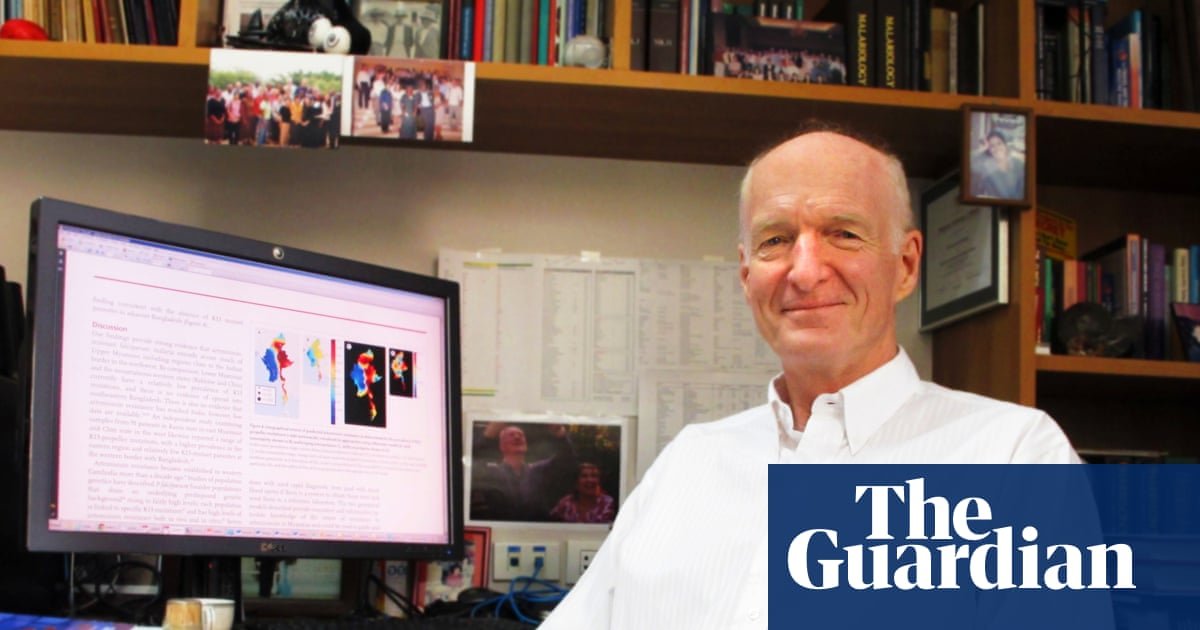
The idea that a traditional Chinese herbal treatment could be the answer to drug-resistant malaria was tough to swallow for many policymakers in global health. With a combination of dogged persistence, commitment to communities in affected countries and impeccable research design, Nick White changed their minds.
He led a campaign to make antimalarial drug combinations containing artemisinin, extracted in China from a common plant, the globally recommended treatment for the most common form of malaria. Millions of lives have been saved as a result.
White, who has died aged 74, embodied an approach to research that entailed a deep personal engagement with the health needs of patients in tropical countries, making Thailand his home for most of his adult life and speaking the language fluently. He trained and mentored numerous doctors and researchers in malaria-endemic countries, many of whom have become leaders themselves.
Yet he was also indefatigable in his advocacy for those without a voice, sitting on high profile advisory committees and putting pressure on governments and the World Health Organization to eliminate poor practice.
Malaria is caused by Plasmodium parasites, transmitted by mosquito bites. Three-quarters of those it kills are children under the age of five, mostly in Africa. By the mid-1970s, parasites were developing resistance to the available drug treatments. Testing traditional remedies for alternatives, Chinese scientists successfully extracted artemisinin from sweet wormwood (Artemisia annua) and found evidence that it could inhibit malaria parasites.
White first learned about this work soon after he arrived at the newly established Mahidol-Oxford Research Unit (MORU) in Bangkok in 1980. He immediately went to China and came back with a sample to test. Over the next two decades he led studies of artemisinin and its semi-synthetic version artesunate, often in challenging locations such as camps for displaced people on the Thai-Myanmar border.
As MORU’s director from 1986, White developed a network of research units in Thailand, Laos, Cambodia, Vietnam and Myanmar, and collaborative research sites across Asia and Africa. His aims were humanitarian as much as scientific. Local partnerships working with the MORU researchers set up free clinics for mothers, and so gained the trust of the community to participate in clinical trials on pregnant women, babies and children.
Nick White at the Shoklo refugee camp on the Thailand-Myanmar border in 1985. Photograph: Jack Dunford
The work of the network encompassed a wide range of other tropical diseases, as well as social and behavioural topics such as the trade in falsified and substandard medicines that promotes drug resistance.
Artemisinin was fast acting and effective, but its effects could wear off quickly. “Nick’s insight was then to add a longer-acting drug, which lasts weeks or even months,” said Nick Day, who succeeded White as director of MORU in 2003. Early trials with these artemisinin combination therapies in Asia in the 90s found that they cured 98% of uncomplicated cases, reduced rates of infection and were safer than the alternatives. But White was frustrated by how long it took to gain official endorsement. “He had a can-do attitude, and really hated bureaucracy,” said Day. WHO finally recommended their use in 2006.
White and his colleagues subsequently proved that injected artesunate could reduce the death rate of children with severe malaria by between a third and a quarter compared with quinine, and in 2010 WHO updated its guidelines accordingly. After health ministries around the world adopted the new guidelines, aided by international donors such as the Global Fund to Fight Aids, Tuberculosis and Malaria, malaria deaths peaked around the year 2000 and fell by more than a third by 2015.
The 2006 WHO guidelines included the optimistic statement that the new therapies “are unlikely to be affected by resistance in the near future”. Sadly that assessment was premature. As early as 2009, MORU’s network of researchers spotted that malaria parasites on the Thai-Cambodian border had already evolved to resist combination therapies.
White was instrumental in setting up the Worldwide Antimalarial Resistance Network that year, serving as its first chair (2009-16). WWARN has since documented the further spread of resistance throughout Asia and into Africa, and death rates are on the rise again. At the time of White’s death he was working on trials of triple combinations, artemisinin plus two other drugs.
“He would have really good ideas all the time of how to improve things,” says Day. Riding pillion on Day’s motorbike in Ho Chi Minh City, Vietnam, in the early 90s, “the whole journey from the hospital to our house, he would just be spouting ideas for things to do. And he was also really funny.”
White acted as MORU’s in-house cartoonist, creating their Christmas cards, and, according to his daughter Rebecca, “he relished opportunities to carry off an April Fools’ prank”.
Born in London, Nick was the eldest of three children of John White, an RAF armament officer, and his wife Eileen (nee Millard), who worked in the joint intelligence bureau at the Air Ministry during the second world war. He underwent surgery for pyloric stenosis at four days old and remained in delicate health for a few years. Once he became stronger the family moved with his father’s postings to places including Malta and Anglesey, in north Wales.
When Nick was nine they moved to Singapore, and he became fascinated by the tropical plants he encountered on walks in the jungles of Malaya (now Malaysia). To his resentment he was sent back to the UK to board at St John’s college in Southsea, Hampshire, run by the De La Salle Brothers, returning to Singapore only for the summer holidays. Though not a churchgoer in adult life, he continued to see himself as Catholic, while also absorbing Buddhist influences from his Thai environment.
White trained in medicine at Guy’s hospital medical school, qualifying in 1974 with the gold medal for the University of London’s top-performing medical student. Influenced by his childhood experiences in the tropics, in 1980 he joined the research team at MORU, a Wellcome Trust-funded partnership between Mahidol University in Bangkok and Oxford University’s Centre for Tropical Medicine and Global Health. Director of its research programme from 1986 to 2002, he became chairman of Wellcome’s Southeast Asian Tropical Medicine Research Programmes from 2001.
Concurrently he held chairs in tropical medicine at Mahidol University (from 1995) and Oxford University (from 1996), where he returned from Thailand for a month each year to serve as a consultant in general medicine. He was in Oxford undergoing treatment for cancer at the time of his death.
In his few leisure hours he was a keen sports fan and sportsman, playing squash and cricket at clubs in Bangkok. He loved blues music and played both electric and acoustic guitars.
He and his wife Jitda, known as Joom, an artist whom he married in 1997, were passionate about wildlife conservation, and turned the garden of their cottage near Oxford into a nature reserve.
Wild birds that they had rescued as fledglings had the run of their houses in both Oxford and Bangkok, and he bought tracts of woodland in Thailand and the UK to preserve them from development.
White was appointed OBE in 1999 and knighted in 2017, and won many other honours including the Gairdner global health award in 2010 and Thailand’s Prince Mahidol award in 2011. His modesty was such that you would find no record of any of these on his institutional web pages.
White is survived by Joom and their daughter Jitrachote, known as Mod, by his daughters Rebecca and Harriet from his previous marriage to Maren Lonergan, a nurse, which ended in divorce, and by his grandchildren Rose, Jesse, Aaran, Ida and Jinta.
Nicholas John White, consultant physician and infectious disease researcher, born 13 March 1951; died 1 February 2026
