

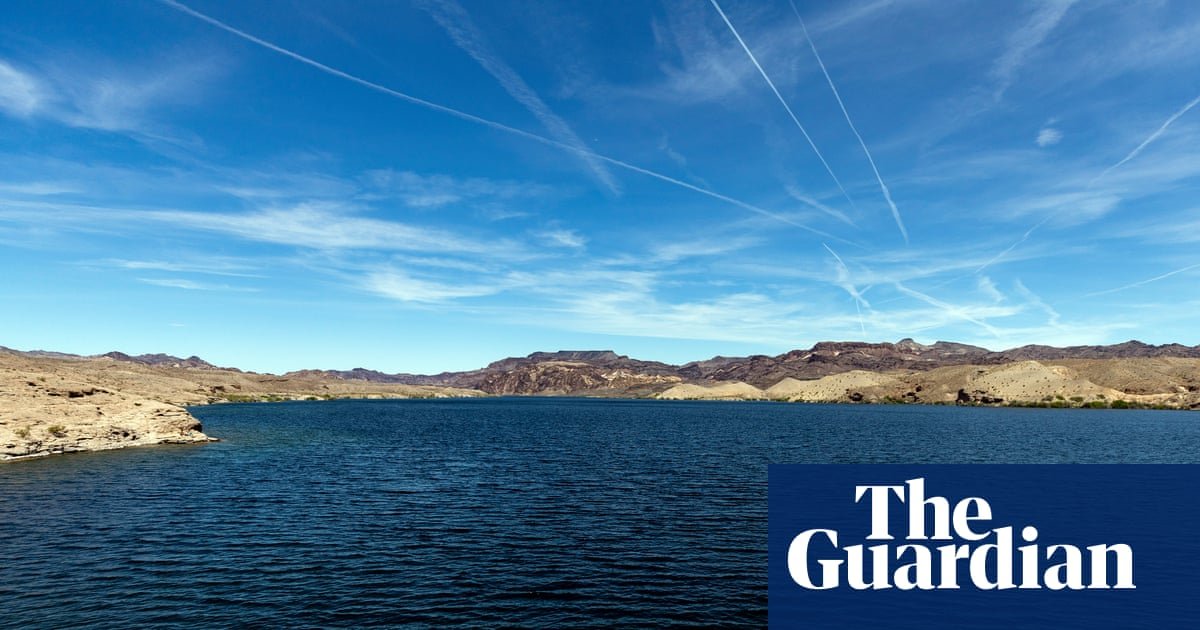
The future of the American west hangs in balance this week, as seven states remained at a stalemate over who should bear the brunt of the enormous water cuts needed to pull the imperiled Colorado River back from the brink. Time is running short to reach a deal before a critical deadline, set for Saturday.
In the region where water has long been the source of survival and conflict, the challenges hindering consensus are as steep as the stakes are high.
Snaking across 1,450 miles (2,300km) from the Rocky Mountains into Mexico, the Colorado supplies roughly 40 million people in seven states, 5.5m acres (2.23m hectares) of farmland and dozens of tribes. The waters fuel an estimated $1.4tn in economic activity, and raised bustling cities, including Los Angeles, Phoenix and Las Vegas. The sprawling basin is also home to diverse ecosystems, with scores of birds, fish, plants and animals, and provides critical habitat for more than 150 threatened or endangered species.
The river has also been overdrawn for more than a century. As demand continues to grow, rising temperatures and lower precipitation caused by the climate crisis are taking an increasingly larger share of declining supplies, a trend only expected to worsen as the world warms.
Up to 4m acre-feet of cuts are needed to bring the basin back into balance – an amount equal to more than a quarter of its annual average flow. One acre-foot, a unit denoting the amount of water that can cover a football field one foot deep, is equal to roughly 326,000 gallons – enough to supply roughly three families for a year.
A record snow drought plaguing the region this year is expected to reduce water supplies further, adding another layer of urgency to the talks.
“There needs to be unbelievably harsh, unprecedented cuts” that will affect water users in major ways, said Dr Brad Udall, senior water and climate research scientist at Colorado State University’s Colorado Water Center. “Mother nature is not going to bail us out.”
Colorado, Utah, Wyoming and New Mexico, which form the upper-basin states – have resisted any cutbacks to their share, insisting lower-basin states – California, Arizona and Nevada – are responsible for creating the deficit. Because they are situated closer to the headwaters, their supply doesn’t come from the reservoirs that the lower basins draw from.
The lower basin has balked at the idea. They have already agreed to take substantial cuts and are demanding their neighbors to the north share the burden. While disagreements range across a series of issues, this is a major sticking point.
After blowing through a deadline last November, experts believe even given months more, negotiators will again come up short.
Boaters seen in Lake Powell, one of two critical reservoirs along the Colorado river. US states are facing a deadline to decide how to divide the river’s water between them. Photograph: Rebecca Noble/Reuters
If they can’t agree on a path forward, the federal government has threatened to issue its own plan, one likely to deeply slash the lower-basin states’ shares. Four draft proposals released for public comment in January include severe reductions of lower states’ supply.
Any of the federal options on the table would almost certainly result in lawsuits and complex court battles, an outcome everyone would like to avoid.
Still, the basin needs a plan – and one that goes far beyond the complex matrix of laws and agreements expiring this year that have been unable to keep pace with the rapidly widening gap between supply and demand.
“Everyone agrees we have to use less water, the problem is states look at each other and say you should use less,” said Dr Jack Schmidt, the director of the Center for Colorado River Studies at Utah State University.
The negotiations have been like the final scene in Thelma and Louise, he added. “Seven people have their hands on the steering wheel driving toward the edge of a cliff – and no one is working the brakes.”
‘A system that fails us when we need it most’
Along with supplying vast water needs across the west, arguments have centered on how much should be released to protect critical reservoirs, Lake Powell and Lake Mead. Storage in these reservoirs has fallen to historic lows and experts have warned that just a couple of dry years could put them at critical levels.
If they fell far enough, the system would cease to function all together. So-called “deadpool” – when water isn’t high enough to pass through the dams and be distributed downriver – would be catastrophic.
Seven people have their hands on the steering wheel driving toward the edge of a cliff – no one is working the brakesJack Schmidt, director of the Center for Colorado River Studies
Schmidt said the federal government would intervene long before deadpool. But if desperately dry conditions like those expected this year fail to improve, then even the Bureau of Reclamation’s proposals might not be able to stabilize the system, according to the environmental analysis released with the alternatives in January.
“That’s pretty damn scary,” Schmidt said. Water managers may have to make urgent decisions in the coming months, even if agreements aren’t in place and the problems could get more complicated still.
“We know temperatures are going up – and going up quite rapidly,” Udall said. Hotter environments mean faster evaporation. It shifts the timing of snowmelt and runoff, produces drier soils, and thirsty plants soak up more water. Flows in the Colorado are down 20% over the last century and precipitation has shrunk by about 7%.
“The chickens are coming home to roost,” he said. “Climate models have underestimated how much warming we are going to get, and humans are not stepping up.”
A formerly sunken boat sits high and dry along the shoreline of Lake Mead. Photograph: John Locher/AP
Shortages could lead to dramatic changes in how water is distributed in the future. More than 70% of water is used by agriculture – which includes thirsty crops like alfalfa and hay that are used to feed cattle and the bulk of the winter lettuce and leafy greens grown in the US. The irrigation systems were set up long before suburbs began to sprawl across the deserts, and frameworks that govern the river dictate that that’s why they get their shares first.
“But you can’t fallow cities,” Udall said. While municipalities need to do more to conserve, “it’s the farmers that will hurt – that’s just super clear,” he added. “We have created a system that was supposed to provide certainty that fails us when we need it most.”
‘We are facing a system crash’
There’s still hope that negotiators may pull out a smaller, short-term deal that would provide incremental steps that buy more time for the big issues. Rather than a multi-decade plan, there could be something that covers just the next few years.
After watching years of small steps taken when tensions ran high, Udall has lost confidence that the states will be able to fall back on the short-term solutions this time.
“Maybe in a normal winter you could impose less drastic solutions, but given the snow drought we have right now and the state of the reservoirs, the federal government is going to have to impose a solution,” Udall said. “I would bet you dollars to donuts that the lawsuits are going to fly.”
Rhett Larson, a professor of water law at Arizona State University, agreed that there’s a good chance this will end in the courts.
Larson also serves as council for the Arizona Municipal Water Users Association, representing 10 of the large central Arizona cities. They face enormous cuts under the federal proposals, plans he said have “fatal flaws”.
Without a deal, it’s likely Arizona will sue, and they will likely be joined by California and Nevada. But the lawsuits might not end there.
If dry conditions push river flows low enough that lower-basin states don’t receive their share secured in the original compact over a century ago, another lawsuit could be filed against the upper-basin states themselves. Legal disputes would center on whether the upper basin can be held responsible for losses in supply due to climate change. An interstate water law conflict like this would go straight to the US supreme court.
While the legal battles unfold, “somebody has still got to manage an ever dwindling river”, Larson said.
A field of spinach is irrigated with Colorado River water in California. More than 70% of water from the river is used by agriculture. Photograph: Caitlin Ochs/Reuters
Dr John Berggren, regional policy manager at Western Resource Advocates, agrees. Litigation, he said, would ultimately be a failure for the river leaving little room to manage the challenges of a highly complicated system.
“It kind of freezes everything – and environmental values are one of the first things to go,” he said. “They’ll protect the reservoirs as best they can, but they’re probably not going to be able to consider environmental flows and things that actually benefit the river itself.”
Berggren added that the waterway needs flexibility, especially during dry years. Emergency actions – especially those governed by courts and not experts – can’t take account of things like timing and temperature, that are so vital to protecting the river’s ecosystems.
“It’s not just a pipeline,” he said, “it’s a living river.”
We are facing a system crash. The river is not going to wait for process or politicsMatt Rice, regional director American Rivers
The ecosystems on the banks of the river have already paid a heavy price. Fourteen native fish species are endangered or threatened. The once-lush wetlands in Mexico’s river delta have been dry for decades and the once mighty river slows to just a trickle as it crosses over the US-Mexico border. “That’s an ecosystem that is lost,” Schmidt said, “and no one is talking about returning it to its former glory.”
Matt Rice, the southwest regional director for the conservation organization American Rivers, said that’s why he’s clinging to hope that something will come out of the negotiations, even if it’s not comprehensive.
Rice has seen year after year of crisis management play out on the river, and lessons continue to go unlearned.
“The positive thing is we know what to do,” he added. Conservation efforts across the Colorado River basin have been successful. Cities in the region have reduced water-use by 18% over the last two decades, even as some saw their populations grow. Farmers have adopted more efficient irrigation systems, infrastructure can be updated for better efficiency and conservationists are working to restore watersheds.
But these fixes have not gone far enough – not by a long shot. Rice said there needs to be a new approach, framed not as an emergency cut that goes from crisis to crisis, but as adaptation to an arid future.
For that, the deadline isn’t coming from the federal government, it’s being imposed by the waterway itself.
“We are facing a system crash,” he said. “The river is not going to wait for process or politics.”
