

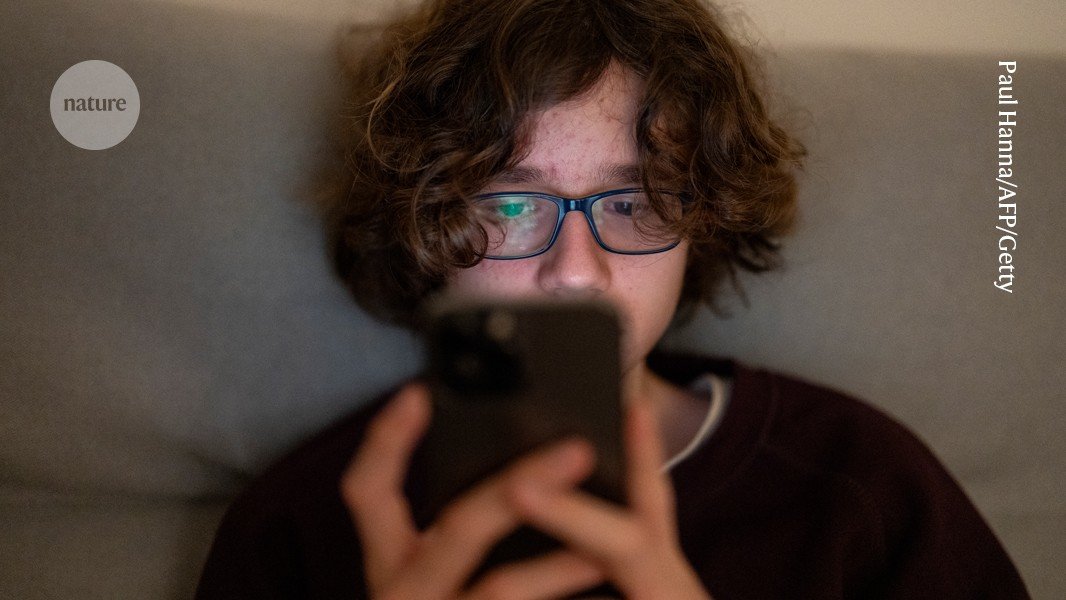
Science has not yet settled whether an all-consuming social-media habit qualifies as a true addiction. Credit: Paul Hanna/AFP/Getty
Is social media addictive to young people? A jury in California is being asked to decide — even though the question still divides researchers.
Opening arguments began this week in a landmark case, among the first in a tsunami of lawsuits over possible harm to children and adolescents caused by social media, video games and artificial intelligence. In the current case, a young woman alleges that she became addicted to social-media platforms as a child, causing the anxiety, depression, and body dysmorphia that she lives with today.
The great rewiring: is social media really behind an epidemic of teenage mental illness?
The jury will grapple with two main questions, says Eric Goldman, who studies Internet law at the Santa Clara University School of Law in California: is there such a thing as social-media addiction, and are social-media services legally responsible for harms suffered as a result? “To answer those, the parties are going to have a battle of the experts,” Goldman says. “You’re going to see a lot of back and forth on science.”
In fact, scientists have yet to reach a consensus as to whether ‘addiction’ is the right term to describe heavy, compulsive use of social-media platforms. “A lot of people will say immediately that you’re not allowed to use ‘addiction’,” says Brian Primack, a public-health researcher at Oregon State University in Corvallis. “Other people are perfectly fine with it.”
Digital natives
One reason for the hesitation is that social-media addiction has not yet been added to the standard psychiatric diagnostic manuals used by the field. Clinical definitions of addiction often include excessive and compulsive use, symptoms of withdrawal when use is discontinued and continued use despite harm and other negative consequences to everyday life. Data on social-media use are mounting, but the field has yet to reach a consensus as to whether the threshold for addiction has been met, says Dar Meshi at Michigan State University in East Lansing, who studies the psychology of technology use.
“Is it really a disorder, or just a really strong, ingrained habitual behaviour?” he says. “I’m not saying social-media addiction doesn’t exist, but it’s a little bit too early to say conclusively.” As an alternative, researchers often default to phrases such as “problematic social-media use”.
A variety of studies have found that mental-health conditions such as depression and anxiety have increased in young people alongside their growing use of social media, but few of these studies were designed to determine whether social media is the cause1. This will probably be a prominent debate in the California lawsuit, says Goldman. “We’re going to have a correlation versus causation battle,” he says.
Quality time
Another complication is how social-media use is evaluated: many studies look only at total amount of time spent on the platforms. This could obscure the varying effects of different activities, some of which could be harmful and others of which could be beneficial to mental health, says Meshi.
In 2024, a committee assembled by the US National Academies of Sciences, Engineering, and Medicine said that its review of the scientific literature did not support the conclusion that social media affects adolescent health at the population level1.
Turning off my phone improved my science
But it also noted that there is the potential for harm. And although debates continue as to social media’s effects on adolescent health at the population level, studies have already shown that excessive use of social medial can be harmful to some individuals, says Tamar Mendelson at Johns Hopkins Bloomberg School of Public Health in Baltimore, Maryland, who studies adolescent mental health.
