

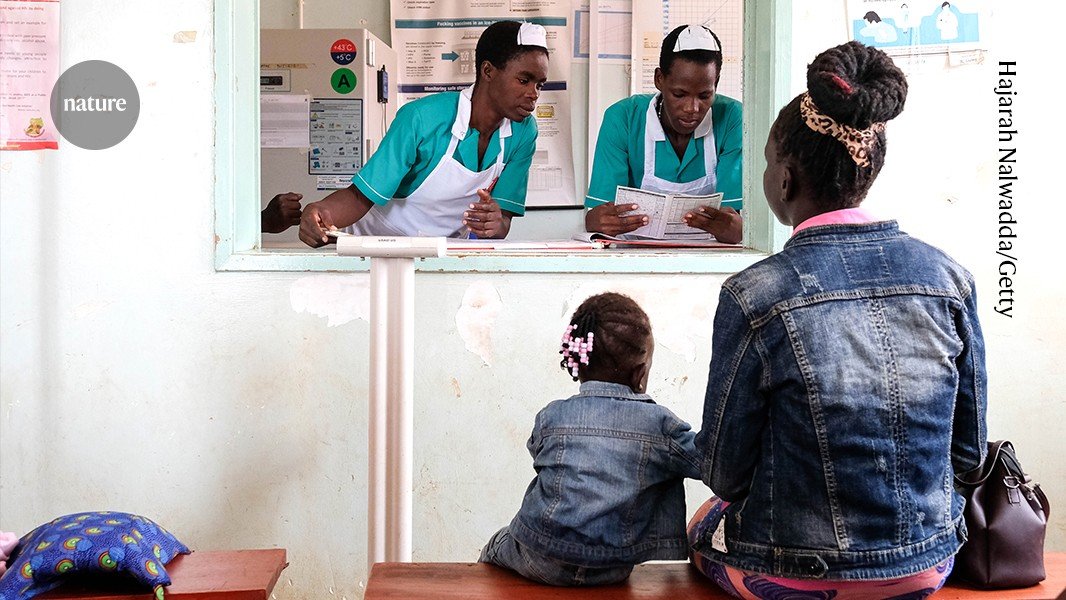
Universal health care must be a priority for African nations.Credit: Hajarah Nalwadda/Getty
One Plan, One Budget, One Report.
There is little doubt that this is what African countries need if they are serious about universal health coverage — ensuring that every member of their populations has access to this fundamental human right. But such an approach has never been implemented in Africa. Some of the reasons for this are outlined in a report on health financing by the Africa Centres for Disease Control and Prevention (Africa CDC), the continent’s public-health agency based in Addis Ababa, published last week (see go.nature.com/3o9wxfc).
But if ever there was a time to put the idea into practice, this is it. Africa faces a seismic challenge: finding a way to protect public health when financial assistance for health care from Europe and the United States has halved. In 2021, it amounted to US$26 billion; last year, the figure was $13 billion. What might happen going forwards remains unclear. Initial estimates suggest that the cuts will increase the death toll from preventable diseases such as malaria, HIV/AIDS and tuberculosis by millions (D. M. Cavalcanti et al. Lancet 406, 283–294; 2025).
Guinea-Bissau suspends US-funded vaccine trial as African scientists question its motives
The one plan, one budget, one report (OPBR) approach is not new. In this instance, it encapsulates the idea that African countries must be able to control their nations’ health-care policies. It means forging a single plan, to be owned and funded by the nations themselves. It means building capacity from the ground up, with more emphasis on nations’ needs, less on the (often competing) priorities of donors, and with centralized accountability for delivery. Considering the burden of preventable infectious diseases in many parts of Africa, a policy for immunization is a top priority (see go.nature.com/4rmcirr).
The call must now be heeded, by the continent’s leaders and by all those in and outside Africa who work in or support health and science on the continent. They face a daunting task. It will require a step-change in public spending on health care, and ways must be found to fund the sector that do not involve burdening households with greater taxation. A wholly new approach is also needed for relationships with donors, replacing what Africa CDC describes as “asymmetric power”.
The scale of the challenge is evident in the numbers: just 35% of African health-care expenditure is funded by the governments themselves. Almost one-quarter of funding comes from donor countries elsewhere in the world. Most of the remainder is described as “out-of-pocket spending”. This is health-policy jargon to describe personal spending on health, which often means individuals having to sell assets, go without essentials or take on debt just to be able to see a doctor or access treatment.
Last August, African leaders met in Accra and pledged to increase health-care spending. In April, they will meet on the sidelines of the World Health Summit in Nairobi to discuss how to achieve this in concrete terms.
African countries are increasing national health-care budgets, but the rate of change so far will do little to compensate for what has been, and is being, lost. A notable concern is that the cost of covering the required increase should not fall disproportionately on the poorest people. As the Africa CDC report shows, health-care spending can be increased in innovative ways, without unfairly burdening vulnerable groups or requiring an overhaul of the machinery of government.
The World Health Organization (WHO), for example, last year launched a campaign to raise $1 trillion over ten years, which it says can come from raising taxes on alcohol, tobacco and sugary drinks — known as sin taxes. Such taxes “cut the consumption of harmful products and create revenue governments can reinvest in health care, education, and social protection”, Jeremy Farrar, an assistant director-general for the WHO, said at the launch.
Africa CDC is also right to highlight the necessity of developing a new kind of partnership with international donors. African countries struggle to assert ownership over public-health policy because of the need to satisfy the individual requirements of the many donors involved in health care on the continent, each demanding compliance with the wishes of a government or philanthropist. It is also common for a substantial amount of aid funding to be spent in the donor’s own country. According to the US Agency for International Development, in 2024 just 12% of its funding was given directly to organizations in recipient countries (see go.nature.com/4a9viw3). And only around 35% of activities were classified as being fully “locally led”.
The US government also insists that aid spending aligns with the priorities of its administration, regardless of the impact on countries receiving that aid. In Kenya, for example, the United States has offered aid in exchange for access to the country’s health data, an arrangement that Kenya’s courts suspended in December. And in Guinea-Bissau, it is funding a controversial clinical trial into a hepatitis B vaccine that has been suspended pending an ethics review.
If the OPBR is to succeed, African countries and their supporters must continue to push back when donor policies risk causing harm. Global solidarity will also be essential. Almost a quarter of a century ago, African countries established a development aid organization in partnership with high-income countries. This was called NEPAD, an acronym for New Partnership for Africa’s Development. It was supposed to be a model for a new way of working together, development that would be “African owned”. A genuine partnership of equals did not materialize, but it is not too late to forge one, or for Africa to build a system to provide accessible health care for all.
