

Two yellowing street lamps cast a pool of light on the dark road winding into the woods outside Mazée village. This scene is typical for narrow countryside roads in Wallonia in the south of Belgium. “Having lights here is logical,” says André Detournay, 77, who has lived in the village for four decades. “I walk here with my dog and it makes me feel safe and gives me some protection from theft.”
Belgium glows like a Christmas decoration at night, as witnessed from space. It is one of the most light-polluted countries in Europe, with the Milky Way scarcely visible except in the most remote areas.
But in the coming months, these lamps outside Mazée in the municipality of Viroinval will be turned off permanently as part of a radical project to remove 75 pointless streetlights in this area of Wallonia.
Jacques Monty dismantles a street lamp. He says his job until now has always been about maintaining lighting. Photograph: Christophe Smets/The Guardian
Across Europe, unnecessary lighting is being extinguished, and a key motivation is to protect nature. Over the past decade an increasing amount of research has shown that illuminating night skies is bad for a wide range of species, including insects, birds and amphibians – disrupting their feeding, reproduction and navigation.
André Detournay says he would need to see evidence of significantly increased biodiversity to support the project. Photograph: Christophe Smets/The Guardian
Detournay is not happy. “I am for frogs. I dug two ponds for them,” he says. “But near a village, we need lights. You would have to prove it significantly increased biodiversity here to persuade me otherwise.”
The idea for the project was born in 2021. A Wallonia public administrator estimated that 6% of the 8,000 streetlights in the Entre-Sambre-et-Meuse national park – a protected landscape of forests, rivers and wetlands near the French border – were pointless, meaning they were more than 50 metres from the nearest building (often on roads between villages where few people walk) and less than 50 metres from a Natura 2000 site, areas judged to be of the highest value to nature.
The national park has allocated €308,000 to restore night-time darkness, treating it as beneficial for nature in the same way as restoring a pond or a woodland. Between now and August, dozens of streetlights are being removed by the municipality’s electricity grid operators.
“We cannot say to an old lady we want to prioritise bats over you,” says Nicolas Goethals, who is leading the project, emphasising that ensuring people’s safety is critical.
Two streetlights in Mazée will soon be dismantled. Photograph: Christophe Smets/The Guardian
Some people, however, are still not convinced. Jacques Monty from the Viroinval municipality is up an eight-metre pole in a cherrypicker detangling electrics and metal to remove a light near the village of Nismes, where nearby limestone caves are a bat hotspot. Monty has worked for the municipality for 35 years, and during that time his job has always been about maintaining lighting. “It could be good, but we need to make sure it doesn’t compromise the safety of people – that is my priority,” he says.
The public debate on streetlights is simple – they make people safer, and this is the main objection for people living in Wallonia. But research paints a messier picture.
Although lighting increases people’s feeling of safety and willingness to walk in public spaces at night, it does not always mean they are actually safer. One study into the effects of reduced street lighting in England and Wales found that it was not associated with significant changes in crime or with the number of road collisions. Other reviews have found inconclusive evidence that lighting reduces crime, and indeed data on it reducing road collisions also paints a mixed picture.
“Seventy-five [streetlights] might not seem like much but you have to start somewhere,” says Goethals, who has organised local talks and night walks and sent out letters to convert people to the merits of the project. “It’s not right that lights are on all night long for everybody and not used. The normal should be darkness. It’s night-time!” he says. People should illuminate themselves with vests and torches if they want to walk on rural roads, he says.
Old electricity pylons are being retrofitted to support the return of white storks. Photograph: Olivier Colinet
Findings of the negative effects of light pollution on nature, as well as human and plant health, are unequivocal. Experts argue that light pollution should be treated as a pressure on nature that is akin to habitat loss or chemical pollution. More than half of insects are active at night. In France, an estimated 2,000 billion insects are killed each year by public lighting, either dying from exhaustion or being eaten by predators.
This is a global problem. The invention of the electric lightbulb 150 years ago was one of the most transformative human inventions, but now 80% of people on the planet live under light-polluted skies.
Thousands of communes across France switch off public lighting in the middle of the night to save energy and reduce light pollution. At the EU level, there is guidance on creating dark corridors for wildlife and reducing artificial light at night. In the UK, campaign groups are raising awareness about the issue, and a number of cities in the US are looking to reduce sky glow. In April, Goethals is collaborating with colleagues in France to extend darkness infrastructure into other parts of Europe. “Here is just the start – real darkness infrastructure will come off the back of this,” he says.
Elsewhere in the park, another form of infrastructure gives an indication of what disused poles could be used for.
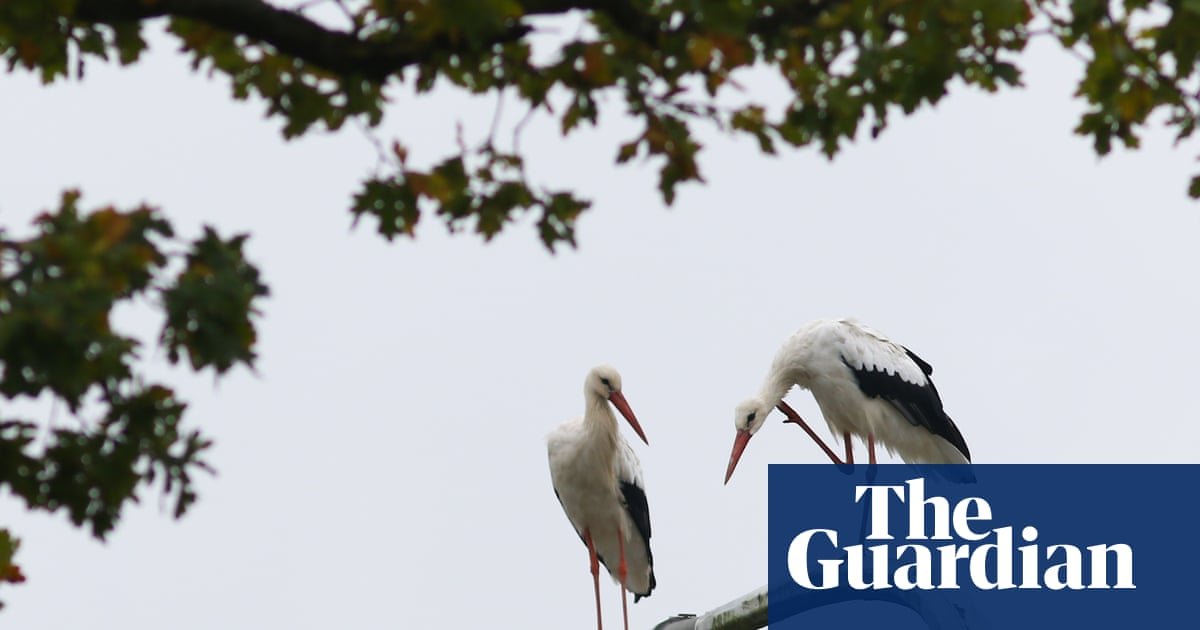
Old electricity pylons – which were once a threat to wildlife – are being retrofitted to support the comeback of white storks. Back in 2011, it was relatively rare to spot a white stork, but in 2025 there were nearly 800 recorded sightings in the national park, with numbers increasing year on year.
The pylon nesting spaces have helped grow the numbers of storks in the national park – there were nearly 800 sightings in 2025. Photograph: Erik de Brandt/Handout
These large white birds would naturally nest at the top of tall trees, but in a human-dominated landscape, an old pylon is a good alternative. Each metal stork nest costs €500 and the goal is to install 30 by this summer. Branches and fake droppings are added to each nest to make it look like it has got the thumbs up from a previous occupant. Unlike removing streetlights, this work is unanimously appreciated. “People love these birds. I’ve never spoken to someone who doesn’t like seeing them in their nests,” says Goethals.
Although this experiment rolling out on Belgium’s rural roads may be small, it is part of a bigger shift. For more than a century, humans have been seeking to light every corner of the night, but there is a growing movement to let it be dark again.
