

A man walked into Soleil Ramirez’s restaurant last month and started to ask strange questions: How many people do you have on staff? Why are you so small? “Stuff nobody asks,” she said.
The man then started talking loudly into his phone. “I’m here doing a dip in a restaurant. There’s not a lot of people here, so I don’t know if it’s worth coming,” Ramirez recalled him saying. The encounter left her unnerved.
Ramirez has owned and run Crasqui, a Venezuelan restaurant, in Saint Paul, Minnesota, since 2023. Though she never got confirmation – the man left once it became clear restaurant staff were concerned about his presence – she concluded he was likely a federal immigration officer in plainclothes.
“It’s terrifying. All my employees are legal. I’m 100% legal,” said Ramirez, a political refugee from Venezuela who moved to the US in 2016. “But that doesn’t mean anything any more.”
The Trump administration in December launched “Operation Metro Surge”, sending more than 2,700 federal agents to Minnesota, with a concentration on the Twin Cities of Minneapolis and Saint Paul, as part of its crackdown on immigrants.
The operation seeks to arrest and deport undocumented immigrants from the region, officials said. Both cities have become home to large immigrant communities over the last few decades, with considerable Somalian, Hispanic, Hmong, Laotian and Ethiopian enclaves across different neighborhoods.
Minneapolis residents say these communities are now under attack, pointing to sporadic and often brutal arrests by federal immigration officers, including those from Immigration and Customs Enforcement (ICE). The killings of Renee Nicole Good and Alex Pretti, who were protesting immigration enforcement, are just examples of how violent agents can be. Even those who are in the country legally don’t feel safe.
In Minneapolis and Saint Paul, small businesses have been on the frontlines. Immigration officers have proven themselves unafraid of arresting people even on the job, including US citizens who say they were racially profiled.
The Guardian spoke to several small business owners in the Twin Cities, some who are immigrants themselves, about how the surge has affected the local economy that sustains its immigrant communities.
Customs and Border Protection agents detain a man who did not provide documents proving he’s a US citizen while patrolling a neighborhood in Minneapolis. Photograph: Octavio Jones/AFP/Getty Images
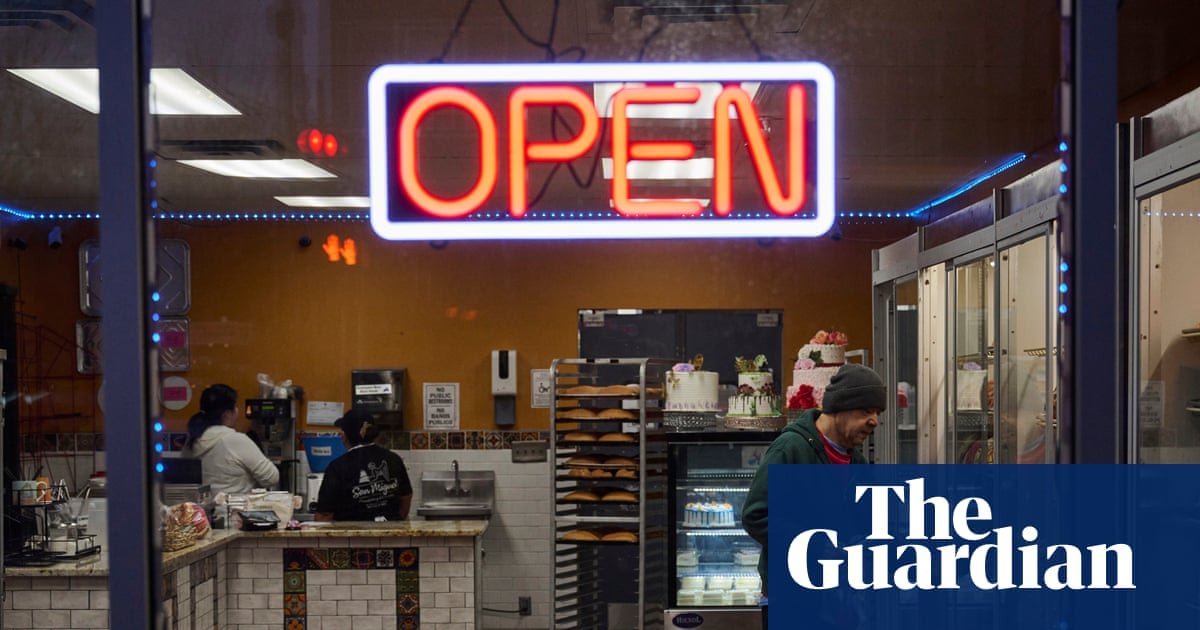
Bustling neighborhoods have turned into ghost towns. Some small businesses have temporarily closed with no signs of reopening. Businesses that stay open keep their doors locked, to prevent agents from entering without a warrant. Many restaurants are doing takeout only.
For some, it’s reminiscent of when the city was under lockdown due to Covid-19 restrictions. Ramirez said this is worse.
“In Covid, the federal government was helping with relief,” she said. Revenue at Crasqui is down 65%. “I have so many friends, they have closed their businesses. All of them,” she said. “I don’t even know how you can recover from that.”
Both customers and employees are afraid to leave their homes. They fear encountering federal agents, regardless of their immigration status.
Oscar Murcia, owner of El Guanaco Bakery y Cafe, which has three locations across the Twin Cities, said sales have halved since the surge. He temporarily closed his cafe on Minneapolis’s Lake Street, in a neighborhood full of Hispanic restaurants and businesses.
“We have seen how ICE has focused a lot on doing operations in that area. Most of the stores surrounding Lake Street have closed,” Murcia wrote in an email to the Guardian. “Right now, most of our customers are not leaving their houses because they are afraid, and that has impacted us severely.”
In a survey of more than 90 Latino-owned businesses in the Twin Cities area conducted by the Latino Economic Development Center, nearly a third said they were temporarily closed due to staff shortages or a drop in foot traffic.
For small business owners, even small drops in revenue can have cascading effects, like an inability to pay rent or vendors. Alma Flores, CEO of the Latino Economic Development Center, said there are deep concerns that many small businesses, especially those with immigrant owners, will not survive the coming months. Many face both existential business challenges and constant fear of encountering agents at work.
“Their presence is fear-inducing,” said Flores. “People don’t want to be near them because, if you have darker skin, you’re a target.”
Gustavo Romero opened his Mexican restaurant, Oro by Nixta, with his wife, Kate, to be a hub for Minneapolis’s Mexican community. A recent James Beard nomination has garnered enough attention to sustain business, but Romero said the last few weeks have taken a heavy toll.
“We work in an industry where a lot of labor is dependent on immigrants,” Romero said. “We are also a Mexican restaurant, and so it impacts the whole community, from the people that work with us to our clientele. We always look at our place like a cultural center. A lot of people come here because they can get a little feel of home.”
The possibility of racial profiling is a constant in Romero’s mind. It looms over many immigrant business owners.
“I’m Mexican and I have all my paperwork in order, but I don’t feel comfortable being out on the streets,” he said. “It doesn’t matter who you are. If you look like what they’re profiling, you’re going to get stopped and you’re going to get asked questions.”
Kate Romero and Gustavo Romero in the kitchen of Oro by Nixta in Minneapolis, Minnesota. Photograph: Bridget Bennett/The Guardian
One local grocery store owner, who wished to remain anonymous due to safety concerns, said he closed his store in East Saint Paul and now only does home deliveries after loyal customers stopped coming in. Though he is a naturalized citizen, “I feel the fear of going out and being arrested every day I go to work, and I think many people experience the same”, he wrote in an email to the Guardian.
The presence of immigration enforcement is felt across the city. Victoria Ford, owner of Comma bookstore, said she’s seen federal agents in the neighborhood, Linden Hills, which is among city’s the most affluent.
“We have, within a block, half a dozen restaurants and other shops. ICE has attempted to enter multiple of those shops and restaurants,” Ford said. “And we’re in a neighborhood that is seeing much less than neighborhoods that are home to more immigrant-owned businesses.”
Non-profits such as the Minnesota Foundation and Latino Economic Development Center have set up emergency relief funds for small businesses, but local business owners and their advocates say sustaining the Twin Cities’ small businesses will require help from the city and state.
“The onus should not be on the philanthropic community alone,” said Flores, of the Latino Economic Development Center. “And since we can’t rely on the federal government to assist, cities need to step up. They will lose their tax base. They will lose the vibrancy of their corridors and main streets.”
Entrepreneurship has been a keystone for immigrants coming to the US, she noted. For those who don’t speak English too well, opening a Main Street business – such as a restaurant, grocery store, gas station or nail salon – may be the best, and sometimes only, way to make a living.
Posters dedicated to Renee Nicole Good and Alex Pretti in Minneapolis, Minnesota. Photograph: Bridget Bennett/The Guardian
Small business owners say they don’t take this diversity for granted and they’re deeply worried about the damage “Operation Metro Surge” will ultimately have on the small businesses that have come to define the Twin Cities.
“It’s hard to think ‘Oh, the economy is important during this time,’ but at the same time, these are people’s livelihoods,” said Dylan Alverson, owner of the Post Modern Times cafe, a restaurant in south Minneapolis that he recently renamed to reflect the state of the city. “And we can’t have cities without immigrant restaurants.”
When Tammy Wong first opened her restaurant, Rainbow Chinese, on Nicollet Avenue in 1987, the Minneapolis neighborhood had few cuisine options. She and two of her siblings opened up businesses, two restaurants and a grocery store, on the same street shortly after moving to the US from Vietnam.
“We wanted nothing else than to make a living serving food to people. We were starting in this spot where the city didn’t have a lot of ethnic food,” Wong said. Soon, she said, “I just became more passionate about introducing food that people might not be familiar with.
“Over the years, it’s been beautiful to see it evolve, to be able to witness this part of the neighborhood get revitalized,” she said.
But in recent weeks, Wong has been losing sleep. Though business has been OK, she’s operating with a smaller staff. Her kids remind her to carry her ID when she’s out. “We’re living with fear,,” she said. “You kind of don’t know what is going to happen next.”
In a statement, the Department of Homeland Security denied that the surge in immigration enforcement is causing economic damage. “Let’s be clear, if there was any correlation between rampant illegal immigration and a good economy, [Joe] Biden would have had a booming economy,” a spokesperson claimed. “Removing these criminals from the streets makes communities safer for business owners and customers.”
Despite the fear and exhaustion, people in the Twin Cities say the surge in law enforcement has brought their communities together more than ever. Neighborhood groups station volunteers on street corners, and warn others when immigration officers are spotted, often with whistles. Mutual aid groups deliver food to those afraid to go out and help vulnerable parents drive their kids to school. Tens of thousands showed up to two massive protests against immigration enforcement in January.
A nearly empty Hmong Village, an indoor marketplace in Saint Paul, Minnesota. Photograph: Bridget Bennett/The Guardian
Wong’s restaurant is just a block away from where Pretti was killed by federal agents last month. Wong’s sister, who owns a restaurant across the street from her own, was setting up her store, My Huong, for lunch when Pretti was killed.
“She was about to open her store and ended up providing shelter for people who were teargassed,” Wong said. “I thought that was what the neighborhood does: treat everyone like an extended family when they need help.”
Alverson, of Post Modern Times, which is a few blocks north from where Good was killed in early January, recently made his restaurant completely free for patrons and is operating off of donations.
“We make our own buttermilk. We make all of our own bread. We’re all still just working around the clock to produce food, and we’re giving it all away,” Alverson said. “It’s giving staff and customers hope.”
Ramirez compared the current atmosphere of fear in the Twin Cities to what it was like living under Venezuelan dictator Hugo Chávez. “For me, it’s kind of like a playbook. I’ve seen this before, I’ve gone through this before,” she said. Though it’s unclear when relief for the Twin Cities will come, “we just need to keep fighting and just praying for the best”.
“They are not going to break us,” she said. “They are going to keep trying, but I really believe in our community.”
