

February 10, 2026
1 min read
Add Us On GoogleAdd SciAm
Scientists may have discovered a pulsar at the Milky Way’s heart—a result that could reveal new physics
If a pulsar that may lie at the center of our galaxy is confirmed, it could enable more precise measurements of the spacetime around the Milky Way’s central supermassive black hole
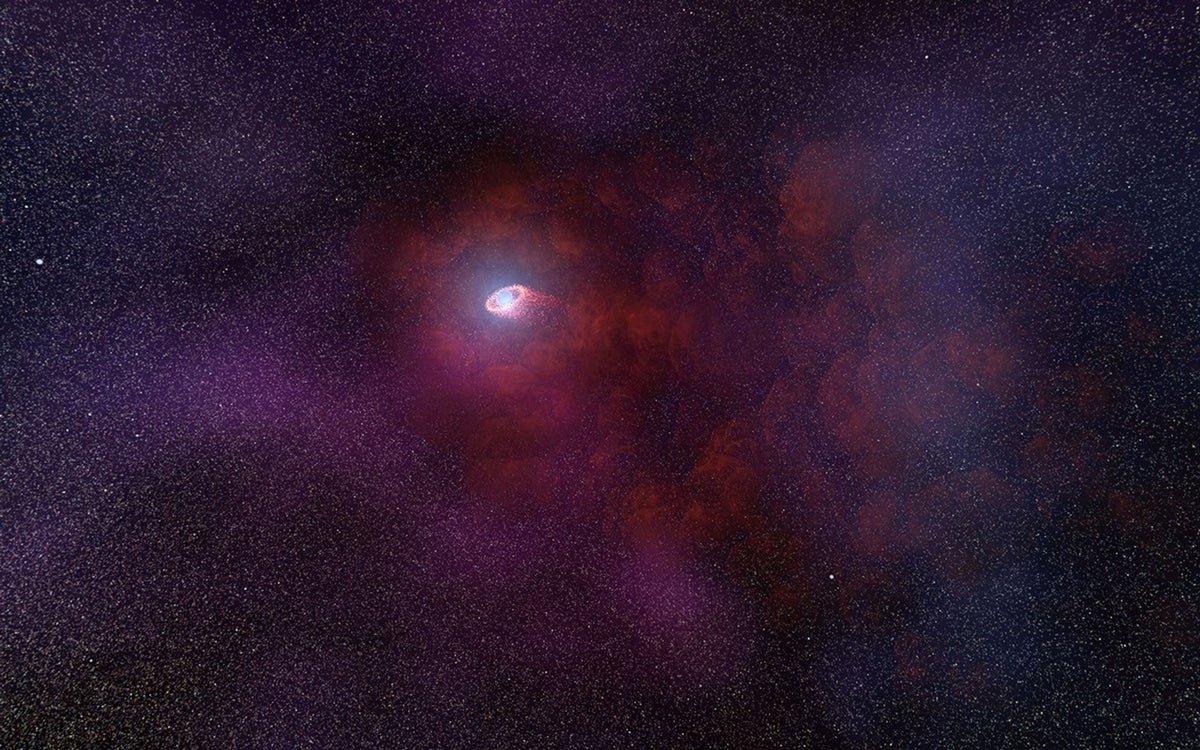
An illustration of a pulsar wind nebula produced by the interaction of the outflow particles from a neutron star with gaseous material in the interstellar medium that the neutron star is plowing through.
NASA/ESA/N. Tr’Ehnl/Pennsylvania State University
At the center of the Milky Way, there might lie a pulsar—a highly magnetized, spinning neutron star that formed from the dead husk of a massive star that had gone supernova. If confirmed, the possible discovery, which was announced in a paper published on Monday, could reveal new physics.
Pulsars are the universe’s lighthouses. As they spin, they emit steady and predictable bursts of radiation. In turn, researchers can use these rhythmic pulses to reveal tiny changes in spacetime and detect gravitational waves caused by large, massive objects—including supermassive black holes. The discovery of a pulsar near the Milky Way’s central supermassive black hole, Sagittarius A*, could prove invaluable to astronomers as they seek to understand this cosmic behemoth, according to the researchers behind the possible finding.
“Any external influence on a pulsar, such as the gravitational pull of a massive object, would introduce anomalies in this steady arrival of pulses, which can be measured and modeled,” said Slavko Bogdanov, an associate research scientist at Columbia University and a co-author of the study, in a statement.
On supporting science journalism
If you’re enjoying this article, consider supporting our award-winning journalism by subscribing. By purchasing a subscription you are helping to ensure the future of impactful stories about the discoveries and ideas shaping our world today.
“If confirmed, it could help us better understand both our own Galaxy, and General Relativity as a whole,” said Karen Perez, a postdoctoral fellow at the SETI Institute and lead author of the paper, in the same statement.
The “intriguing” candidate pulsar, which researchers have called BLPSR, has a rotational period of 8.19 milliseconds, making it especially fast-spinning. “Further tests and observations are necessary to conclusively confirm or reject BLPSR as a pulsar,” the authors wrote in the paper.
It’s Time to Stand Up for Science
If you enjoyed this article, I’d like to ask for your support. Scientific American has served as an advocate for science and industry for 180 years, and right now may be the most critical moment in that two-century history.
I’ve been a Scientific American subscriber since I was 12 years old, and it helped shape the way I look at the world. SciAm always educates and delights me, and inspires a sense of awe for our vast, beautiful universe. I hope it does that for you, too.
If you subscribe to Scientific American, you help ensure that our coverage is centered on meaningful research and discovery; that we have the resources to report on the decisions that threaten labs across the U.S.; and that we support both budding and working scientists at a time when the value of science itself too often goes unrecognized.
In return, you get essential news, captivating podcasts, brilliant infographics, can’t-miss newsletters, must-watch videos, challenging games, and the science world’s best writing and reporting. You can even gift someone a subscription.
There has never been a more important time for us to stand up and show why science matters. I hope you’ll support us in that mission.
