

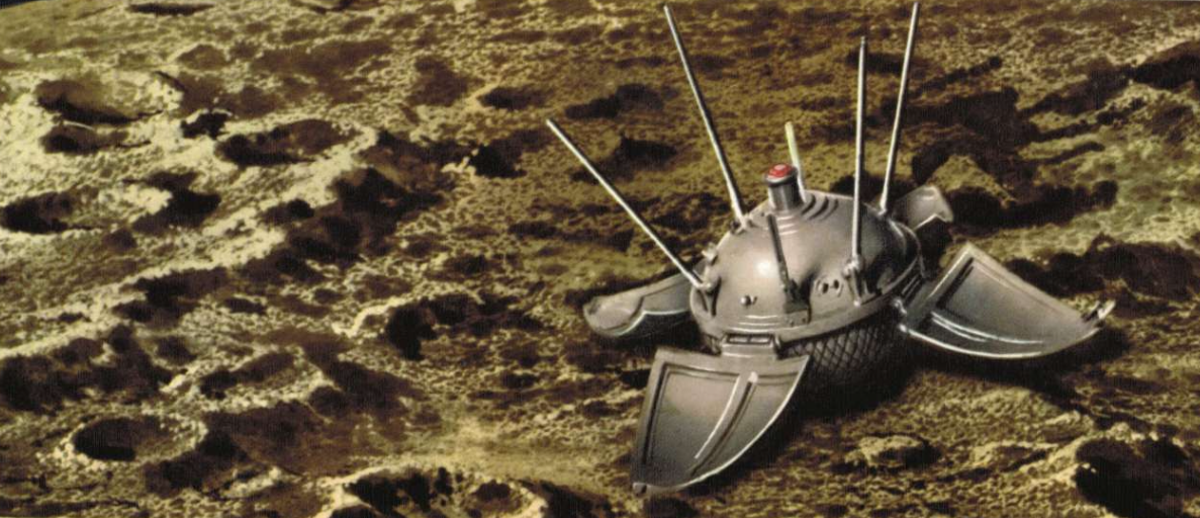
Humanity’s first successful lunar lander is missing. Sixty years ago the Soviet Luna 9 became the first human-made object to achieve a soft landing on the moon—or, for that matter, any celestial body. Yet today its exact location remains a mystery.
While NASA’s Lunar Reconnaissance Orbiter (LRO) and India’s Chandrayaan-2 have mapped nearly the entire lunar surface—capturing the Apollo landing sites and Soviet rover tracks in exquisite detail—Luna 9 has eluded detection. The craft, it turns out, is too small for even the sharpest orbital cameras to easily distinguish from the surrounding rubble.
That may soon change. “Space archaeologists” from England, Japan and Russia—leveraging machine-learning algorithms and painstaking manual open-source intelligence methods—have identified several promising candidate sites. And they say deeper scrutiny from India’s Chandrayaan-2 could soon confirm the discovery.
On supporting science journalism
If you’re enjoying this article, consider supporting our award-winning journalism by subscribing. By purchasing a subscription you are helping to ensure the future of impactful stories about the discoveries and ideas shaping our world today.
Luna 9 was a product of the second generation of Soviet lunar probes, a program designated Ye-6. The road to success was paved with failure: 11 previous Ye-6 launches ended prematurely as a result of rocket malfunctions, booster failures or orientation system errors. Success finally came on the 12th attempt. On February 3, 1966, the spacecraft touched down in Oceanus Procellarum (the Ocean of Storms).
Its landing sequence was a feat of unconventional engineering. Unlike modern probes that descend on landing legs, Luna 9 jettisoned its orientation modules during descent and fired a braking engine. As it neared the surface, it deployed a sensor downward. When the sensor touched the ground, the spacecraft ejected a 100-kilogram spherical capsule from five meters above the surface. Encased in inflatable shock absorbers, the sphere bounced across the lunar surface like a beach ball, eventually settling and unfolding four petal-like panels to stabilize itself. The 430-kilogram descent stage crashed nearby. Of the 1.5 metric tons launched from Earth, only that small sphere survived to operate on the lunar surface.
Equipped with no solar panels, the probe ran on batteries for just three days. In that time, it transmitted three panoramic photos, measured radiation and—most crucially—demonstrated that landing on the moon was possible at all. Back then some researchers feared the moon was covered in a deep “ocean” of dust that would swallow any lander whole. Luna 9 proved the ground was firm, clearing the path for the next missions.
At the time, the Soviet newspaper Pravda published the landing coordinates: seven degrees and eight minutes north latitude, 64 degrees and 22 minutes west longitude (or 7.13 degrees north latitude and 64.37 degrees west longitude). But precision was not a hallmark of the 1960s space race.
“The error could have reached tens of kilometers,” says geochemist Alexander Basilevsky, who selected landing sites for later Soviet missions. “Luna 9 was designed so there was no need to choose convenient terrain. Wherever it landed—on a rock or a slope—it would roll, unfold its petals when stopped and work,” he says.
A chance to test Pravda’s accuracy emerged half a century later, in 2009, when the Lunar Reconnaissance Orbiter voyaged to the moon carrying the LROC camera, capable of spotting half-meter-scale objects from 50 kilometers above the surface.
That same year the spacecraft captured its first images of the Apollo landing sites. Planetary scientist Jeff Plescia of Johns Hopkins University’s Applied Physics Laboratory soon began to search the LROC imagery for Soviet landers, combing Oceanus Procellarum despite knowing that success was unlikely.
He hoped the descent engine might have scoured away lunar dust, creating a visible “halo” or blast zone. But despite his success in locating the Apollo 16 rocket booster impact site in 2015, evidence of Luna 9 remained elusive.
The search gained new momentum in 2018 from research led by Vitaly Egorov, a science communicator and former employee of the private company Dauria Aerospace. Egorov was no stranger to the hunt; in 2013 he identified the Soviet Mars 3 lander in Mars Reconnaissance Orbiter (MRO) images.
He relied then on a methodical scan of the area, which proved successful thanks to the high resolution of MRO imagery (0.25 meter per pixel) and a relatively small search zone of 24 by five kilometers. The lunar case proved much more challenging: the search area was 100 km in diameter, while the resolution of LRO images for most of that region was no better than one meter. A simple manual scanning method didn’t work; Egorov’s initial attempt did not produce any results.
By 2025 Egorov—now living in exile and designated a “foreign agent” by Russian authorities for his opposition to the war in Ukraine—returned to the problem. Egorov crowdsourced the effort, recruiting his blog audience to help analyze data. Нe used a triangulation method, identifying distinctive features in Luna 9’s original 1966 ground-level panoramas—two distant hills, specific boulders and an ejecta streak—and matched them with topographic data from the LRO’s laser altimeter.
NASA/GSFC/Arizona State University/Vitaly Egorov
Egorov then drew azimuth lines; where they intersect, Luna 9 should lie. “There was a very convincing picture there,” he says. “The reconstructed landing site matched the pattern of light and shadow exactly.” Still, he cautions, only pixels are visible so far, and there is no guarantee that the pixel he identified truly represents Luna 9.
The new coordinates he calculated were 7.86159 degrees north, 63.85562 degrees west—roughly 25 kilometers from the “official” Soviet site.
LROC photo (left) and a three-dimensional reconstruction of the Luna 9 landing site (right).
NASA/GSFC/Arizona State University/АН СССР/Andrey Larin (CC BY 4.0)/Vitaly Egorov
Egorov passed the coordinates to Indian specialists planning to image the area in March 2026 with Chandrayaan-2’s cameras, which might be able to confirm the discovery. “The resolution of its images reaches 0.25 meters; in theory, this would make it possible to see the shape of the craft—the central body as a pixel and the four petal antennas as distinct pixels,” he explained.
Simultaneously, a team of researchers in England and Japan led by Lewis Pinault at University College London’s Center for Planetary Sciences has been tackling the mystery from a different angle. The scientists adapted a machine-learning algorithm, originally designed to identify micrometeoroids in photographs, to instead scan images of the lunar surface for human-made artifacts.
After training the algorithm on images of Apollo landing sites, Pinault’s team found that it could successfully identify the Luna 16 site in photographs it had never previously analyzed. The system also flagged several candidate objects within five kilometers of Luna 9’s official coordinates—though Egorov’s candidate lies about 25 kilometers away.
The scientists emphasize that human assistance and new images are still required.
“The identification of possible Luna 9 hardware also underscores the value of combining automated methods with expert human analysis. Machine learning efficiently isolates statistically significant anomalies, while domain expertise remains essential for physical interpretation and validation…. Further confirmation of the candidate Luna 9 site will require directed imaging by the Lunar Reconnaissance Orbiter or future orbiters,” the researchers wrote in an article recently published in the journal npj Space Exploration.
The quest to find Luna 9 is more than a game of celestial hide-and-seek. “The most important thing is locating these artifacts to understand how materials change after decades of exposure to the lunar environment,” Basilevsky says.
As India’s Chandrayaan-2 prepares for a new imaging pass this March, we may finally find the “beach ball” that started it all. And for the seekers, the stakes are also personal. As Egorov puts it: “Maybe one day, people will take guided tours to the site where we first touched the moon.”
