

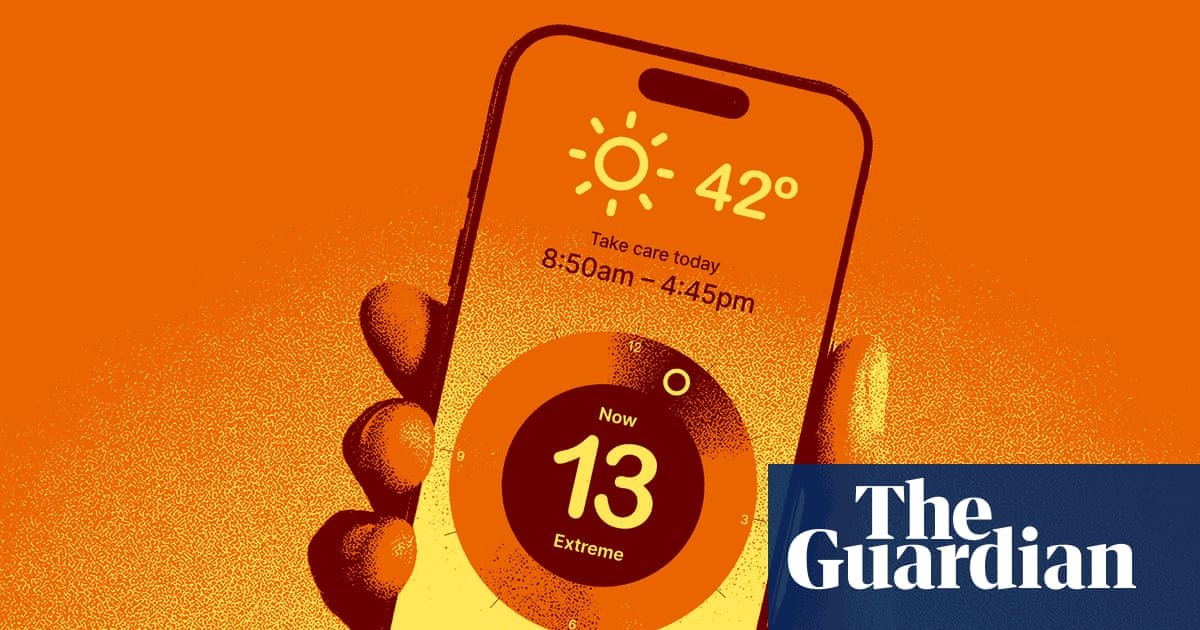
Smartphone apps that claim to offer “safe” and “healthy” tanning routines for users as young as four are being heavily prompted by influencers, helping to fuel what has been described as a dangerous resurgence in tanning culture among Australian teens.
“Get your best tan safely” and “get a healthy glow faster” are among some of the claims made by apps downloaded by Guardian Australia. One of the tanning apps, labelled as suitable for users aged 4+, is among the top downloaded free apps in the “weather” category in the Apple app store.
Many of the apps ask users to choose their ideal skin colour, such as “espresso glow” or “golden bronze”. Users then choose from tanning intensity levels such as “mild”, “medium” or “intense” for “faster, deeper tanning”.
Some apps prompt users to add body oils, tanning butters and accelerants to their routines, or to select a post-sun cool-off activity such as showering or swimming.
The apps then recommend a tailored tanning routine centred on deliberate exposure to ultraviolet (UV) radiation, with the app guiding users on when and how long to spend in the sun to achieve their desired skin tone.
A sponsored social media ad for one of the apps features a young tanned woman, the caption reading: “Didn’t check UV. Didn’t reapply. Didn’t even think about it”.
Sign up: AU Breaking News email
“It’s all nonsense,” said Dr Deshan Sebaratnam, a dermatologist and conjoint associate professor at the University of New South Wales, adding the concept of “safe tan” from UV exposure does not exist.
“A tan is actually a distress signal from your skin,” he said. “It means your skin cells have been damaged by ultraviolet radiation and are responding by producing melanin. There is no such thing as a safe tan. The only safe tan is a fake tan.”
Sebaratnam said apps that suggest gradual tanning schedules are safer, or that there are safe thresholds of exposure, are misleading because any colour change in the skin indicates damage – regardless of whether it happens slowly.
He said tanning apps targeting young people are particularly troubling, as UV damage early in life carries a higher lifetime risk of skin cancer, long after the skin heals.
This is because damage from UV “gets into your DNA, causing mutations, even if your skin heals and looks OK,” he said, with those DNA mutations in skin cells staying around afterwards.
“When you acquire enough mutations, that’s what causes cancer,” he said.
“We know sunburns in childhood really increase risk and that’s why there are policies like ‘no hat, no play’.”
While melanoma in children is rare, Sebaratnam said he had treated young patients who required surgery and lymph node removal.
Sebaratnam said using tanning accelerants or oils as suggested by some of the apps is a “terrible idea”, and products might contain ingredients that increase photosensitivity and lead to severe burns.
The head of the Cancer Council Victoria’s SunSmart program, Emma Glassenbury, said: “We’re hearing from parents who are worried their kids are chasing tan lines again, asking about UV levels and when it’s ‘safe’ to tan.”
“That’s deeply concerning.”
‘There is no such thing as a safe tan. The only safe tan is a fake tan,’ Dr Deshan Sebaratnam said. Photograph: Zoonar GmbH/Alamy
A poll published by The Royal Children’s hospital in Melbourne in December found 23% of teens aged between 12 and 17 surveyed falsely believed a tan protects from skin cancer, while half said they would prefer to look tanned.
About 2,000 Australians die from skin cancer each year.
“What we’re doing is really trying to raise the awareness of the dangers of these apps,” Glassenbury said.
“We’re urging all Australians not to buy into these dangerous tanning apps because they’re just simply too risky, targeting particularly our young people.
“By promoting tanning trends, they are really undermining our public health efforts in tackling skin cancer. SunSmart has spent decades really trying to shift Australian attitudes away from that tanning mentality.”
