

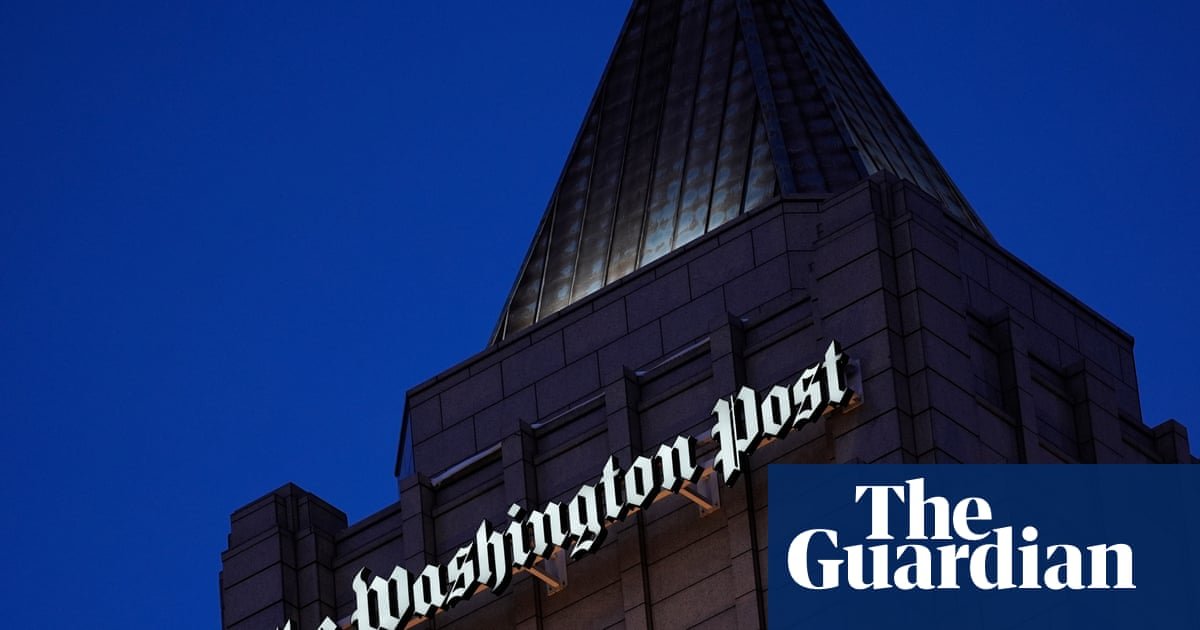
Under Marty Baron, the Washington Post won 11 Pulitzer prizes and expanded its newsroom to house more than 1,000 journalists. The storied newspaper’s future is now in question, according to its former executive editor.
“The aspirations of this news organization are diminished,” Baron told the Guardian in an interview. “I think that’ll translate into fewer subscribers. And I hope it’s not a death spiral, but I worry that it might be.”
Matt Murray, who now leads the Post as editor in chief, promised staffers on Wednesday that the news organization has a plan to survive and thrive into the future – as it executed one of the largest layoffs in American newspaper history. Nearly one-third of the entire company – which stood at 2,500 employees in late 2023, before a round of buyouts – was axed.
The cuts decimated large swaths of the newspaper, shuttering its sports department and shredding its teams covering local news, style and the world, not to mention its audio and video departments, which had already been battered by previous cuts. Commercial teams were also cut.
All told, the Post is now a significantly smaller news organization, and one that many journalists who care deeply about the institution worry will be significantly less ambitious, just as the media industry confronts both financial headwinds and animosity from Donald Trump and his officials.
Trump regularly threatens news networks and encourages his regulatory arms to crack down on outlets he dislikes. During an incredibly newsworthy period in American history, news networks like CBS News – now owned by the Trump-friendly Ellison family – and even newspapers like the Atlanta Journal-Constitution have endured rounds of layoffs in recent months.
Baron, who led the Post for eight years until 2021, wrote favorably about the tech billionaire Jeff Bezos’s stewardship of the paper in his 2023 memoir. But now, Baron said, “he’s not the owner he was”.
He attributes this change to the re-election of Trump in November 2o24 – and a desire for Bezos to stay on his good side to protect the other companies he controls: Amazon, the retail giant, and the spaceflight startup Blue Origin.
Bezos, who remained silent in recent weeks as Post employees pleaded with him to avoid cuts, has not responded to the Guardian’s requests for comment.
“I think the most important thing that’s changed is that Donald Trump is back in the White House, and he clearly would seek vengeance against his political enemies,” Baron said Wednesday. “I understand why Bezos might fear the consequences of that. I understand that he would fear that Trump would deny contracts to Amazon and deny contracts to Blue Origin.
“But I think that the Post is important, too, and it’s even more important than those other enterprises to American democracy. I firmly believe that Bezos is prioritizing his other business efforts over the Washington Post.”
Much of the blame – from employees past and present – has centered on Post publisher Will Lewis, who was hired by Bezos in late 2023 to help reverse the newspaper’s fortunes. Lewis did not appear during a Zoom conversation with employees on Wednesday morning, which struck some employees as odd.
“I think he was awol today, and I think he’s been awol in the past,” Baron said. “He’s kind of the invisible publisher. When you announce something as traumatic as what they announced today, shouldn’t the publisher be on the call?”
Donald E. Graham, who sold the Post to Bezos in 2013, on Wednesday broke his general policy of not commenting on the current ownership. “It’s a bad day,” he wrote in a widely – shared post on Facebook. “I am sad that so many excellent reporters and editors – and old friends – are losing their jobs. My first concern is for them; I will do anything I can to help.”
During a virtual meeting with employees on Wednesday morning, Murray said the Post’s largest reporting group would be its politics and government team, whose work “will remain central to our engagement and subscriber growth”. The Post will also cover national news, science, technology, climate and business, though with diminished staffs.
But, as a smaller news organization focused primarily on covering politics, campaigns and the operation of the federal government and Trump administration, the Post faces stiff competition from outlets like Politico and Axios that have been laser-focused on those areas, not to mention smaller upstarts like Punchbowl News, which covers Congress.
“I have no clue what their strategy was or is,” said Jim VandeHei, who left the Post in 2006 to co-found Politico, and later co-founded Axios, where he remains CEO. “We do: be useful, indispensable [and] illuminating to people who care deeply about government, AI, business and the information ecosystem. And then match the business expertise with our editorial excellence.”
During the fall of 2024, the Post lost hundreds of thousands of subscribers after Bezos abruptly shelved its planned endorsement of Kamala Harris for president. He also re-oriented the paper’s opinion pages to a more narrow focus on supporting “personal liberties and free markets”.
There are concerns that Wednesday’s cuts will create a new groundswell of cancellations that could further damage the Post’s financial health, not to mention the millions of dollars that could be paid out in severance.
Robert Allbritton, the former owner of Politico, said he was saddened by Wednesday’s layoffs. “These are some wonderful journalists who have produced quality work,” he said. “They will land at other publications, but the disruption is painful and not their fault.”
Looking forward, “these layoffs signal that Jeff wants to move the Post back to sustainability”, Allbritton added. “I’m hopeful that once the Post regains its financial footing that Jeff will continue as a responsible owner of one of the most important brands in media.”
Some Post veterans feel differently, and have called for Bezos to sell the newspaper. The union representing most Post employees said on Wednesday: “If Jeff Bezos is no longer willing to invest in the mission that has defined this paper for generations, and serve the millions who depend on Post journalism, then the Post deserves a steward that will.”
But Baron highlighted a big question surrounding any potential sale: “To whom?”
