

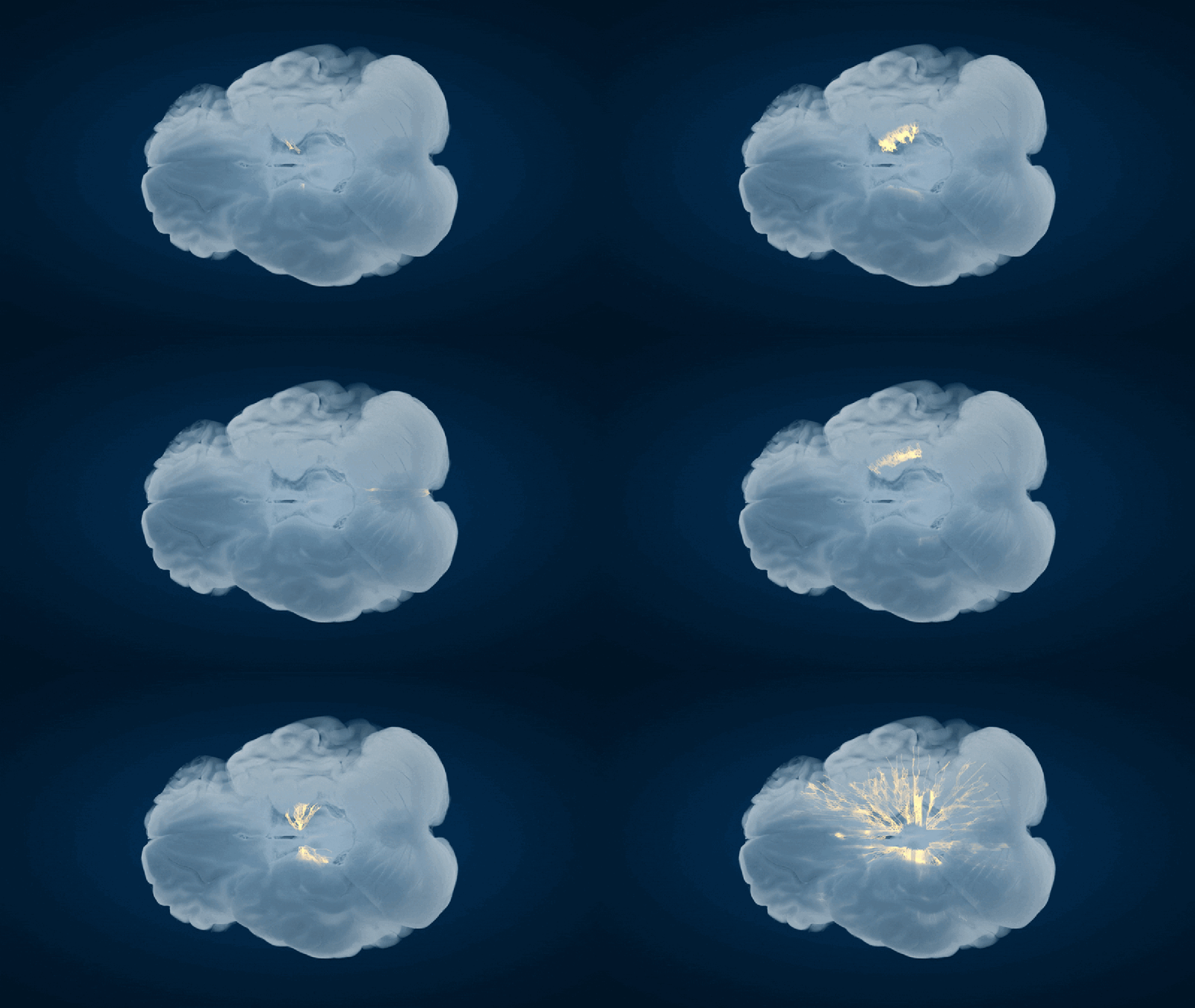
Scientists have found a key brain network that’s disrupted by Parkinson’s disease, according to a study published today in Nature. The results change doctors’ understanding of what causes Parkinson’s symptoms and may unlock more effective and precise treatments.
Parkinson’s has long been considered a movement disorder. Its hallmark symptoms include involuntary muscle contractions, tremor and difficulty walking. But the disease can also disrupt sleep, blood pressure regulation, digestion and cognitive function. The movement-related symptoms can worsen when someone with the disease is under stress, for example, but improve while they are listening to music.
The common factor underlying these seemingly disconnected symptoms, according to the new results, is a brain network that was only discovered in 2023. Called the somato-cognitive action network, or SCAN, it links the mind and the body to turn thoughts into actions. The researchers found that targeting this network with brain-stimulating treatments could better alleviate the symptoms of Parkinson’s disease.
On supporting science journalism
If you’re enjoying this article, consider supporting our award-winning journalism by subscribing. By purchasing a subscription you are helping to ensure the future of impactful stories about the discoveries and ideas shaping our world today.
“Parkinson’s is not just a movement problem involving one body part. This study shows it is a whole-body brain network disorder that links movement, thinking, arousal and internal body control,” says Michael Okun, a neurologist at the University of Florida and medical director of the Parkinson’s Foundation, who was not involved in the study.
It’s an “extraordinary” set of findings, says Todd Herrington, a neurologist at Massachusetts General Hospital who treats and studies Parkinson’s.
A Strange Pattern
Neuroscientists have long known that a region of the brain called the primary motor cortex, nicknamed M1, controls the body’s movements. This headband-shaped brain strip extends from ear to ear and contains a “map” of the entire body—often visualized as a distorted humanoid figure called the homunculus. If you want to move your hand, higher-level brain regions closer to your forehead send signals back to M1, which in turn sends motor signals to the hand.
But neurologist Nico Dosenbach of Washington University in St. Louis had observed something strange. When a person in a brain scanner moves their mouth, multiple parts of M1—not just the “mouth” region—activate. These extra spots of activation “just didn’t make sense, if all the things I thought I knew were true,” he says.
It turns out that neuroscientists had been underestimating M1 for nearly a century. M1 is not a simple map of the body. Interspersed between body-part-specific areas are nodes of a network that coordinates higher-level planning for movement. Instead of being a mere foot soldier following orders from more frontal brain regions, M1 helps plan, guide and coordinate action. Dosenbach and his colleagues named the network the somato-cognitive action network, or SCAN, reflecting how it bridges the body and the mind.
READ MORE: How Our Team Overturned the 90-Year-Old Metaphor of a ‘Little Man’ in the Brain Who Controls Movement
These findings caught the eye of Hesheng Liu, a neuroscientist at Changping Laboratory in Beijing. For a decade, he’d been studying Parkinson’s disease, trying to figure out how a treatment called deep-brain stimulation (DBS) works to alleviate symptoms. His team had noticed the strange patterns in M1, too. “We had no idea what they are,” Liu says. When he saw Dosenbach’s paper on SCAN, everything started to make sense. “Probably, that region is behind Parkinson’s disease,” he thought.
A Mind-Body Network
Doctors don’t know what sets off the chain of events that cause Parkinson’s disease. But they know which brain area it most devastates: the substantia nigra, a structure deep in the brain, where neurons that produce the brain signaling chemical dopamine slowly die off.
Stimulating other regions connected to the substantia nigra can alleviate Parkinson’s symptoms, suggesting an entire circuit is involved. Researchers knew that M1 was part of this circuit—and the new results show that it specifically involves the SCAN regions of M1 that plan and coordinate movement. Using multiple brain-imaging datasets from 863 real people with Parkinson’s and healthy individuals, Liu’s team found that SCAN was overlyconnected to deep-brain regions in those with Parkinson’s but not in healthy people or those with other movement disorders. Individuals with Parkinson’s who had higher connectivity in this circuit experienced worse symptoms.
The researchers also found that existing treatments for Parkinson’s, including the medication levodopa (also known as L-DOPA), as well as brain stimulation, decreased the circuit’s connectivity, making the brains of people with the condition look more like those of healthy people. The more a treatment reduced someone’s SCAN connectivity, the more their motor function improved.
Doctors don’t yet know if dying neurons in the substantia nigra cause these SCAN disruptions, or vice versa, says Michael D. Fox, a neurologist at Brigham and Women’s Hospital in Boston, who was not involved in the study. Neurons begin dying decades before symptoms appear, so it seems likely that the former may cause the latter. But it’s “not impossible” that the SCAN dysfunction could start early, too, and cause more neurons to die, he says.
Guiding Better Treatment
Brain stimulation treatments for Parkinson’s were more effective when doctors specifically targeted SCAN regions, Liu’s team also found. This experiment involved a noninvasive technique called transcranial magnetic simulation, or TMS, in which doctors place a wand containing a magnetic coil over the scalp, just on top of M1. Previous studies had shown that the treatment improved symptoms but wasn’t more effective than the medication levodopa. In part because of that limitation, Fox says, TMS isn’t offered clinically to people with Parkinson’s.
But focusing TMS on SCAN regions specifically can improve results, Liu’s team showed. “I’m excited by these results,” Fox says. TMS may be more appealing and accessible to patients than deep-brain stimulation, which requires surgery. “This, in my mind, elevates the potential of noninvasive brain stimulation for helping patients with Parkinson’s in a way that wasn’t there before,” Fox says.
