

February 4, 2026
4 min read
Add Us On GoogleAdd SciAm
Physicists trace particles back to the quantum vacuum
Scientists have found “strange quarks” that originated as virtual particles that sprang from nothing
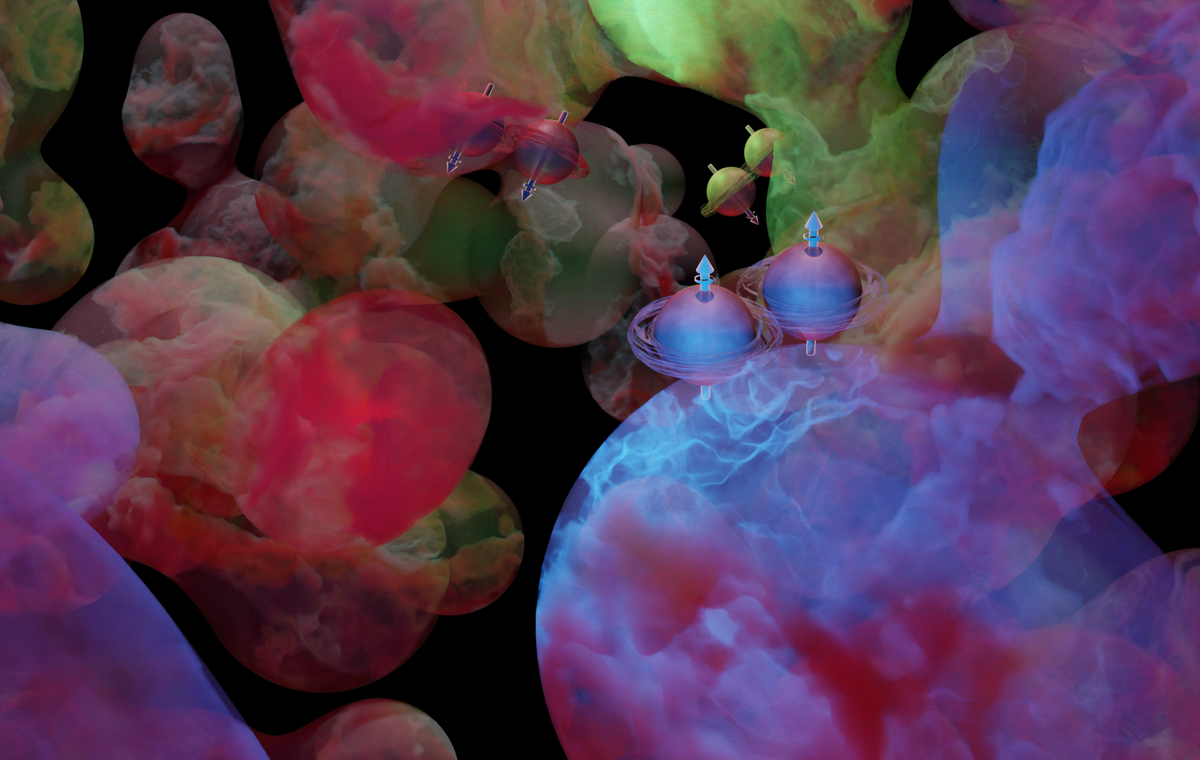
An illustration depicts pairs of strange quarks arising out of nothing in the quantum vacuum.
Valerie A. Lentz/Brookhaven National Laboratory
Quantum physics paints a strange picture of the world, one filled with spooky connections, unsettling uncertainties and—perhaps oddest of all—particles that spontaneously spring into being from the void. These so-called virtual particles have indirect effects that scientists have measured before. But now, for the first time, researchers have traced the evolution of these something-out-of-nothing particles directly.
In a study published today in Nature, physicists at the Relativistic Heavy Ion Collider (RHIC) at Long Island’s Brookhaven National Laboratory describe how they found pairs of subatomic particles with an uncanny correlation in the direction of their spin. Particle spin is a quantum property that can point either up or down. Most groups of particles will have a random mix of up and down spins, but the researchers found that a particular kind of particle that has been produced at the collider has often come in pairs with matching spin directions.
These pairs, the scientists think, must be direct descendants of sets of virtual particles that spontaneously arose out of nothing from the quantum vacuum.
On supporting science journalism
If you’re enjoying this article, consider supporting our award-winning journalism by subscribing. By purchasing a subscription you are helping to ensure the future of impactful stories about the discoveries and ideas shaping our world today.
“The vacuum in quantum theory is not empty space,” says physicist Dmitri Kharzeev of Stony Brook University. “It’s a field filled with virtual particles.” Such particles are a consequence of Heisenberg’s uncertainty principle, which states that certain correlated properties—such as the energy and the lifetime of a quantum state—cannot both be known with precision. If a quantum state is very, very brief, then its energy can be highly uncertain. This means that pairs of particles—a particle and its antimatter partner—can briefly come into being by borrowing energy from nothing.
Usually these particles almost immediately disappear again by annihilating each other—but not this time.
Within RHIC, scientists smash protons together at nearly the speed of light to produce explosions of astounding energy. When a virtual particle pair happens to arise in the vacuum there, it can commandeer the freely available energy of the collision to become real. “When two particles collide at high energies, it gives the vacuum an energy boost,” says Brookhaven physicist Zhoudunming (Kong) Tu, who was one of the authors of the new study. “Now the virtual particles get a push without having to annihilate back to the vacuum.”
Using the Solenoidal Tracker at RHIC (STAR) detector, physicists were able to trace this process. The details of how they did so, though, might make your head spin.
Because these newly real particles originated as a pair, they are entangled, retaining a connection regardless of how far they may be separated. So when they fly apart after the collision, they share the same direction of spin.
The experiment traced pairs of “strange” quarks—cousins to the “up” and “down” quarks that make up protons and neutrons. Quarks aren’t stable on their own, so when the new quarks sprang into existence, they quickly joined with others to form conglomerate particles called lambda hyperons. These are exotic versions of protons contain an up quark, a down quark and a strange quark instead of the proton’s two ups and one down.
Lambdas, in turn, aren’t so stable themselves. They last for only about 10–10 second and travel a few centimeters inside the collider before they decay into more mundane particles that STAR can see.
The direction of the momentum for these decay particles reveals the spin of the lambda hyperons that created them. And the spin of the lambda is thought to be determined solely by the spin of its strange quark (because the spins of its up and down quarks cancel out).
When the researchers looked at their measurements, they were surprised at how correlated these particles were. “Their spins seem to be parallel,” says study co-author Jan Vanek, a physicist at the University of New Hampshire. “That hints we are actually seeing these vacuum strange quark pairs found in these lambda hyperons.”
The finding confirms a 30-year-old prediction by Kharzeev and his colleagues that strange quark virtual particle pairs must have parallel spins. “It’s exciting because you can come up with plausible theoretical ideas in your head, but you never know whether nature follows this or not,” he says. “So to see that this was finally measured in a real experiment is very gratifying.”
This new window on virtual particles should help answer a major mystery in nuclear physics: Where does a proton’s mass come from? The three quarks that form protons only contribute a minuscule amount of mass—the other 99 percent is thought to arise from interactions between these real quarks and swarms of virtual quarks in the vacuum. “If we can trace a pair of quarks from virtual particle to real particle, maybe we can gain some insight about how this mass is generated through the interaction with the vacuum,” Tu says.
The discovery also marks another achievement for RHIC as the collider prepares to shut down. Friday will be its last day of collisions, after a record-breaking 25-year-long run. Parts of the machine will be repurposed in Brookhaven’s upcoming Electron-Ion Collider, which is set to start up at the lab in the mid-2030s.
It’s Time to Stand Up for Science
If you enjoyed this article, I’d like to ask for your support. Scientific American has served as an advocate for science and industry for 180 years, and right now may be the most critical moment in that two-century history.
I’ve been a Scientific American subscriber since I was 12 years old, and it helped shape the way I look at the world. SciAm always educates and delights me, and inspires a sense of awe for our vast, beautiful universe. I hope it does that for you, too.
If you subscribe to Scientific American, you help ensure that our coverage is centered on meaningful research and discovery; that we have the resources to report on the decisions that threaten labs across the U.S.; and that we support both budding and working scientists at a time when the value of science itself too often goes unrecognized.
In return, you get essential news, captivating podcasts, brilliant infographics, can’t-miss newsletters, must-watch videos, challenging games, and the science world’s best writing and reporting. You can even gift someone a subscription.
There has never been a more important time for us to stand up and show why science matters. I hope you’ll support us in that mission.
