

Two Minnesota school districts and the state’s teachers’ union filed a lawsuit Wednesday seeking to stop immigration agents from carrying out enforcement activity at or near schools.
The suit challenges the Trump administration’s decision to revoke a long-standing policy that generally prohibited Immigration and Customs Enforcement and Border Patrol agents from making immigration arrests and carrying out raids at schools and other “sensitive locations,” including places of worship and hospitals, without permission from agency headquarters.
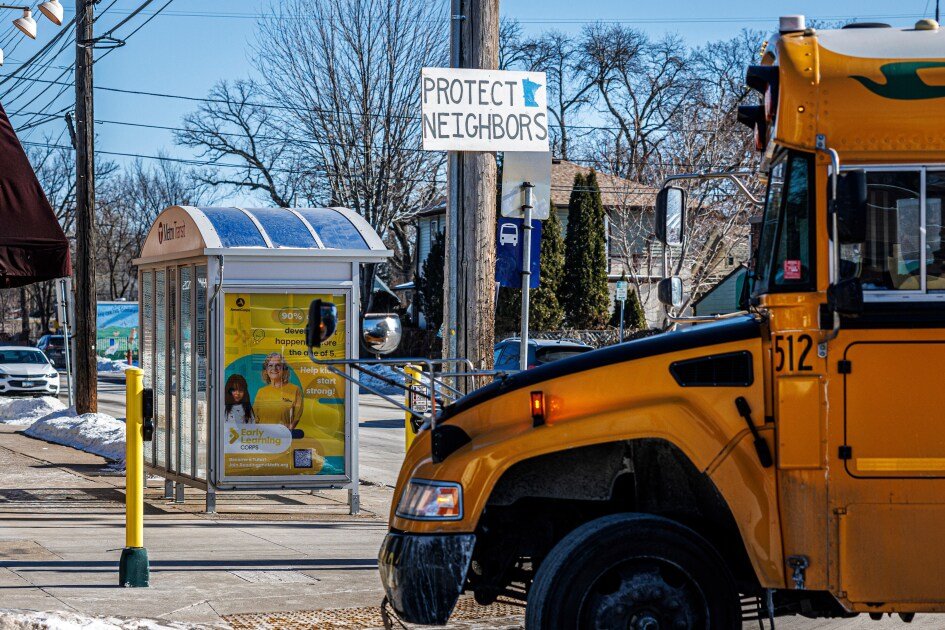
In Minnesota—the recent focus of a broad, intense immigration crackdown—Department of Homeland Security agents have detained people and staged immigration enforcement actions at or near schools, school bus stops, and day care centers, the suit contends.
In one district that signed onto the lawsuit—Fridley Public Schools, near Minneapolis—the change in policy has led to a dramatic drop in attendance, spurred a major expansion of online learning options, and strained staff time and resources, the lawsuit argues.
In the other district that joined the suit—Duluth Public Schools in northern Minnesota—school safety officials now devote about 30% of their time to figuring out how to keep schools secure in the wake of the immigration crackdown, the lawsuit says.
Immigration agents’ presence has “created an atmosphere of fear,” at schools, including for native-born citizens and legally present immigrants, the suit argues: “Parents across the state are afraid to send their children to school, and schools have had to adjust their programs.”
Tricia McLaughlin, the Homeland Security Department’s assistant secretary for public affairs, said agents’ actions in and around schools are intended to protect children.
“ICE is not going to schools to arrest children—we are protecting children. Criminals are no longer able to hide in America’s schools to avoid arrest,” she said in a statement. “The Trump administration will not tie the hands of our brave law enforcement and instead trusts them to use common sense.”
An arrest might be made at school “if a dangerous illegal alien felon were to flee into a school, or a child sex offender is working as an employee,” McLaughlin said. “But this has not happened.”
Homeland Security Secretary Kristi Noem is the primary defendant in the lawsuit, along with ICE, U.S. Customs and Border Protection, and their respective leaders. Both of those agencies fall under the Homeland Security umbrella.
This is the third lawsuit challenging the Trump administration’s decision to revoke the “sensitive locations” policy at schools that cites its impact on student learning, attendance, and well-being, according to Education Week tracking. An earlier lawsuit by Denver public schools was dismissed, though the school system has the ability to sue again over the policy change.
Democracy Forward, a nonprofit legal advocacy organization representing the school districts and Education Minnesota, the teachers’ union, has also mounted legal challenges to ICE’s presence at churches and other religious institutions, with some success in federal district court.
Minneapolis-area schools have felt the effects of the ICE surge
Immigration enforcement has been especially fierce and divisive in Minnesota since the Trump administration launched “Operation Metro Surge” in the Twin Cities in early December, the lawsuit contends. That brought a reported 3,000 ICE and Border Patrol agents into the area, or about five times the total number of Minneapolis police officers.
Federal agents have shot and killed two American citizens in Minneapolis, sparking protests.
On Feb. 4, the day the lawsuit was filed, Trump’s border czar, Tom Homan, announced Homeland Security would withdraw 700 federal agents from the state.
As part of the Trump administration’s immigration enforcement surge—and its decision to make schools fair game for that action—federal officers have staged operations in the parking lots of at least two Fridley district schools, the lawsuit adds.
Immigration agents have followed the district’s superintendent and board members, according to the suit. District social workers have also seen agents following them when they bring food to families too afraid to shop at the grocery store, the suit says.
Elsewhere in the area, a paraprofessional in a St. Paul suburb was arrested by agents in her school parking lot. And the parent of an elementary school child in Brooklyn Center, a suburb near Fridley, was detained while waiting at a school bus stop.
Immigration agents have also pulled over school district vans from multiple districts while on their way to school, including when students were on board, according to the lawsuit.
On Jan. 7—the day Minneapolis resident Renee Good was killed by an ICE officer—federal agents came onto the campus of Roosevelt High School in Minneapolis and handcuffed two staff members. Agents sprayed students with pepper spray when one threw a snowball at them, the report contends.
These actions have had a serious impact on student attendance and made it impossible for districts to continue normal school operations, the lawsuit argues.
Schools in Minneapolis closed Jan. 8-9, just after Good was slain. Half of the St. Paul district’s Spanish-speaking students were absent on Jan. 9, as were a quarter of its Somali students, according to the lawsuit.
A handful of school districts in the area—including Bloomington, Columbia Heights, Fridley, Minneapolis, Robbinsdale, and St. Paul—have started offering online learning for students who are too afraid to come to school.
In Fridley, with an enrollment of just over 2,700 students, over 400 families have opted into virtual learning. Educators have scrambled to create a new curriculum for the online classes, diverting financial resources and time from their other work.
Fridley schools’ attendance rate has dropped by nearly one-third during the immigration enforcement surge, the lawsuit notes. That could cost the district financially, since under state law, districts lose funding for each student who is absent more than 15 days during the school year.
Similarly, school officials in Duluth also worry about losing state funding due to a drop in attendance.
“We’ve seen increased anxiety among students, disruptions to attendance, and families questioning whether school remains a safe and predictable place for their children,” Superintendent John Magas said in a statement. “Schools function best when families trust that education can happen without fear, and that stability has been undermined.”
