

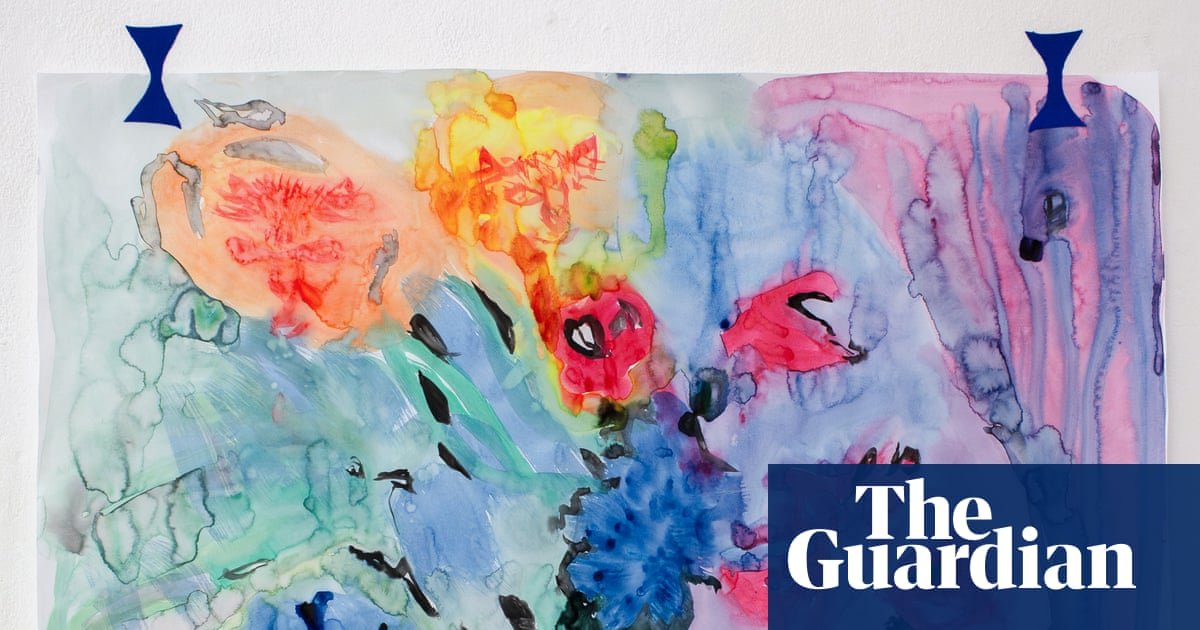
Daisy Lafarge was lying on the floor in excruciating pain when she started her latest paintings. A severe injury, coupled with a sudden worsening of her health, had left her unable to sit upright, while brain fog and fatigue made reading and writing impossible. So the award-winning novelist and poet fell back on her art school training, using the energy and materials she had to hand to create impressionistic paintings of her surroundings – her cat Uisce, her boyfriend’s PlayStation controller – alongside unsettling imagery of enclosed gardens and flowers decaying.
“Making the paintings was a way of coexisting with pain,” says the 34-year-old. “I was on my living room floor in agony for a few hours, but I wanted to get something out of that time. I’ve always been fascinated by artists and writers who turn limitations into formal constraints. I see the paintings as my attempt at that.”
The works were made with basic materials: “quite cheap” paper, paints and brushes, as well as kinesiology tape, an adhesive that Lafarge, who has the connective tissue disorder Ehlers-Danlos syndrome, uses to provide support to her joints and ligaments. Seeing as the tape needs to be cut in very specific ways, it leaves behind distinctive butterfly-shaped remnants that Lafarge repurposed into decorative elements. The watercolours will be accompanied by a poem cycle inspired by William Blake’s The Sick Rose and the 13th-century text The Romance of the Rose, drawing on the principles of courtly love to tell the allegorical story of a relationship in which pain is characterised as an “intoxicating, sometimes quite violent” lover.
Is Nnena Kalu’s Turner win really a turning point, unless disabled people can afford to be alive in this country?
The paintings and poetry will be on display this month at Dundee Contemporary Arts Centre as part of We Contain Multitudes, an exhibition bringing together the work of four artists with disabilities. Also showing are Jo Longhurst, whose latest project is inspired by bindweed, an unwanted yet resilient plant; Andrew Gannon, who creates work modelled on casts of his left arm; and Nnena Kalu, whose highly textural, cocoon-like sculptures and drawings gained her the 2025 Turner prize – the first time it had been awarded to an artist with learning disabilities.
Daisy Lafarge: ‘Making the paintings was a way of coexisting with pain.’ Photograph: Murdo MacLeod/The Guardian
“I think it’s great that Nnena won the Turner,” says Lafarge. “I’m yet to see her work in the flesh, but I love the way it takes up space, its undaunted physicality. I hope it leads to more inclusion of disabled artists. But I don’t want to be naively optimistic. I just find it so hard to disentangle from the fact that disabled artists are disabled people. So is it really a turning point, unless disabled people can afford to be alive in this country? And that comes down to structural issues: are they able to heat their own homes, pay their carers and access very basic things? It’s been an incredibly bleak time from that perspective. A celebratory representation without actual material change is kind of meaningless.”
For many disabled people, the effort of managing complex conditions and chronic pain is exacerbated by the bureaucratic hurdles they face to receive treatment and support. Lafarge, who lives in Glasgow, has never been able to see a specialist for Ehlers-Danlos on the NHS, as there are none in Scotland. Many of her paintings were made while being put on lengthy call queues for adult disability payment, the Scottish equivalent of personal independence payment. “When you’re trying to get support from these institutions, which are punitive in various ways, that can take a lot out of you as well. Those processes can be incredibly difficult.”
Your Pain Is As Unique As You Are, 2024. Photograph: Eleni Avraam/Daisy Lafarge
The welfare cuts implemented by Labour last year were a “huge assault” on disability rights, says Lafarge, but she accepts there has been progress in certain areas, such as the increasing use of access documents, in which art workers set out the adjustments they will require from a venue, such as wheelchair ramps or regular breaks. “Most of the time now, thankfully, they’ll come back and say, ‘Yes.’ But sometimes they’ll say, ‘No, we can’t.’”
Lafarge hopes exhibitions like We Contain Multitudes can challenge preconceptions about disabled artists – and by extension disabled people. Its four artists represent a diversity of conditions, and each tackles the subject of disability in a very different way. “One great thing to come out of this show would be for people to say, ‘I wouldn’t have assumed the artist who made that is disabled’ – because it shouldn’t have to be obvious from the content.”
Gate Theory of Pain (III), 2024. Photograph: Eleni Avraam/Daisy Lafarge
She hopes her paintings and poems will speak to people regardless of any physical ability. “You don’t have to be disabled to engage with this work. That’s a diminishing of it.”
She has thought a lot about the concept of identity. “When I was first diagnosed, I really didn’t want to over-identify with it and say, ‘I am a writer with this condition.’ I just wanted to be a writer, or I wanted to be an artist. There’s this pressure to outwardly identify with something you might feel personally ambivalent about. That’s frustrating.”
Disability, she says, shouldn’t be seen as something removed from the everyday, or a separate category of personhood. “People don’t realise that this work is about them as well,” says Lafarge. “Many people will, either through old age or injury or illness, come to know something of that experience. We’re one in four people. It’s not unusual. This implicates all of us.”
We Contain Multitudes is at Dundee Contemporary Arts from 7 February to 26 April. Lafarge’s most recent book, Lovebug, is published by Peninsula Press
