
Close Menu

    Subscribe to Updates

    Get the latest creative news from FooBar about art, design and business.

    What's Hot

    DeVry Embeds AI Literacy in All Courses

    China is betting on ‘optical’ computer chips – will they power AI?

    Labour chooses Angeliki Stogia for Gorton and Denton byelection | Labour

    Facebook X (Twitter) Instagram
    Facebook X (Twitter) YouTube LinkedIn
    Naija Global News |
    Saturday, January 31
    • Business
    • Health
    • Politics
    • Science
    • Sports
    • Education
    • Social Issues
    • Technology
    • More
      • Crime & Justice
      • Environment
      • Entertainment
    Naija Global News |
    You are at:Home»Science»China is betting on ‘optical’ computer chips – will they power AI?
    Science

    China is betting on ‘optical’ computer chips – will they power AI?

    onlyplanz_80y6mtBy onlyplanz_80y6mtJanuary 31, 2026003 Mins Read
    Share Facebook Twitter Pinterest LinkedIn Tumblr Email
    China is betting on ‘optical’ computer chips – will they power AI?

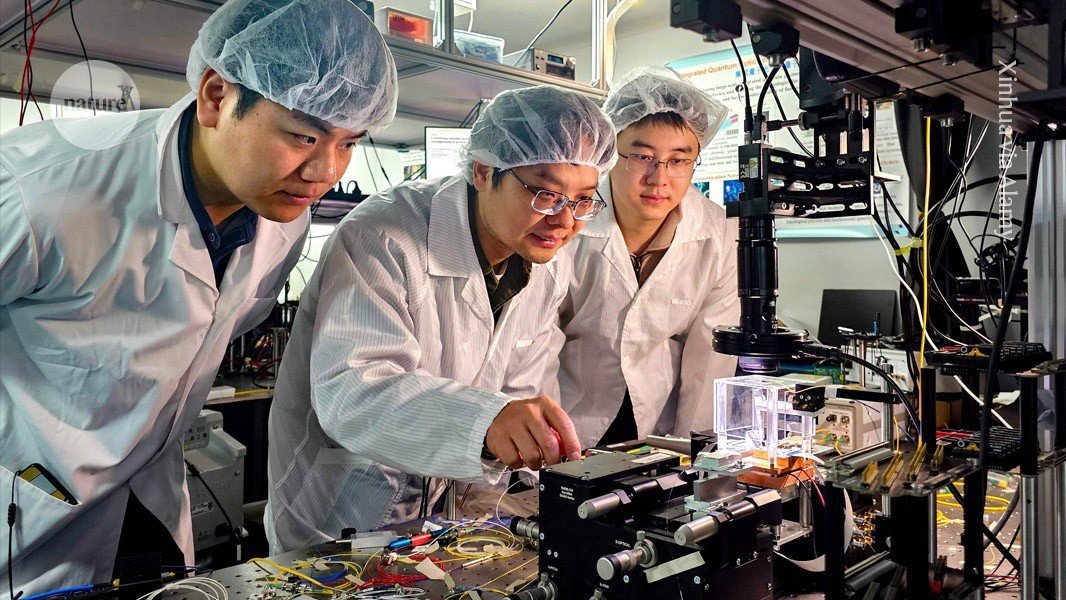
    Researchers at Peking University in China test an integrated photonic quantum chip.Credit: Xinhua via Alamy

    Share
    Facebook Twitter LinkedIn Pinterest Email

    Researchers at Peking University in China test an integrated photonic quantum chip.Credit: Xinhua via Alamy

    As generative artificial-intelligence models become more sophisticated and eat up more energy to produce images and videos, the electronic chips that power them are reaching their limits of speed and efficiency. Optical chips – semiconductor chips that run on light rather than electricity – could solve these problems, say researchers working in the field.

    Such chips, also called photonic chips, are still years away from being integrated into consumer computers and are unlikely to wholly replace electronic chips. However, optical chip research has grown drastically in the past five years, with China leading the charge.

    “China has for the past decade invested strategically in infrastructure, capability and talent” in this field, says Ben Eggleton, a physicist at the University of Sydney, Australia. Eggleton, who was the editor-in-chief of APL Photonics for more than a decade until his tenure ended in December 2025, says that he has seen an increase in the number of high-quality publications on photonic chips from China.

    Chinese researchers published 476 papers on optical chips last year, the most of any country, according to a Nature analysis of papers in the Dimensions database (part of Digital Science, a firm operated by the Holtzbrinck Publishing Group, which has a share in Nature’s publisher, Springer Nature). The number of Chinese-authored papers grew by tenfold between 2017 and 2025. The United States was the next top producer, with an output that more than doubled during that period.

    China’s embrace of optical computing has accelerated in the wake of US policies to limit China’s access to the most advanced electronic chips and to restrict the equipment necessary to manufacture them. Such chips are needed to train and deploy large AI models.

    The restrictions have sharpened China’s incentive to find alternative pathways to high-performance computing, says Zengguang Cheng, a materials scientist at Fudan University in Shanghai, China. “China’s 14th five-year plan finds mention of photonics, along with quantum computing projects. China’s government has provided sustained investments for this,” he adds.

    Computation challenges

    Optical chips transmit information using photons rather than electrons. Because photons travel fast and do not shed energy as heat, optical systems can perform better than electronic ones and have lower energy loss. Such chips are already found in sensors, data communication systems and biomedical devices. But using them to perform computation — particularly for generative AI tasks — poses extra challenges.

    Electronic chips manipulate voltages using transistors. Photonic chips, by contrast, depend on controlling the amplitude, phase and interference patterns of light. This makes them energy efficient but harder to scale, reconfigure and train for complex tasks, says Yitong Chen, an electronic engineer at Shanghai Jiao Tong University in China. Until recently, most photonic chips could perform only narrow functions, such as classifying images.

    Last month, Chen and colleagues unveiled the first all-optical chip1, called LightGen, that can run advanced generative AI models to produce images and videos.

    The researchers used densely integrated metasurfaces — stacked layers engineered to manipulate light at the nanoscale, which allowed them to integrate millions of photonic neurons into the chip. They also developed a training algorithm tailored specifically for optical systems. According to the team, LightGen generated images, edited video content and even produced 3D scenes at speeds and energy efficiencies exceeding those of high-end processors, such as NVIDIA’s A100.

    Eggleton says that the work is an impressive proof of concept for a fast and energy-efficient photonic chip that can complete specific tasks.

    betting China chips computer optical Power
    Share. Facebook Twitter Pinterest LinkedIn Tumblr Email
    Previous ArticleLabour chooses Angeliki Stogia for Gorton and Denton byelection | Labour
    Next Article DeVry Embeds AI Literacy in All Courses
    onlyplanz_80y6mt
    • Website

    Related Posts

    Mass grave in Jordan sheds new light on world’s earliest recorded pandemic | Infectious diseases

    January 31, 2026

    Largest galaxy survey yet confirms that the Universe is not clumpy enough

    January 31, 2026

    Briefing Chat: What Brazilian centenarians could reveal about the science of ageing

    January 31, 2026
    Add A Comment
    Leave A Reply Cancel Reply

    Top Posts

    Watch Lady Gaga’s Perform ‘Vanish Into You’ on ‘Colbert’

    September 9, 20251 Views

    Advertisers flock to Fox seeking an ‘audience of one’ — Donald Trump

    July 13, 20251 Views

    A Setback for Maine’s Free Community College Program

    June 19, 20251 Views
    Stay In Touch
    • Facebook
    • YouTube
    • TikTok
    • WhatsApp
    • Twitter
    • Instagram
    Latest Reviews

    At Chile’s Vera Rubin Observatory, Earth’s Largest Camera Surveys the Sky

    By onlyplanz_80y6mtJune 19, 2025

    SpaceX Starship Explodes Before Test Fire

    By onlyplanz_80y6mtJune 19, 2025

    How the L.A. Port got hit by Trump’s Tariffs

    By onlyplanz_80y6mtJune 19, 2025

    Subscribe to Updates

    Get the latest tech news from FooBar about tech, design and biz.

    Most Popular

    Watch Lady Gaga’s Perform ‘Vanish Into You’ on ‘Colbert’

    September 9, 20251 Views

    Advertisers flock to Fox seeking an ‘audience of one’ — Donald Trump

    July 13, 20251 Views

    A Setback for Maine’s Free Community College Program

    June 19, 20251 Views
    Our Picks

    DeVry Embeds AI Literacy in All Courses

    China is betting on ‘optical’ computer chips – will they power AI?

    Labour chooses Angeliki Stogia for Gorton and Denton byelection | Labour

    Recent Posts
    • DeVry Embeds AI Literacy in All Courses
    • China is betting on ‘optical’ computer chips – will they power AI?
    • Labour chooses Angeliki Stogia for Gorton and Denton byelection | Labour
    • Eton head apologises after former teacher jailed for sexual assault of pupil | Private schools
    • Drone strikes in Ethiopia’s Tigray kill one amid fears of renewed conflict | Conflict News
    © 2026 naijaglobalnews. Designed by Pro.
    • About Us
    • Disclaimer
    • Get In Touch
    • Privacy Policy
    • Terms and Conditions

    Type above and press Enter to search. Press Esc to cancel.