
Close Menu

    Subscribe to Updates

    Get the latest creative news from FooBar about art, design and business.

    What's Hot

    Africa particularly vulnerable as Iran conflict disrupts supply chains, say experts | Africa

    Writing Faculty Push for the Right to Refuse AI

    Bank of America settles Epstein survivors’ lawsuit | Jeffrey Epstein

    Facebook X (Twitter) Instagram
    Facebook X (Twitter) YouTube LinkedIn
    Naija Global News |
    Tuesday, March 17
    • Business
    • Health
    • Politics
    • Science
    • Sports
    • Education
    • Social Issues
    • Technology
    • More
      • Crime & Justice
      • Environment
      • Entertainment
    Naija Global News |
    You are at:Home»Science»3,000-light-year-long jet offers new clues to first black hole ever imaged
    Science

    3,000-light-year-long jet offers new clues to first black hole ever imaged

    onlyplanz_80y6mtBy onlyplanz_80y6mtJanuary 30, 2026003 Mins Read
    Share Facebook Twitter Pinterest LinkedIn Tumblr Email
    3,000-light-year-long jet offers new clues to first black hole ever imaged

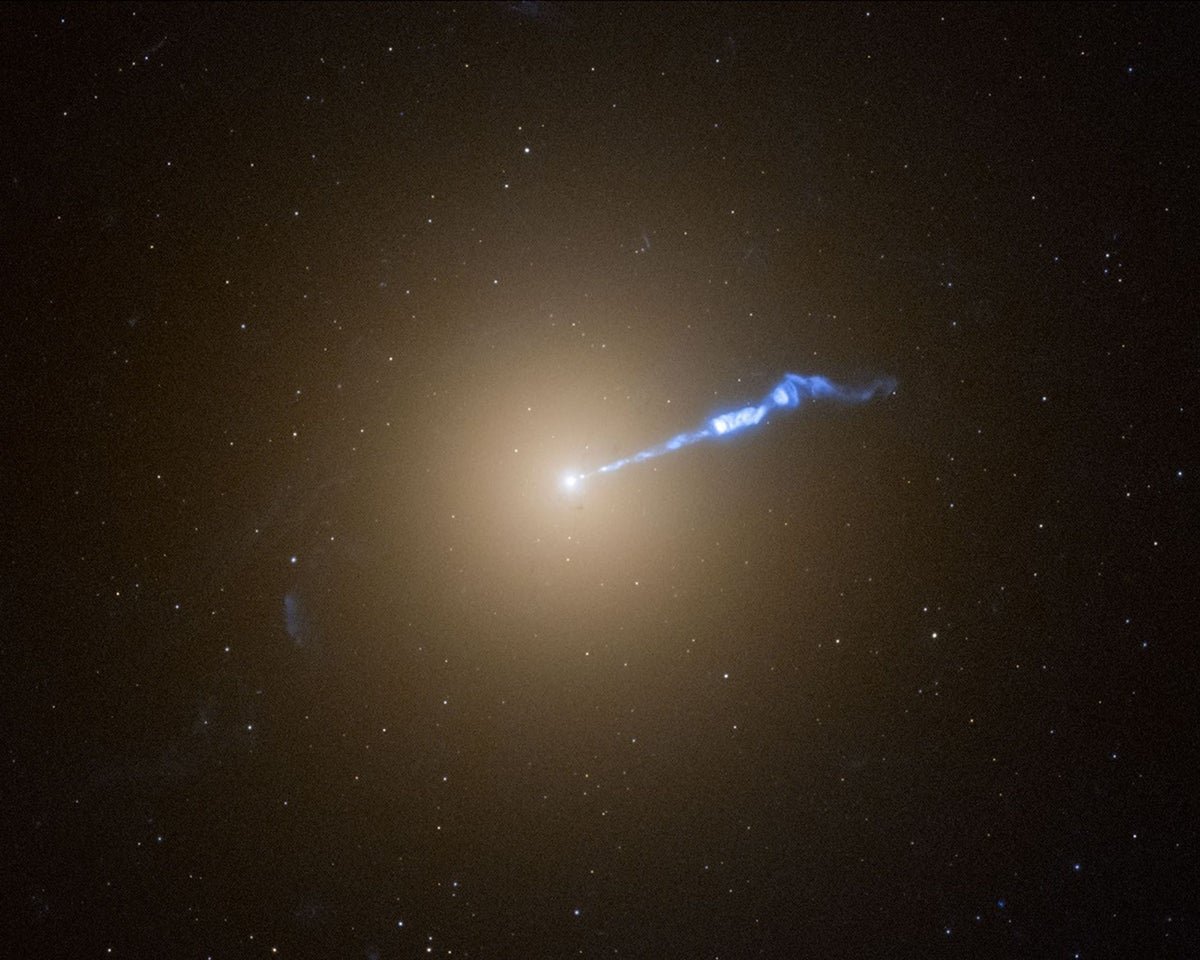
    The galaxy Messier 87 (M87) and a 3,000-light-year-long jet of plasma blasting from its central black hole.

    NASA/ESA/STScI/Alec Lessing/Stanford University/Michael Shara/AMNH (image); Edward Baltz/Stanford University (acknowledgment); Joseph DePasquale/STScI (image processing)

    Share
    Facebook Twitter LinkedIn Pinterest Email

    January 30, 2026

    1 min read

    Add Us On GoogleAdd SciAm

    3,000-light-year-long jet offers new clues to first black hole ever imaged

    Astronomers have traced the origin point of a jet of material that is thousands of light-years long emanating from the supermassive black hole M87*

    By Jackie Flynn Mogensen edited by Claire Cameron

    The galaxy Messier 87 (M87) and a 3,000-light-year-long jet of plasma blasting from its central black hole.

    NASA/ESA/STScI/Alec Lessing/Stanford University/Michael Shara/AMNH (image); Edward Baltz/Stanford University (acknowledgment); Joseph DePasquale/STScI (image processing)

    Located at the center of the galaxy Messier 87 (M87), the supermassive black hole M87* holds a special place in the science history books: it’s the first black hole ever imaged and is the origin of what NASA has called “one of nature’s most amazing phenomena.” That’s because the black hole is spewing out a gigantic jet of material that is blazing a 3,000-light-year-long trail through the cosmos.

    M87* is both a messy and greedy eater: as dust and gas falls toward it, the black hole shoots out powerful jets of charged particles. But astronomers didn’t exactly know where these jets originated—until now. In new research published in the journal Astronomy & Astrophysics, scientists lay out evidence of what they believe are the “first hints” of M87*’s jet base.

    Using observations from the Event Horizon Telescope, the team examined the glowing ring of superhot material around M87* and identified what they believe is the “probable position” of the extremely long jet’s origin.

    On supporting science journalism

    If you’re enjoying this article, consider supporting our award-winning journalism by subscribing. By purchasing a subscription you are helping to ensure the future of impactful stories about the discoveries and ideas shaping our world today.

    The first image of the black hole at the center of the galaxy M87. The image was released April 2019.

    Event Horizon Telescope Collaboration

    The results could inform future studies of M87*’s superlative jet and the mechanics of similar supermassive black holes.

    “This study represents an early step toward connecting theoretical ideas about jet launching with direct observations,” said the paper’s lead author Saurabh, a researcher at the Max Planck Institute for Radio Astronomy in Bonn, Germany, in a statement.

    “Identifying where the jet may originate and how it connects to the black hole’s shadow, adds a key piece to the puzzle and points toward a better understanding of how the central engine operates,” he said.

    It’s Time to Stand Up for Science

    If you enjoyed this article, I’d like to ask for your support. Scientific American has served as an advocate for science and industry for 180 years, and right now may be the most critical moment in that two-century history.

    I’ve been a Scientific American subscriber since I was 12 years old, and it helped shape the way I look at the world. SciAm always educates and delights me, and inspires a sense of awe for our vast, beautiful universe. I hope it does that for you, too.

    If you subscribe to Scientific American, you help ensure that our coverage is centered on meaningful research and discovery; that we have the resources to report on the decisions that threaten labs across the U.S.; and that we support both budding and working scientists at a time when the value of science itself too often goes unrecognized.

    In return, you get essential news, captivating podcasts, brilliant infographics, can’t-miss newsletters, must-watch videos, challenging games, and the science world’s best writing and reporting. You can even gift someone a subscription.

    There has never been a more important time for us to stand up and show why science matters. I hope you’ll support us in that mission.

    3000lightyearlong Black Clues Hole imaged Jet offers
    Share. Facebook Twitter Pinterest LinkedIn Tumblr Email
    Previous ArticleAfter Trump call, Russia agrees to pause attacks on Kyiv amid cold spell | Russia-Ukraine war
    Next Article Judge rules Luigi Mangione will not face death penalty in healthcare CEO case | Brian Thompson shooting
    onlyplanz_80y6mt
    • Website

    Related Posts

    What’s behind the injectable peptide craze? – podcast | Science

    March 17, 2026

    A single course of antibiotics can cause lingering changes in gut microbes

    March 17, 2026

    Deadly campus meningitis outbreak in the U.K. kills 2, sickens many more

    March 17, 2026
    Add A Comment
    Leave A Reply Cancel Reply

    Top Posts

    Watch Lady Gaga’s Perform ‘Vanish Into You’ on ‘Colbert’

    September 9, 20251 Views

    Advertisers flock to Fox seeking an ‘audience of one’ — Donald Trump

    July 13, 20251 Views

    A Setback for Maine’s Free Community College Program

    June 19, 20251 Views
    Stay In Touch
    • Facebook
    • YouTube
    • TikTok
    • WhatsApp
    • Twitter
    • Instagram
    Latest Reviews

    At Chile’s Vera Rubin Observatory, Earth’s Largest Camera Surveys the Sky

    By onlyplanz_80y6mtJune 19, 2025

    SpaceX Starship Explodes Before Test Fire

    By onlyplanz_80y6mtJune 19, 2025

    How the L.A. Port got hit by Trump’s Tariffs

    By onlyplanz_80y6mtJune 19, 2025

    Subscribe to Updates

    Get the latest tech news from FooBar about tech, design and biz.

    Most Popular

    Watch Lady Gaga’s Perform ‘Vanish Into You’ on ‘Colbert’

    September 9, 20251 Views

    Advertisers flock to Fox seeking an ‘audience of one’ — Donald Trump

    July 13, 20251 Views

    A Setback for Maine’s Free Community College Program

    June 19, 20251 Views
    Our Picks

    Africa particularly vulnerable as Iran conflict disrupts supply chains, say experts | Africa

    Writing Faculty Push for the Right to Refuse AI

    Bank of America settles Epstein survivors’ lawsuit | Jeffrey Epstein

    Recent Posts
    • Africa particularly vulnerable as Iran conflict disrupts supply chains, say experts | Africa
    • Writing Faculty Push for the Right to Refuse AI
    • Bank of America settles Epstein survivors’ lawsuit | Jeffrey Epstein
    • What’s behind the injectable peptide craze? – podcast | Science
    • Cannabis is not an effective treatment for common mental health conditions, says review | Cannabis
    © 2026 naijaglobalnews. Designed by Pro.
    • About Us
    • Disclaimer
    • Get In Touch
    • Privacy Policy
    • Terms and Conditions

    Type above and press Enter to search. Press Esc to cancel.