

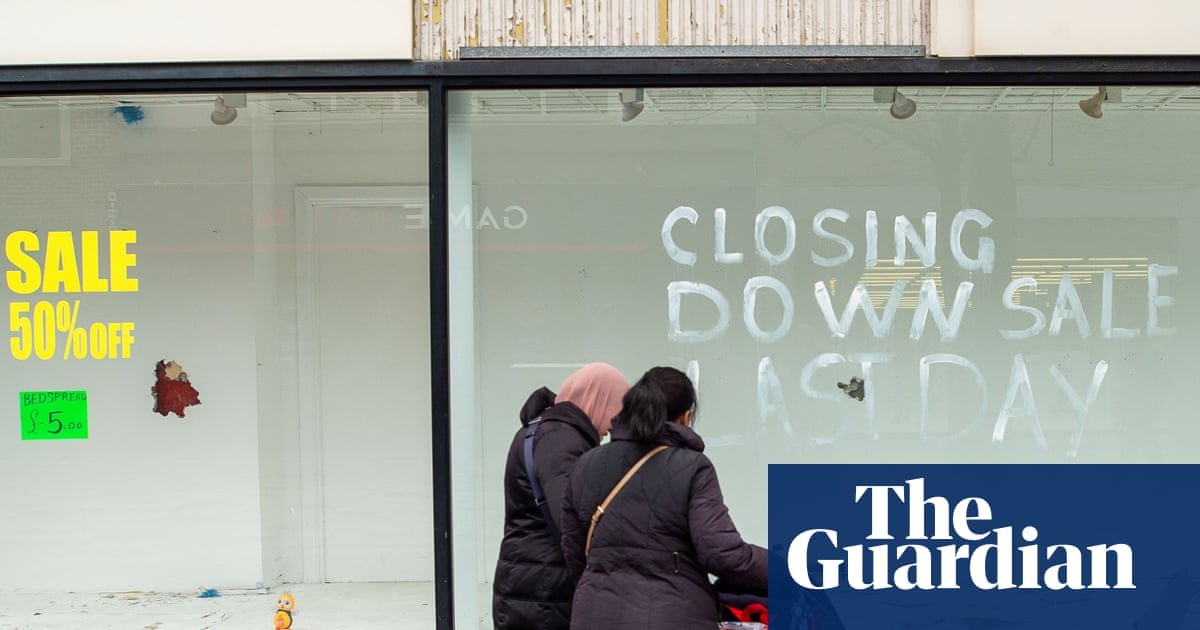
Labour will be “washed away in a tide of discontent” at the next general election unless it tackles the decline of Britain’s high streets, a study has warned, as Guardian analysis lays bare the changing face of town centres.
Research by the University of Southampton found people feel high streets have declined more than any other part of their local area over the past decade as household brands collapsed and shoplifting rose.
Improving shopping precincts was the third most important local issue for voters, behind good healthcare and reducing crime, according to polling conducted by YouGov.
Reform UK supporters were more likely than anyone else to say their area had significantly declined, underlining what researchers called a “deep sense of place-based resentment” towards Westminster.
Labour MPs say they are increasingly alarmed by the state of high streets, which for many voters have become symbolic of whether their area is prospering – and have been a focus of business backlash over the significant increases to business rates in November’s budget.
In response to that anger, a business rates discount for pubs announced on Tuesday came alongside the promise of a “high street strategy”, with a set of measures to be announced later this year. Dan Tomlinson, a Treasury minister, said: “We do understand it’s a tough time for other businesses on the high street … consumers have changed their habits, increasingly working from home and shopping online, and these trends continue to make it harder.”
Those changes are starkly illustrated by new Guardian analysis of Ordnance Survey and Landmark Information data, which found there were at least 8,000 fewer retail outlets in 2025 than in 2019, as traditional shopping faltered and new types of businesses moved in to fill the gaps.
Restaurants, vape shops and discount stores are among the winners on Britain’s high streets over the past six years, as bookmakers, department stores and clothing shops have continued to disappear.
Much of the shift is due to the rise in online shopping during and after the Covid-19 pandemic. According to the Office for National Statistics, 28% of retail sales took place online in October 2025, up from 19% in the same month in 2019.
Chart shows traditional retail is in decline on high streets
Despite inflationary pressures, high street restaurants expanded from just over 17,000 to 25,000 since 2019 as demand for eating out rebounded after the lockdowns. As retail has retreated, services such as tattoo and piercing salons (up 20%) and hairdressers (up 17%) have taken over vacant units.
Soaring e-cigarette use among younger adults – with recent figures showing there are now more over-16s using vapes than smoking cigarettes – has driven an estimated 38% rise in specialist vaping shops since 2019. There has also been a 41% increase in bargain stores, as retailers target cash-strapped consumers after the cost of living crisis.
Some traditional retailers have also done well: despite the continued dominance of Amazon in the book market, the number of bookshops increased by almost a fifth.
At the same time, other long-established fixtures of town centres have continued to retreat. Slightly more than 1,000 department stores remain on high streets, down from more than 1,700 six years ago.
Opticians have reduced their presence by 12%, while betting shops have lost more than a fifth of their outlets since before the pandemic. (That decline has been partly offset by a 26% rise in slot-machine arcades, often operating in some of the most deprived areas of the country.)
The number of clothing shops has fallen by 13%, while florists are down 24% and stationers are down by 23%. Nightclubs have declined by almost a fifth, with young people who came of age during the pandemic reportedly more likely to stay in. In contrast, there are 46% more high street gyms, driven by the expansion of chains such as PureGym and The Gym Group.
The data also highlights the erosion of basic amenities. The number of public toilets on high streets has fallen by a fifth as English councils have cut discretionary spending to protect legally required services such as adult social care. Cash machines have declined from 4,380 to 2,573 as card payments have taken over.
Leigh Ingham, a Labour MP, said there was a “proper sense of decline in our towns”, calling it the “heritage of 14 years of austerity”. She is backing legislation to allow councils to take control of empty shops for community projects until permanent tenants move in. “This is a massive issue for everyone,” she said. “It’s about wanting to do right by our communities.”
Ingham said Labour was taking action to tackle high street decline – such as allowing communities to reclaim empty shops – but that this was due to “wanting to do right by our community” and not “the perceived threat” from Reform UK. She added: “Change works better when you do it with local input, not places being done to.”
Charts show food, drink and gyms are becoming the focus of the high street
Prof Will Jennings, who led the University of Southampton research, said Labour’s political fate rested on its ability to address this local gloom. “Our report reveals a high level of place-based resentment in British politics,” he said. “People tend to think that politicians in Westminster don’t care about their region and that not enough is being done to improve the economic situation.”
The study builds on two previous YouGov surveys and shows a collapse in local pride between the end of Boris Johnson’s time as prime minister in September 2022 and the end of Rishi Sunak’s premiership in July 2024, driven by concerns about healthcare, shops, crime and opportunities for young people. There was a partial rebound last year under Labour, but the state of the high street remained by far the issue people felt had worsened most over the past decade.
The government has launched a £5bn, 10-year regeneration programme under its “pride in place” scheme, with 250 places across England, Scotland and Wales to receive up to £20m each to support locally led plans to revitalise town centres and bring vacant units back into use. Lisa Nandy, the culture secretary, has also announced that the UK’s first “town of culture” will be crowned in 2026.
Business groups warn that regeneration schemes must be matched by practical support. Tina McKenzie, the policy chair at the Federation of Small Businesses, said high streets were vital to jobs, pride and wellbeing but faced a risk of “a vicious cycle setting in” without help on costs such as business rates, staffing and energy bills. She said a strong mix of businesses was essential to sustaining footfall, adding that “high streets keep on evolving to reflect changing customer needs”.
Almost a fifth of freeholdings in England and Wales’s shopping districts are owned by real estate companies and less than 2% are owned by retailers, a Guardian analysis of Land Registry data has found. There were 94 retail areas across the country where most freehold land titles were held by one single company or council.
