

Tools of the Scribe: How Writing Systems, Technology, and Human Factors Interact to Affect the Act of Writing Brian Roark et al. Springer (2025)
The world’s oldest writing system still in use, that of Chinese characters, dates from about 1200 bc. It has survived almost as long as its even older predecessors. For instance, cuneiform — comprising wedge-shaped marks inscribed in clay tablets with a stylus — was used in ancient Mesopotamia until the first century ad and Egyptian hieroglyphs remained in use until the fourth century ad. Moreover, Chinese characters were central to the development of writing systems in several other cultures, notably those of Japan and Korea.
How the world’s largest language family spread — and why others go extinct
Yet today, millions of people who speak and read Chinese have forgotten how to compose many of the traditional characters by hand, relying instead on simpler phonetic and digital equivalents. This controversial trend in China, generally known as character amnesia, opens Tools of the Scribe, a stimulating and original, if technical, book by computational linguists Brian Roark, Richard Sproat and Su-Youn Yoon.
The book explores how “the implement, the medium, the writing system and the writer” interact to produce text. The authors analyse the linguistic structure of writing systems ranging from ancient cuneiform to modern alphabets; the technologies that have shaped writing in both the past and the present; and the processes underlying computer-based ‘scribes’, including large language models. Although their main focus is on technology, the authors draw on research in many fields, including psychology, neuroscience, linguistics, ergonomics, anthropology and speech and language pathology.
Writing evolves
Chinese characters illustrate this interaction between implement, medium, system and writer vividly. Their first incarnation was in ‘oracle bones’ used for divination during the Shang dynasty (about 1600 bc to 1046 bc). Notches were drilled and chiselled into the surfaces of turtle shells and ox scapulae, such that when heat was applied, cracks would appear. These cracks were interpreted by a diviner to answer questions posed by the Shang king. The answers were often written on the bones using symbols — many of them recognizable antecedents of modern Chinese characters.
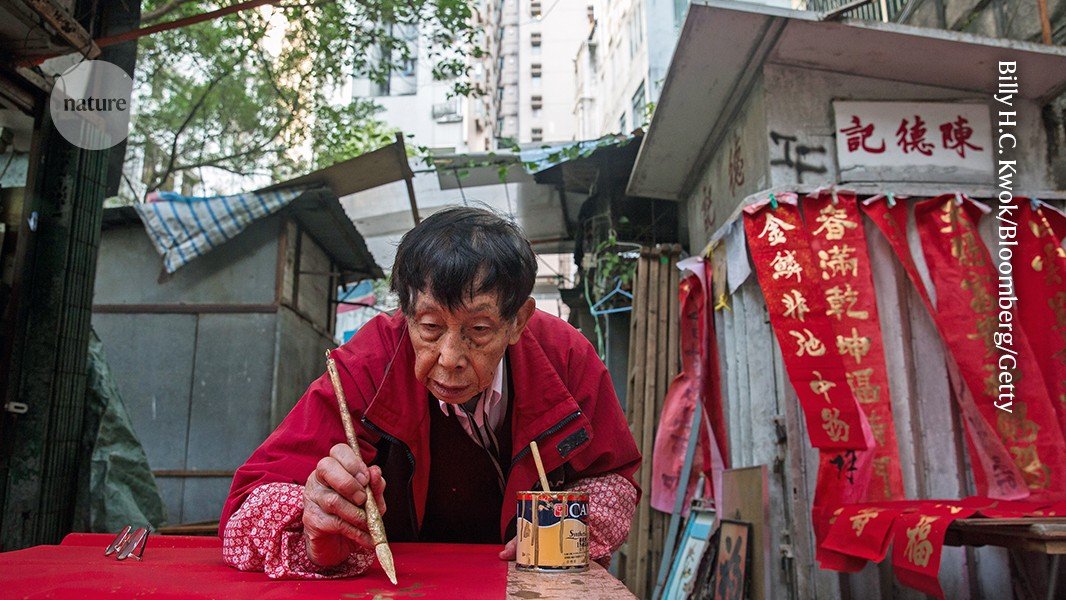
Subsequently, during the late Shang (about 1250 bc to 1046 bc) and Western Zhou (about 1046 bc to 771 bc) dynasties, inscriptions on bronze vessels were used to record ancestor worship, royal decrees, military victories, land grants, marriages and family histories. Then, during the latter half of the first millennium bc, the characters evolved into a more complex calligraphic form, painted in ink with a brush or pen on bamboo or paper: an art form still practised today. In ad 868, Chinese script was used to write the world’s oldest extant printed book: a paper scroll known as The Diamond Sutra, which records a dialogue between the Buddha and a senior monk.
The script’s complexity increased over time, from some 4,500 characters initially to roughly 47,000 by the eighteenth century. Today, almost 100,000 characters are listed in Unicode — the international character-encoding standard. However, around the start of the twentieth century, the system hit a technological barrier: the typewriter. The first commercial typewriter, designed for simple Western alphabets, was launched in 1874. By contrast, several attempts to commercialize a Chinese typewriter, beginning in 1919, were unsuccessful owing to the quantity and complexity of Chinese characters.
Many university students use chatbots powered by large language models, such as OpenAI’s ChatGPT, to help write assignments.Credit: Alamy
In 1936, Mao Zedong, leader of the Chinese Communist Party and a devoted calligrapher, announced in his first interview with a Western journalist that “sooner or later, we believe, we will have to abandon the Chinese character altogether if we are to create a new social culture in which the masses fully participate”. After Mao’s government came to power in 1949, it began to simplify characters by eliminating some variants and reducing the number of strokes in many of those remaining. In 1958, officials introduced a romanized Chinese script (using Latin letters) called Pinyin (which translates as spelled sounds) as the modern system for writing the Chinese sounds — hence the modern spelling of Peking as Beijing.
Many people now rely on Pinyin to input Chinese characters into digital devices. What Chinese speakers have gained in ease of writing thanks to modern technology has come “at the cost of losing practice with the neuromotor infrastructure needed to maintain their complex script”, the authors write. Nevertheless, Chinese characters continue to dominate China’s non-digital communication as a symbol of national identity.
A technological helping hand
The technology of writing has changed radically over the centuries — both in China and elsewhere. However, until the late twentieth century, the technologies used to input text were passive, the authors observe. Styluses, chisels, brushes, pens, woodblocks, movable type and typewriters gave the writer full control over what appeared on the writing surface. By contrast, computers can now suggest alternative spellings or synonyms, automatically correct errors and — with the advance of artificial intelligence — even write a whole text. As a result, “the notion of ‘writer’ itself becomes unclear”, the authors note.
The book dives into the challenges surrounding the increasing use of AI systems by students. In a 2024 survey, 96% of US university students reported having used OpenAI’s ChatGPT chatbot for at least one project in that academic year, and 69% had done so for writing assignments (see go.nature.com/4pyzbyv). In another study, US secondary-school students used ChatGPT mainly to plan essays (S. Levine et al. J. Adolesc. Adult Lit. 68, 445–457; 2025). However, they tended to accept or reject the tool’s suggested edits as a whole, instead of examining each suggestion separately “to learn from their mistakes”.
