

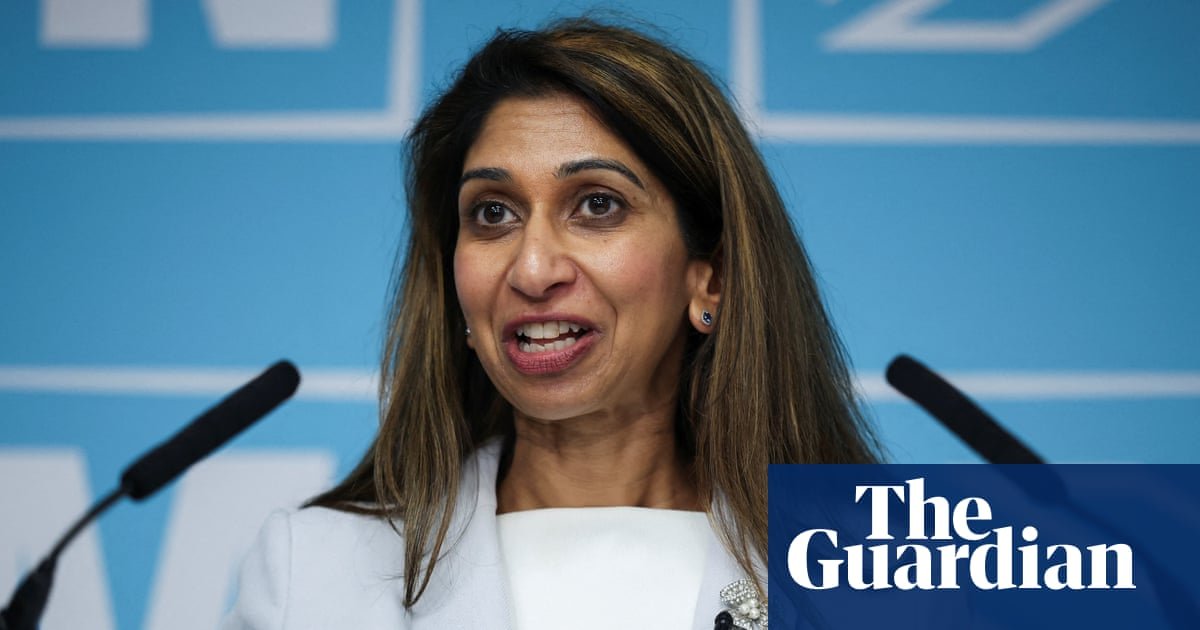
The Conservatives have withdrawn a claim that Suella Braverman’s defection to Reform UK on Monday was connected to her mental health, following criticism from across the political spectrum.
Earlier, in an official statement it now says was “sent out in error”, the party said: “It was always a matter of when, not if, Suella would defect. The Conservatives did all we could to look after Suella’s mental health, but she was clearly very unhappy.”
The statement was shared with journalists by a Conservative party spokesperson and swiftly condemned by MPs, peers and mental health charities for its brutality and indiscretion, as well as for trivialising and weaponising mental health struggles.
Speaking to GB News after the statement was released, Nigel Evans, a former Conservative MP, said it was an “absolute disgrace” and “completely underhand”.
Stewart Jackson, a Tory peer, wrote on X: “What a nasty and unpleasant statement from @Conservatives. That’s another few thousand votes they’ve lost.”
The Conservative spokesperson subsequently apologised for the error and circulated a statement that omitted the reference to Braverman’s mental health.
Sojan Joseph, a Labour MP and the chair of the all-party parliamentary group on mental health, described the comments as “frankly appalling”. He added: “Conflating a political defection with mental illness downplays an incredibly important issue and undermines the hard work of mental health staff and the genuine struggle of people living with mental health issues.”
A Reform source told the Guardian that the Tory statement was “not true” and “a gross affront to millions of people in this country”. The source said: “Whether you like Suella or not, she is a Cambridge-educated barrister who has served in a series of extraordinary senior positions in this country.
“To just throw around a wild claim of this nature – it goes without saying that she has never been diagnosed with a mental health condition. It is a testament to the extent to which the Tory party is in real panic mode and is prepared to say anything.”
Mike Tapp, a Home Office minister, posted on X that while he had “no sympathy” for Braverman and her immigration policies, “the Tories attacking her mental health is below the standards we expect. British values are strong but decent, firm but fair. Neither the Tories nor Reform sign up to that.”
Josh Fenton-Glynn, the Labour MP for Calder Valley, said the statement was “horrible”. He wrote on X: “Attacking someone on mental health is wrong. The whole thing reads as petty and churlish. The kind of first draft of an email you do before having a cup of tea and letting your better angels take over.”
Mental health charities also shared their disapproval. Tom Pollard, the head of policy at Mind, said it was “disappointing to see a political party commenting publicly on someone’s mental health”.
He added: “Using mental health as a criticism of someone’s actions is stigmatising and unhelpful for anyone who has a mental health problem.”
Brian Dow, the deputy chief executive of Rethink Mental Illness, said: “Employers should never disclose any details about the mental health of their employees or former staff. Doing so says far more about them than the person they are referring to. People living with mental ill-health do not deserve to have their experiences trivialised or used as a political football.”
