

January 23, 2026
2 min read
Add Us On GoogleAdd SciAm
This is the most complete skeleton yet of our ancestor Homo habilis
A partial skeleton dating back more than two million years is the most complete yet of Homo habilis, one of the earliest known species in our genus
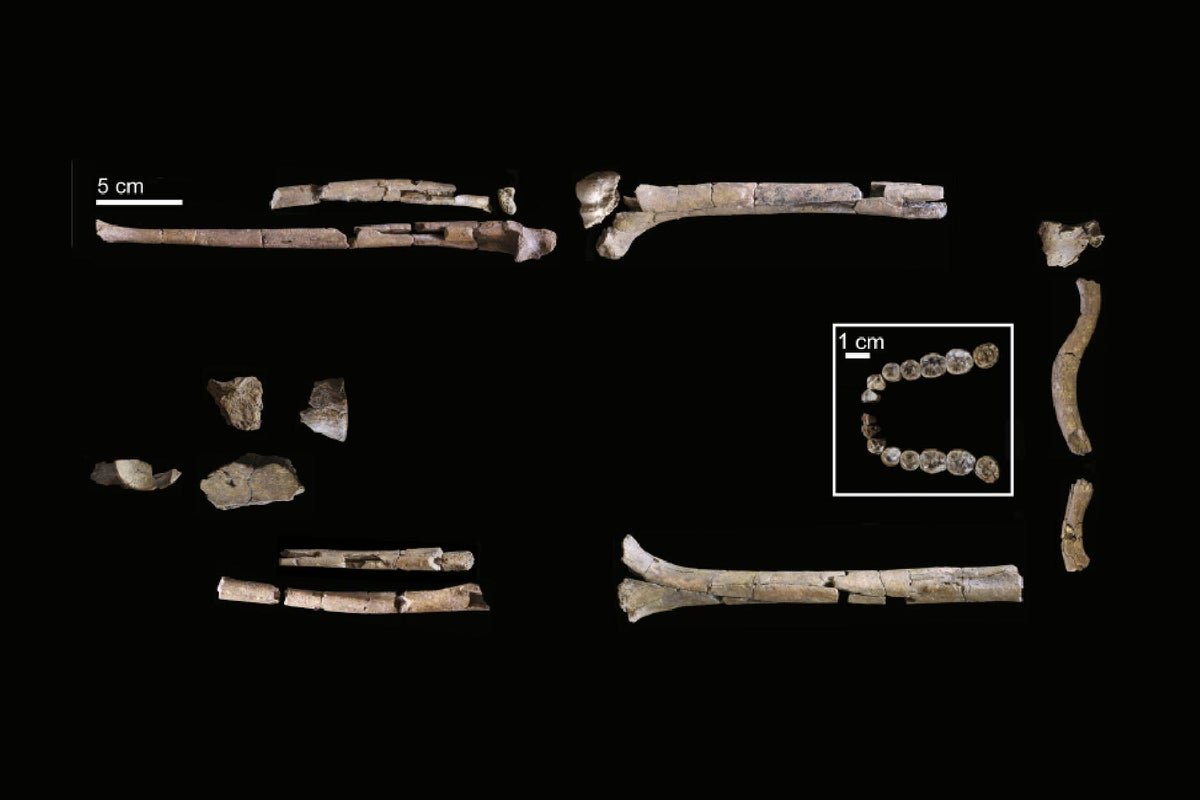
The bones of the Homo habilis skeleton found in found in the Lake Turkana Basin of Kenya.
Adapted from “New partial skeleton of Homo habilis from the upper Burgi Member, Koobi Fora Formation, Ileret, Kenya,” by Grine, et al., in The Anatomical Record; January 13, 2026
A skeleton found in the Lake Turkana Basin area of northern Kenya is the most complete set of remains ever found of Homo habilis, a species that was one of the earliest members of the Homo genus and lived more than two million years ago. Its large brain and flat face—attributes found in today’s humans—have long set the species apart from earlier hominins such as Australopithecus africanus. A new study analyzing the uniquely complete skeleton, however, suggests H. habilis’ body looked much less modern.
The analysis of the bones, published on January 13 in the Anatomical Record, affirms previous assumptions about the species, such as that H. habilis had long and strong arms that were more similar in proportion to those of apes than to those of modern humans. Additionally, H. habilis was small—perhaps even smaller than Lucy, a 3.2-million-year-old hominin specimen known for her tiny size.
“A finding like this does give hope,” says William Harcourt-Smith, a paleoanthropologist at the American Museum of Natural History, who was not involved in the study. “It’s been tough with Homo habilis, as there are very limited, scrappy remains. It shows us that hard work in the field, and constantly looking for them, reaps important dividends.”
On supporting science journalism
If you’re enjoying this article, consider supporting our award-winning journalism by subscribing. By purchasing a subscription you are helping to ensure the future of impactful stories about the discoveries and ideas shaping our world today.
Some of the skeleton’s teeth were first found in the sediments of Lake Turkana by Arbollo Aike of the Koobi Fora Research Project in 2012. Over the next couple of years, the study authors followed a trail of bone fragments downslope for several meters, discovering more teeth and a series of larger bones from the upper body. The fully excavated skeleton includes a nearly complete set of lower teeth, both collarbones, both upper arm and forearm bones, and fragments of the shoulder blades and pelvis.
Analyzing the bones took more than a decade, study co-author Ashley Hammond said in a statement. First researchers had to ascertain that all the bones came from the same individual and that the individual was from the H. habilis species. “Fortunately for us, the teeth are one of the most diagnostic parts of the skeleton for identifying hominin species,” says study co-author Carrie Mongle, an assistant professor of anthropology at Stony Brook University.
Still elusive is the build of H. habilis’ lower body. The pelvic fragment found with the new skeleton suggests the species might have been able to walk more upright than earlier hominins, Mongle says. Still, more information about the lower body is needed to learn exactly where the species fits into the evolution of humanlike posture and gait.
Because H. habilis is one of the earliest members of our genus, understanding more about this species helps to shed light on the evolution that led to our own, researchers say.
“This study underlines how crucial individual fossil discoveries can be,” says Rebecca Wragg Sykes, an honorary archeology researcher at the University of Cambridge and the University of Liverpool in England, who was not involved in the study. “Just a few new fragments can transform our view not only of that species but [of] their evolutionary context, too.”
It’s Time to Stand Up for Science
If you enjoyed this article, I’d like to ask for your support. Scientific American has served as an advocate for science and industry for 180 years, and right now may be the most critical moment in that two-century history.
I’ve been a Scientific American subscriber since I was 12 years old, and it helped shape the way I look at the world. SciAm always educates and delights me, and inspires a sense of awe for our vast, beautiful universe. I hope it does that for you, too.
If you subscribe to Scientific American, you help ensure that our coverage is centered on meaningful research and discovery; that we have the resources to report on the decisions that threaten labs across the U.S.; and that we support both budding and working scientists at a time when the value of science itself too often goes unrecognized.
In return, you get essential news, captivating podcasts, brilliant infographics, can’t-miss newsletters, must-watch videos, challenging games, and the science world’s best writing and reporting. You can even gift someone a subscription.
There has never been a more important time for us to stand up and show why science matters. I hope you’ll support us in that mission.
