

January 23, 2026
4 min read
Add Us On GoogleAdd SciAm
AI’s next battleground is your body
Tech giants are betting that we are finally ready to invite a persistent digital device into our lives
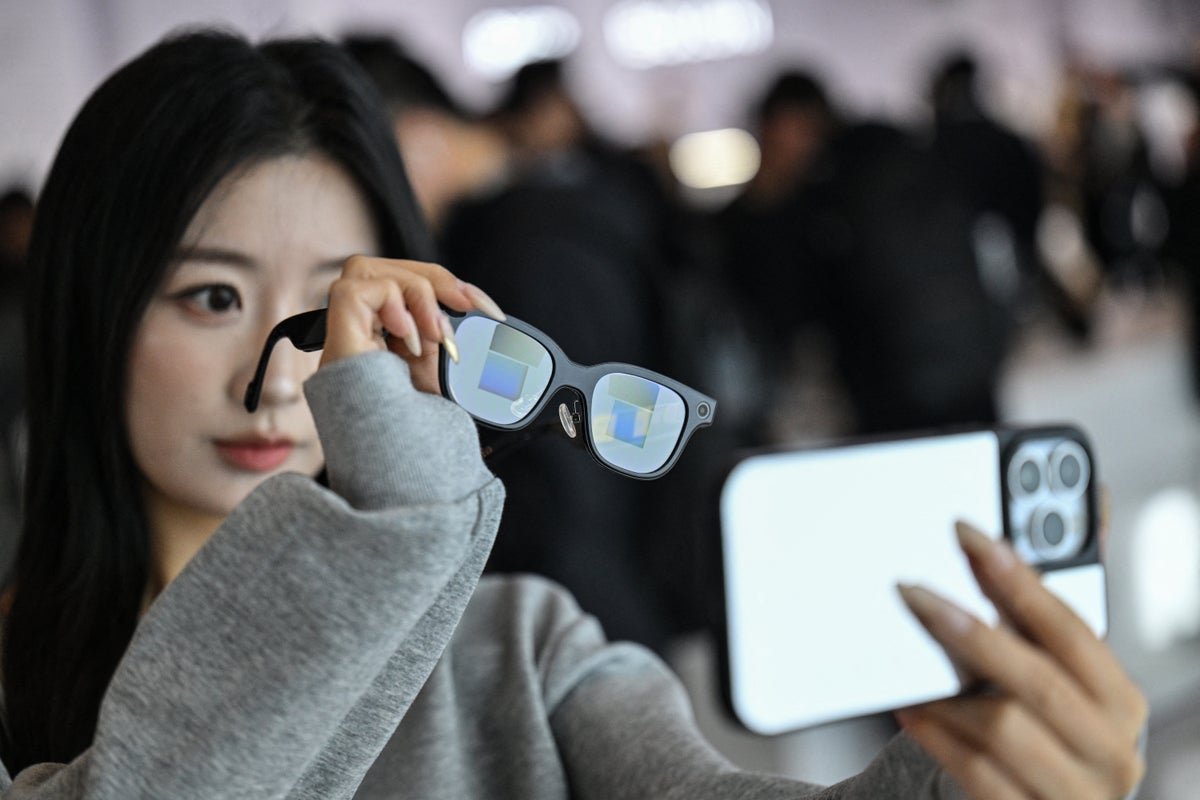
A woman tests AI-powered Rokid smart glasses during a product presentation in Hangzhou, China, on November 13, 2025, as advances in artificial intelligence and augmented reality fuel renewed global interest in smart eyewear.
Artificial intelligence is everywhere online, but are we ready to wear it? Reports from The Information suggest Apple is in the “early stages” of developing an AI-powered wearable the size of an AirTag, outfitted with microphones, a speaker and cameras. Meanwhile, at the World Economic Forum’s annual meeting in Davos, Switzerland, OpenAI confirmed plans for its own AI device—predicted to be a collaboration with Jony Ive, who shaped Apple’s most iconic products.
If you’ve spent the past decade watching the parade of tech wearables (pins, pendants, rings, clips, glasses), it’s reasonable to ask whether people will use ones powered by AI—not just for a TikTok video but on the subway, in a meeting or at dinner with a spouse. And if so, a bigger question remains: What level of social tolerance will such devices have?
To understand how wearables from Apple and OpenAI might be received, look at the sensory soup they intend to organize. Microphones and cameras capture and catalog faces, voices, traffic and signs. The AI could remind you of a person’s name, count your calories or even prompt you with questions on a date, extending “chatfishing”—online seduction using AI—into the physical world.
On supporting science journalism
If you’re enjoying this article, consider supporting our award-winning journalism by subscribing. By purchasing a subscription you are helping to ensure the future of impactful stories about the discoveries and ideas shaping our world today.
As for the challenges, the most pressing is privacy. In the early 2010s Google Glass turned wearers into walking surveillance systems. The social tension became so high that “Glassholes” were banned from cinemas and bars. “The face is a really intimate place, and to have a piece of technology on it is unsettling,” said Ryan Calo, a University of Washington law professor, to Reuters in 2013.
More recently, Humane’s AI Pin showed how dramatically a tech wearable can fail. Its sci-fi promise—a screenless assistant that projected info onto your palm—crashed because of poor performance. YouTuber Marques Brownlee, a consumer-technology reviewer, called it “the worst product I’ve ever reviewed.” Humane closed down shop in early 2025, selling most of the company to Hewlett-Packard for $116 million.
Then, in 2025, the start-up Friend released an AI companion in the form of a pendant and spent more than $1 million on a New York City subway ad campaign. Defacing the posters became a civic pastime. People scrawled “surveillance tool” and “get real friends” over the ads—a collective act of street-level critique.
So why, after Glass and the AI Pin, are tech giants taking aim at this fraught target? They’re doing so because the prize is enormous. In 2025 Amazon acquired Bee, the maker of a Fitbit-like AI wristband. Last December Meta acquired Limitless, a start-up with a conversational AI pendant. Meanwhile more than two million pairs of Ray-Ban Meta smart glasses have been sold. Though those sales are just a fraction of the three billion iPhones Apple has shipped as of mid-2025, the glasses show that a product category that spent years as a punchline is finally gaining traction.
Living with so much AI already helps explain our gradual acceptance and our resistance. The technology has spread to almost every corner of our lives—except, until now, direct social interactions. AI hesitancy doesn’t explain everything. The pushback is also a crisis of consent. To wear a device is to pull everyone around you into your data stream, where an off-color joke or a bad moment will be recorded—and eventually used to train future AI systems. As privacy philosopher Helen Nissenbaum wrote in a 2011 paper, when the flow of information violates “entrenched norms,” the result is predictable: “protest and complaint.”
Trust is also a question. If an AI app glitches, you close it. But if a wearable has been on you all day and suddenly starts broadcasting private data, the stakes are catastrophic.
Acceptance may come down to usefulness. Smartphones survived early quirks because they quickly became necessary. Meta’s smart glasses are gaining traction because glasses are an accessory that people already want or need, and the AI can give directions, answer questions, translate languages or send messages. For people who are vision-impaired, it can read signs and menus, describe what’s in front of them or connect to live helpers through services such as Be My Eyes, which normally requires using a phone camera. For hearing-impaired people, the glasses can generate live captions for conversations.
Apple and OpenAI have an edge here. Apple’s reputation as the “adult in the room” of tech conveys trust, and an Apple pin will likely be connected not only to Siri—which is slated to be revamped into an AI chatbot—but to the entire Apple ecosystem, which could make the new device significantly more useful than its competitors. OpenAI, meanwhile, can leverage its 800 million weekly ChatGPT users.
Trends suggest AI wearables are gaining more acceptance than many realize. But to move from niche to widespread use, they must respect privacy so as not to alienate the people around us. The winners will have both excellent hardware and social grace. As technology and social media scholar danah boyd wrote in a 2014 article, “People want to be in public, but that doesn’t necessarily mean that they want to be public.”
It’s Time to Stand Up for Science
If you enjoyed this article, I’d like to ask for your support. Scientific American has served as an advocate for science and industry for 180 years, and right now may be the most critical moment in that two-century history.
I’ve been a Scientific American subscriber since I was 12 years old, and it helped shape the way I look at the world. SciAm always educates and delights me, and inspires a sense of awe for our vast, beautiful universe. I hope it does that for you, too.
If you subscribe to Scientific American, you help ensure that our coverage is centered on meaningful research and discovery; that we have the resources to report on the decisions that threaten labs across the U.S.; and that we support both budding and working scientists at a time when the value of science itself too often goes unrecognized.
In return, you get essential news, captivating podcasts, brilliant infographics, can’t-miss newsletters, must-watch videos, challenging games, and the science world’s best writing and reporting. You can even gift someone a subscription.
There has never been a more important time for us to stand up and show why science matters. I hope you’ll support us in that mission.
