

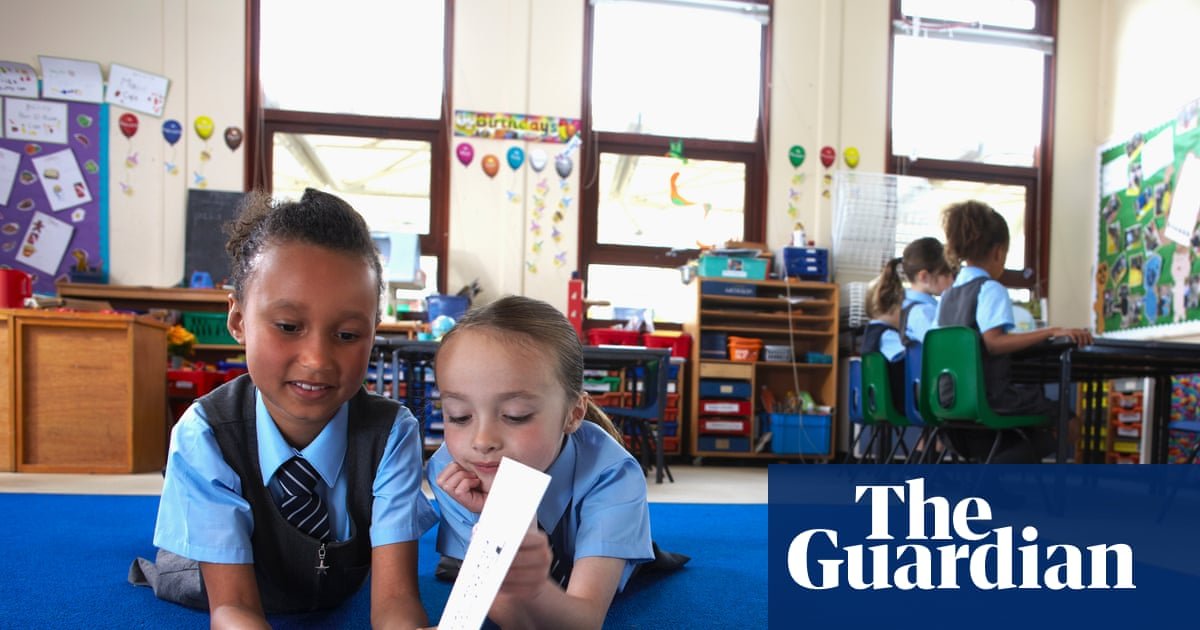
Last night, the culture secretary, Lisa Nandy, announced a £27.5m package for libraries. It’s the latest in a string of reading-focused government initiatives, the flagship being the education department’s National Year of Reading 2026, which kicked off last week with an event at the Emirates Stadium in London.
The Year of Reading campaign comes on the back of research by the National Literacy Trust (NLT), which found reading enjoyment among children and young people is at its lowest recorded level, with just one in three of those aged eight to 18 now reporting enjoying reading “very much” or “quite a lot”.
The year-long campaign aims to work with schools, communities, libraries and early years settings to boost reading for pleasure and, in doing so, “give kids the best start in life”.
Other plans are in the works too. In September, Rachel Reeves pledged that every state primary school in England will have a library by the end of this parliament. In late November, an inquiry into reading for pleasure was launched. Non-government schemes are also under way, with the Children’s Booker prize launched in October.
The education secretary, Bridget Phillipson, talks with pupils at Welland Academy, Peterborough. Photograph: Joe Giddens/PA
“It’s about making reading seem as natural and everyday as breathing,” says Noughts & Crosses author and former children’s laureate Malorie Blackman, who is among a star-studded list of ambassadors for the Year of Reading campaign. “Reading is so important for understanding the world around you. It’s very easy to become laser-focused on just your own experiences, but reading gives you a way of expanding your horizons, learning about other people and other ways of thinking and feeling and doing. We’re in danger of losing that ability to connect and communicate.”
As a child, it was access to a local library that first sparked Blackman’s love of reading. “I used to live in my local library. I didn’t actually go into a bookshop until I was 14, because I couldn’t afford the books,” she says. “Having a public library within walking distance, and the revelation that I could read any and all of the books, made me who I am.”
This is the third National Year of Reading campaign, after earlier iterations in 1998 and 2008. But as the first in the era of widespread smartphone use and streaming, the campaign will focus on all forms of reading material – something Blackman is passionate about.
“I think reading has got a reputation for being this overly worthy, solitary activity, and it so isn’t,” she says. “There are so many types of reading you can do. There’s nothing wrong with, for example, reading graphic novels or comic books. If you’re into cars or motorbikes or whatever it might be – whatever hobby or pastime – you can get more out of it if you read about it.”
‘I used to live in my local library’ … Malorie Blackman signs a book for a young fan at the Hay festival during her time as children’s laureate. Photograph: Steven May/Alamy
Reading “doesn’t seem to offer the immediate social rewards that motivate us today,” says Jonathan Douglas, chief executive of the NLT, which is helping the government deliver the campaign. “It’s seen as slow, solitary, and studious in a world that values speed, status and spectacle.”
The DfE is encouraging parents to “lead by example” when it comes to reading habits, and to read with their children. “Shared reading in the very early years is the most impactful way to build a lifelong love for reading,” says Julie Hayward, director of partnerships for BookTrust, one of the campaign partners. Reading with children under six also helps with self-regulation, empathy and bonding.
Hayward acknowledges that access to reading is not a level playing field. Barriers parents might face in reading with their children include having had a “negative kind of educational journey” or “low confidence in their own literacy levels”.
The campaign approach is key, adds Hayward. “We shouldn’t be judgmental or preachy. It should be fun and joyful.” The 2026 campaign “focuses on appeal, not duty, and highlights the immediate rewards of reading, making it feel relevant, exciting and rewarding right now, not just in the future,” says Douglas.
While the focus on enjoyment makes intuitive sense, studies on childhood reading suggest it could be overly narrow.
Research by Sabine Little, a senior language education lecturer at the University of Sheffield, found that multilingual children spend more time reading for pleasure than monolingual children, and read a wider variety of texts and formats.
Multilingual children typically think about the importance of reading in a broader range of ways, explains Little. When she asked multilingual children she worked with to list three things they had read that were important to them, there were “very, very few” books that were included “because of the plot or because they were favourites. It was much more to do with the connections that the books facilitated” – for example, “the first book read in a new country, the book that introduced them to a new hobby”.
One child cited racehorse listings in Hungarian, because he read those with his grandmother when he was visiting Hungary. Little believes we can learn from the way multilingual children forge connections to books and apply this with monolingual children too. Validating reading material that holds importance to them in different ways would help create a better culture around reading.
For Hayward, the newly launched Children’s Booker prize is a huge step forward. The first winner will be announced in early 2027, with £50,000 awarded for the best fiction for readers aged eight to 12, decided by a mixed panel of adult and child judges. The Booker prize foundation will also give 30,000 copies of shortlisted and winning books to children each year.
While more attention for children’s books is always positive, Steven Pryse, who co-owns the independent children’s bookshop Pickled Pepper Books in north London, is sceptical about the prize’s impact. “The children’s book award scene is crowded, and I’m not convinced the Children’s Booker will make much of a difference.”
There is “a fear as well that the prize might pick up on literary books rather than stuff that is more accessible, which, for me, might be a bit of a danger, with things becoming a little hierarchical.”
However, Little says the prize will create a good opportunity for children to discuss reading in the way they discuss games, television and social media. “One of the things children enjoy doing is speaking about books to their peers.” She is “super excited” that the new prize will include books in translation and has the potential to show that books from different cultures and originally written in languages other than English are a valuable part of British children’s literature.
“It’s important for the authors and the publishing houses, but it’s especially important for children”, explains Hayward, “to have great books that are really exciting and engaging, that they can see themselves in.” Ultimately, the Children’s Booker and the Year of Reading have the same aim: encouraging children to discover books they’ll enjoy. “Whatever you’re into, there are books out there for you,” says Blackman. “When people say to me that they don’t like reading, I always say to them: you just haven’t found the right book yet.”
5 tips to get children reading
Make it fun
“We’re surrounded by words and stories all the time – read the adverts on the bus or on billboards together,” says Pryse. “Reading doesn’t have to always mean a book – try reading a recipe together, or making up a story based on your shopping list.”
Create a relaxed environment
Little encourages parents not to panic if there is a period when their child isn’t reading as much, adding that the more you push children, the more you create a pressurised environment around reading.
Share stories early
“Share stories in the early years, so when children get into school, it doesn’t all become about homework,” says Hayward.
Read yourself
“Let your kids see you reading, even if it’s a magazine or newspaper,” says Pryse. “Why not revisit some classics from your own childhood and share them with them.”
Let them read what they want
“Let children gravitate to the books that capture their interest, even if they seem ‘lightweight’,” says Sarah Satha, who co-founded Inclusive Books for Children (IBC). “Supplement these with award shortlists – Carnegie, Booker, The Week Junior or IBC awards – and don’t be afraid to experiment with genres, formats, and reading levels until you find what hooks them in.”
