

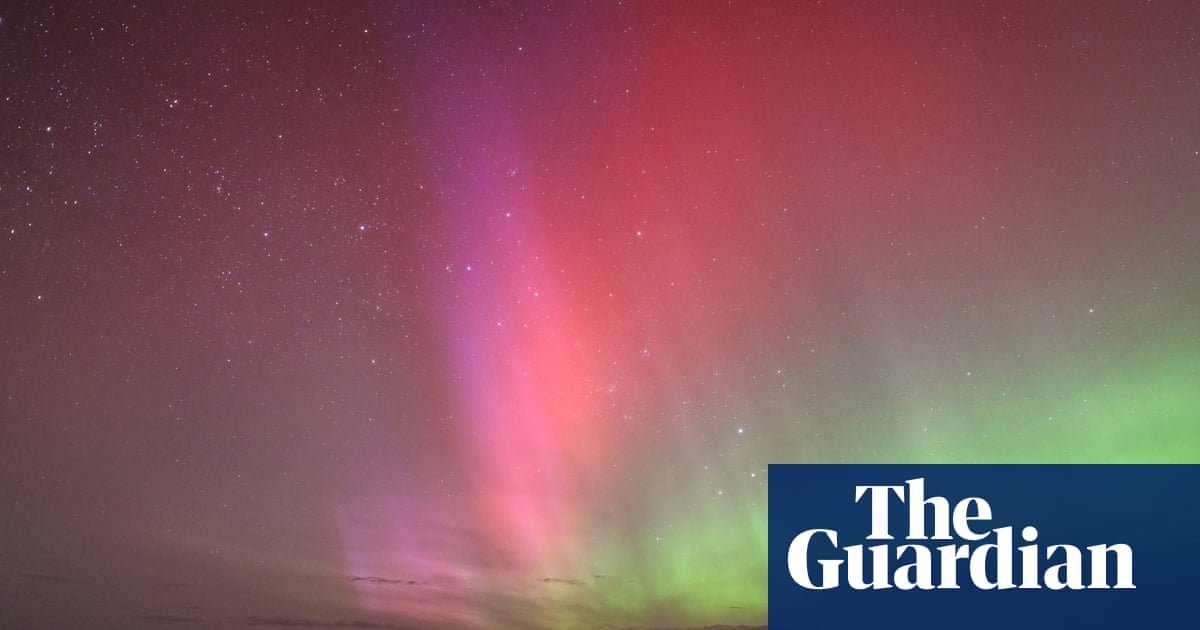
A ‘severe’ solar storm, which is being monitored by the National Emergency Management Agency, could make auroras visible in Australia as well as cause disruptions to the power grid.
Here’s what you need to know about the solar storm.
What is a solar storm?
Just like our planet has weather, so does the sun.
Australian astrophysicist, science communicator and author, Sara Webb, said “a solar storm is a sudden event on the surface of the sun, where particles and plasma are ejected away from the surface and into space.”
“When these storms happen, the particles and plasma can be in direct line of the Earth and end up interacting with our magnetic field”.
When solar particles and plasma collide with the Earth’s magnetic field, they can create the awe-inspiring displays called aurora australis, commonly known as the southern lights.
Webb said that a large flare of energy and material was ejected from the sun on 18 January, and “was starting to hit the Earth late last night.”
Where and when will you be able to see the aurora australis?
The Bureau of Meteorology (BoM) has issued an alert for 20 January that the severe geomagnetic storm in progress could make auroras observable during night time hours in Australia.
In “good observing conditions”, the BoM says, Australian viewers will be able to catch a glimpse of the light show as far north as the middle latitudes – including parts of Victoria and New South Wales.
Hannah Schunker, a physicist in the School of Information and Physical Sciences at the University of Newcastle, said New Zealand and Tasmanian viewers have the best bet at catching a glimpse of the light show, “the closer you get to a pole the more chances you have of seeing the aurora and to see a more vivid and spectacular display.”
But Schunker said that, despite most Australians being far away from the South Pole, the last few years have been “very kind to us” when it comes to auroras and viewers who venture out after dark to a place with a clear view of the southern horizon and very little artificial lighting might get lucky.
Schunker said that the display could come at any moment and they typically last from 20 minutes to an hour.
But Australians will not have the auroras all to themselves, Webb said that people in different parts of the world will also be able to see the displays caused by the solar storm.
“It’s looking very likely that many parts of North America, and Europe will have the chance to spot the northern lights, hours before we look up here in Australia to spot the southern lights”.
Shawn Dahl, service coordinator at the National Oceanic and Atmospheric Administration (Noaa) told the Guardian that the intensity of this storm has not been seen in more than two decades, and could lead to the aurora being visible places it is not normally seen.
But the storm may also interfere with satellite operations, GPS communications and other infrastructure, according to the US Geological Survey.
Will the solar storm impact the Australian power grid and disrupt other technology?
Schunker said that the solar storm could change the Earth’s protective magnetic field and allow particles to flow lower into the atmosphere.
“One consequence of this is the Earth’s atmosphere – the ionosphere – can increase in size and density which changes the height and speed of satellites in orbit, resulting in inaccurate GPS signals, and errors in communications,” Schunker said.
“Another is that the Earth’s rapidly changing magnetic field can generate very strong electric currents which can severely damage power grids”.
“Hopefully there will be very little impact for New Zealand or Australia’s power grids or global GPS systems, but there have been severe consequences in the past in other parts of the world,” Schunker said.
“So the power companies will be keeping a close eye on their grids and satellite companies will be watching for anomalies on the GPS data”.
While Webb said that there is no immediate concern about the solar storm, “there is a non-zero chance that we could see outages or planned shutdowns of power grids and satellite systems.”
“Although we try to be prepared for such events, we’ve seen in recent history that some subsystems aren’t able to function correctly with large geomatic storms, this can even affect air traffic control and has in the past seen planes grounded”.
“For us humans, we’ll be more than fine and might be lucky enough to see the aurora,” Webb said.
The National Emergency Management Agency (Nema) told Guardian Australia that no significant impacts are expected for Aotearoa New Zealand, where the storm is likely to be most intense, and a spokesperson for Transpower said that they have been closely monitoring the solar storm and that “mitigation actions are not needed,” the spokesperson said.
“We have a contingency plan in place to switch out circuits to mitigate effects if needed but there would be no impact on consumer electricity supply even if this were necessary”.
