

January 16, 2026
2 min read
Add Us On GoogleAdd SciAm
It’s so cold in Florida that iguanas might rain from the skies
Florida’s iguanas are an introduced species, and they aren’t used to the chilly temperatures the state is currently experiencing
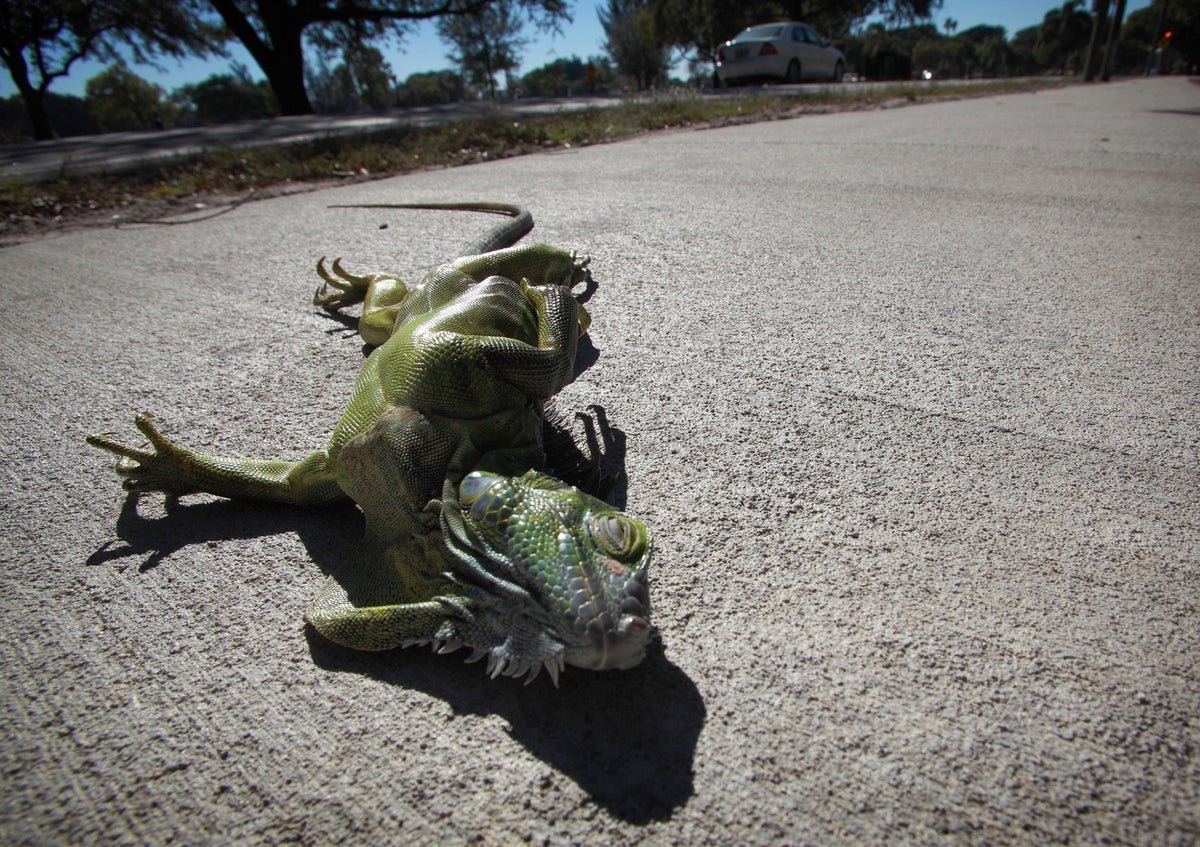
A cold-shocked iguana seen in Florida in late 2022.
Cristobal Herrera/South Florida Sun Sentinel/Tribune News Service via Getty Images
Florida’s iguanas are in for a rude surprise: temperatures have plummeted across the southeastern U.S. Overnight lows are forecast to drop to the mid-30s Fahrenheit (single digits Celsius) or even into the 20s F (negative single digits C) in parts of the state.
Green iguanas (Iguana iguana) are not native to the U.S. but were brought to Florida in the 1960s, where they have, for the most part, flourished—except, that is, when temperatures have dropped below 50 degrees F (10 degrees C). These chilly conditions can cause a cold shock in the lizards. And because the iguanas tend to sleep in trees, getting cold shocked can sometimes cause the animals to fall from the skies in an infamous Florida phenomenon.
The animals—which can reach more than five feet in length—are native to rainforests in Central and South America, where temperatures are far more consistent than they are in Florida. “These tropical lizards were experiencing conditions that they’ve never experienced in their entire evolutionary history before, tens of millions of years,” says James Stroud, an evolutionary biologist at the Georgia Institute of Technology.
On supporting science journalism
If you’re enjoying this article, consider supporting our award-winning journalism by subscribing. By purchasing a subscription you are helping to ensure the future of impactful stories about the discoveries and ideas shaping our world today.
But in Florida, colder conditions occur every few years—albeit less often as temperatures rise because of climate change. The experience of the iguanas that have been forced to confront the cold in the state can teach scientists more about how animals respond to new climates more generally, Stroud says.
“We don’t have a great grasp on what happens when species or entire populations are confronted with brand new climates that they’ve never experienced before,” Stroud says. Florida’s non-native tropical lizards mark a rare real-world example. That’s why Stroud and his colleagues studied such critters during a 2020 cold snap. In that research, they found that lizards that had experienced the chill became more tolerant of cold temperatures.
“Because they’re extreme events, they can be incredibly powerful in leading to responses of species at the population level,” Stroud says. Now he’s working to understand whether such tolerance might be an example of evolution—or simple adaptation.
And if you live in Florida, Stroud says you don’t need to worry about any cold-shocked iguanas you might see. Unless the animals fall from high enough to cause them harm on impact, the lizards will likely be fine, he says.
“Once the sun comes out and air temperature warms up, it’s likely that they might actually wake up and become active again,” Stroud says. “You don’t have to, like, put a blanket on them.”
It’s Time to Stand Up for Science
If you enjoyed this article, I’d like to ask for your support. Scientific American has served as an advocate for science and industry for 180 years, and right now may be the most critical moment in that two-century history.
I’ve been a Scientific American subscriber since I was 12 years old, and it helped shape the way I look at the world. SciAm always educates and delights me, and inspires a sense of awe for our vast, beautiful universe. I hope it does that for you, too.
If you subscribe to Scientific American, you help ensure that our coverage is centered on meaningful research and discovery; that we have the resources to report on the decisions that threaten labs across the U.S.; and that we support both budding and working scientists at a time when the value of science itself too often goes unrecognized.
In return, you get essential news, captivating podcasts, brilliant infographics, can’t-miss newsletters, must-watch videos, challenging games, and the science world’s best writing and reporting. You can even gift someone a subscription.
There has never been a more important time for us to stand up and show why science matters. I hope you’ll support us in that mission.
