

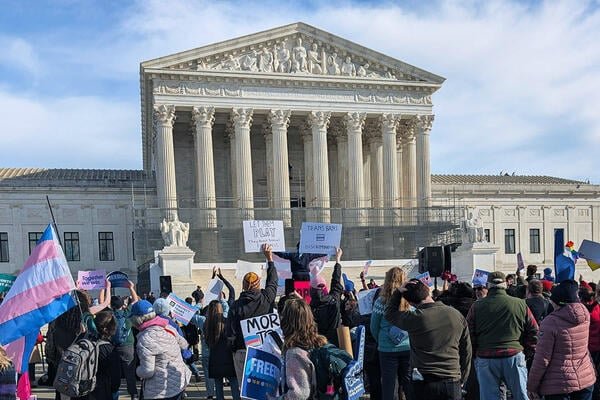
For years, state laws prohibiting transgender girls and women from playing on sports teams matching their gender identity have proliferated, along with legal challenges to these bans.
But now, the U.S. Supreme Court may settle what’s become a national controversy.
On Tuesday, the high court considered the legality of the bans in Idaho and West Virginia.
In more than three hours of oral arguments, the justices and attorneys debated when there should be exceptions allowed to broad legislation that discriminates against specific groups, how the presence or absence of medical testosterone regulation and biological performance advantages affect the legality of these prohibitions, whether sex should be defined as biological sex under Title IX, and what Title IX’s allowance for sex-segregated teams means if transgender women are allowed to play on women’s teams.
“You don’t think we should have an operating definition of sex in Title IX?” Chief Justice John Roberts said at one point to an attorney representing a trans child.
Lawyers representing the students who have challenged the bans said the cases were about access to athletics for a small number of transgender people, including those who are regulating their testosterone. Kathleen R. Hartnett, an attorney challenging the Idaho ban, said her client “has suppressed her testosterone for over a year and taken estrogen,” saying the Idaho law “fails heightened scrutiny” as applied to such trans women “who have no sex-based biological advantage as compared to birth sex females.”
Twenty-seven states ban trans women from participating at some level of athletics, according to lawyers both defending and arguing against such prohibitions. Repeatedly Tuesday, Justice Brett Kavanaugh asked whether states that don’t have such bans are breaking the law or should be allowed discretion—suggesting he’s considering a ruling affecting more than the restrictions in Idaho and West Virginia.
Kavanaugh asked whether states without prohibitions are violating Title IX and the Constitution’s Equal Protection Clause, and whether sex under Title IX could reasonably be interpreted to allow different states to define it differently. He said trans participation can harm girls who don’t make the cutoff for teams, but also expressed hesitancy to rule nationally, asking why the court should “constitutionalize a rule for the whole country while there’s still … uncertainty and debate.”
Justice Samuel Alito didn’t ask many questions, but when he did, he homed in on how sex should be defined under Title IX. He asked how the court could determine discrimination based on sex without determining what sex means. He also asked whether female athletes who oppose transgender women on their teams should be considered “deluded” or “bigots.”
At one point, Justice Neil Gorsuch said that “I’ve been wondering what’s straightforward after all this discussion.” Regarding whether puberty blockers and testosterone suppressants eliminate all competitive advantage, Gorsuch said there’s a “scientific dispute about the efficacy of some of these treatments.”
Almost a year ago, long after West Virginia and Idaho passed their laws, President Trump signed an executive order banning trans women from participating in women’s sports and threatening universities with loss of federal funding if they disobey. The next day, the NCAA announced a policy restricting “competition in women’s sports to student-athletes assigned female at birth only.”
The Trump administration has since pressured institutions to further bar trans women from sports. In April, for example, the Education Department’s Office for Civil Rights concluded that the University of Pennsylvania violated Title IX by allowing a trans woman to compete on a women’s sports team—presumably referring to Lia Thomas, who last competed on the swim team in 2022, in accord with NCAA policies at that time.
Idaho and West Virginia
The court took up two cases Tuesday, Little v. Hecox and West Virginia v. B.P.J. These suits, which center on whether anti–transgender participation laws violate Title IX and the Fourteenth Amendment’s Equal Protection Clause, have been ongoing for years.
In 2020, Idaho became the first state to pass a law outright banning trans girls and women from participating in school sports matching their gender identity. Lindsay Hecox is a trans woman who was nevertheless able to participate in women’s club running and club soccer at Boise State University because she sued that same year and a district court blocked enforcement of the law against her.
In 2024, her lawyers wrote that she tried out for the university’s women’s cross-country and track teams but didn’t make it, “consistently running slower than her cisgender women competitors.” Her attorneys stress that her “circulating testosterone levels are typical of cisgender women.”
Hecox’s attorneys had opposed the Supreme Court taking up the case, previously writing that it’s “about a four-year-old injunction against the application of [the Idaho law] with respect to one woman, which is allowing her to participate in club running and club soccer.” Then, in September 2025, her lawyers argued the case had become moot, saying Hecox dismissed her claims and “committed not to try out for or participate in any school-sponsored women’s sports covered by” the state law.
“In the five years since this case commenced, Ms. Hecox has faced significant challenges that have affected her both personally and academically,” including an illness and her father’s death, her lawyers wrote. They said she’s “come under negative public scrutiny from certain quarters because of this litigation, and she believes that such continued—and likely intensified—attention in the coming school year will distract her from her schoolwork and prevent her from meeting her academic and personal goals.”
“While playing women’s sports is important to Ms. Hecox, her top priority is graduating from college and living a healthy and safe life,” they wrote.
But attorneys defending the Idaho law have argued not to dismiss the case—a position that may allow a national ruling from the high court.
Protesters gathered outside the Supreme Court on Tuesday as the justices heard arguments in two cases concerning trans athletes.
Ryan Quinn | Inside Higher Ed
On Tuesday, Alan M. Hurst, Idaho’s solicitor general, argued that the case wasn’t moot, saying Hecox’s plans about whether to play sports have changed before and may change again. Justice Sonia Sotomayor challenged this, saying Hurst was asking the court to “force an unwilling plaintiff … to continue prosecuting this case.” Justice Ketanji Brown Jackson said “it’s a little odd that a defendant would not want a case dismissed.”
Hurst argued that Idaho’s law wasn’t about excluding transgender people, saying the Legislature there instead “wanted to keep women’s sports women-only.” He also said testosterone doesn’t reliably suppress performance.
“Sports are assigned by sex because sex is what matters in sports,” Hurst said.
Justice Amy Coney Barrett asked whether Hurst was arguing to allow separation by biological sex of even 6-year-olds in sports. Hurst replied that even at that age, boys have a small advantage, but co-ed sports could be an option.
The West Virginia case was filed by the mother of Becky Pepper-Jackson, then a transgender sixth grader, back in 2021. Judges blocked enforcement of the Mountain State’s law against the student.
“In West Virginia’s telling, it passed [its law] to ‘save women’s sports’ by staving off an impending tidal wave of ‘bigger, faster, and stronger males’ from stealing championships, scholarships, and opportunities from female athletes,” the student’s lawyers wrote. “In reality, West Virginia’s law banned exactly one sixth-grade transgender girl from participating on her school’s cross-country and track-and-field teams with her friends.”
Her attorneys wrote that the sports she’s participated in are non-contact, and that she “has received puberty-delaying medication and gender-affirming estrogen that allowed her to undergo a hormonal puberty typical of girls, with all the physiological musculoskeletal characteristics of cisgender girls and none of the testosterone-induced characteristics of cisgender boys.”
They wrote that she “wants to play sports for the same reasons most kids do: to have fun and make friends as part of a team.” She’s participated in post-season shot put and discus, “where her performance is well within the range of cisgender girls her age,” they wrote.
Lawyers defending the West Virginia law, though, wrote that “male athletes identifying as female are increasingly competing in women’s sports, erasing the opportunities Title IX ensured.” They wrote that “women and girls have lost places on sports teams, surrendered spots on championship podiums, and suffered injuries competing against bigger, faster, and stronger males.”
Michael R. Williams, West Virginia’s solicitor general, said the state’s law “is indifferent to gender identity because sports are indifferent to gender identity,” and said “we don’t have an actual transgender exclusion.” He also argued that Title IX defines sex as biological sex because that was the understanding at the time Congress passed it.
Barrett suggested West Virginia’s arguments could be used by a state to argue for separate math classrooms if it produced a study saying women’s presence in calculus was holding men back. Gorsuch made similar arguments.
Federal Intervention
In both cases Tuesday, the federal government defended the state laws. Hashim M. Mooppan, the U.S. principal deputy solicitor general, said Title IX regulations “say you can separate based on sex … the circulating testosterone levels are just legally irrelevant under the regulations.” He also said transgender women aren’t “being excluded from participating on the boys team.”
During and after the oral arguments, hundreds of proponents for trans athletes and opponents held dueling rallies right next to each other outside the Supreme Court, each with their own sound systems and speakers. Education Secretary Linda McMahon was among those who spoke in favor of the state bans.
Education Secretary Linda McMahon speaks outside the US Supreme Court as justices hear arguments in challenges to state bans on transgender athletes in women’s sports.
Photo by Oliver Contreras / AFP via Getty Images
In her remarks, McMahon praised a legal organization, Alliance Defending Freedom, that was defending the bans, and touted the Trump administration’s actions to “restore common sense by returning sanity to the sexes.” She also criticized the Biden administration’s regulations that declared that sex-based discrimination, which is barred under Title IX, includes discrimination based on sexual orientation or gender identity. A federal judge vacated those Title IX regulations in early 2025.
“In just four years, the Biden Administration reversed decades of progress, twisting the law to argue that ‘sex’ is not defined by objective biological reality, but by the subjective notion of ‘gender identity,’’’ she said. (The Title IX regulations took effect in August 2024 but federal courts had already blocked them in dozens of states.)
McMahon added that while the Supreme Court deliberates, the administration will continue enforcing Title IX “as it was intended, rooted in biological reality to ensure fairness, safety, and equal access to education programs for women and girls across our nation.”
“As President Trump has made clear, America is in its Golden Age, one where female students and athletes have equal access to fair and safe competitions and female-only intimate spaces, free from divisive and discriminatory ideologies,” she said.
