

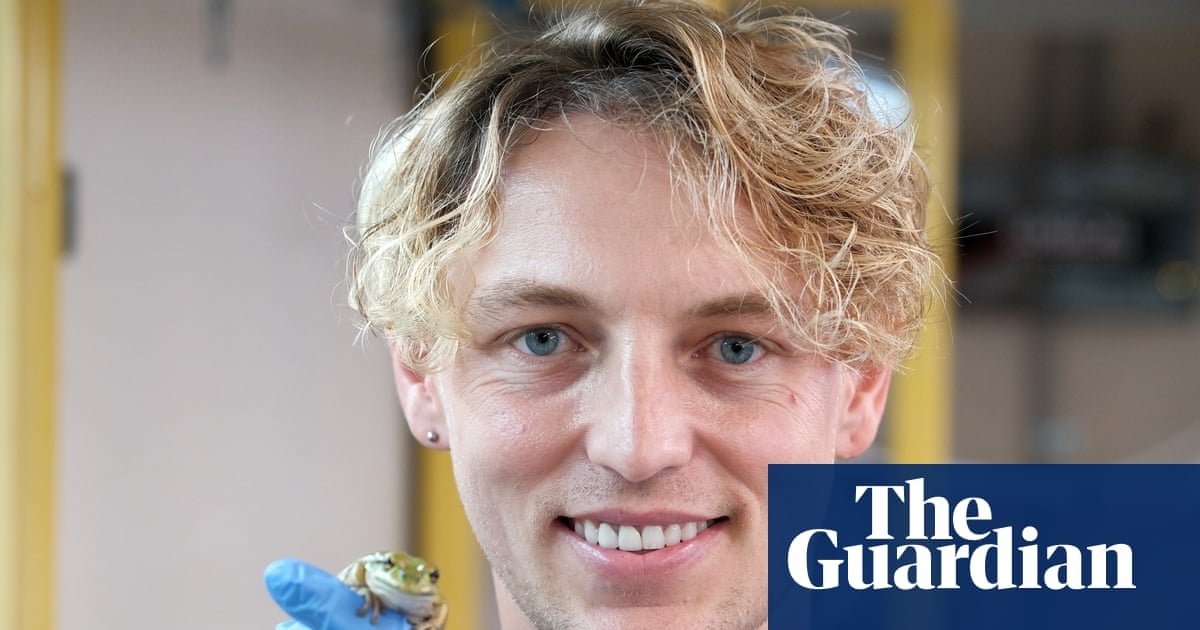
Standing ankle-deep in water between two bare cottonwood trees on a hot spring day, eight-year-old Anthony Waddle was in his element. His attention was entirely absorbed by the attempt to net tadpoles swimming in a reservoir in the vast Mojave desert.
It was “one of the perfect moments in my childhood”, he says.
“Tadpoles: so cool. I wanted to get as many in my net as I could, and just look at them and admire them and understand,” he says, recalling the moment. “I think metamorphosis is the one reason why kids bring tadpoles home. They want to watch that change.”
The endangered Australian green and golden bell frogs who spent the winter in the saunas were less likely to fall prey to the infectious fungus. Photograph: Courtesy of Macquarie University
Waddle has been through a metamorphosis of his own. He has gone from being a child obsessively clutching a binder full of animal trivia in a Las Vegas neighbourhood, his parents barely scraping by, he says, to becoming the first person in his family to get a PhD, which he received from the University of Melbourne in 2022. Today, the 35-year-old is working in Australia to help save the species that fascinated him as a boy. Waddle is an award-winning conservation biologist on a mission to save frogs from the deadly chytrid fungus, which has wiped out 90 species and is threatening more than 500 more.
Frogs and other amphibians play a critical role in the planetary ecosystem, consuming many insects that transport human diseases. Their skin is considered an important potential source of new painkillers that may be less addictive than opiates and could help with antibiotic resistance. The fungus infecting them is almost always deadly, and can rapidly wipe out populations.
In an attempt to slow the march of the disease, Waddle began a novel experiment: building frog saunas. Working out of his lab in Australia during the pandemic, he and a fellow researcher began experimenting with masonry bricks for their perfect, frog-sized holes. Soon, stacks of bricks housing endangered green and golden bell frogs rose “like a Jenga tower, three levels of bricks with a greenhouse over the top” at the test site, Waddle says. They hoped that by raising frogs’ body temperatures, the saunas would help stave off the chytrid fungus – which, like the flu, runs rampant in the winter months.
The saunas were made using masonry bricks in small greenhouses. Photograph: Courtesy of Macquarie University
The experiment worked – frogs that spent the winters warmer in their new shelters were less likely to fall prey to the infectious fungal pathogen, which is temperature sensitive. They were also resistant when re-exposed. It was good news for frogs lucky enough to access these shelters, but Waddle wanted to look further, at solutions that could help save more amphibians at risk.
We can’t be willy-nilly slapping genes into frogs, but at the research level we should be investigating synthetic biologyAnthony Waddle
The search for a scalable, multi-species solution took him into the world of immunisation and synthetic biology. One of his larger projects involves raising and vaccinating hundreds of green and golden bell frogs, a species slowly dying off, largely due to chytrid, for release into the wild.
When they are released, it will be “probably the largest input of frogs in that population in a decade”, he says.
Scientists hope gene replacement could save the southern corroboree frog from extinction. Photograph: Auscape International Pty Ltd/Alamy
Not all species can be vaccinated, however. For those that can’t, such as the critically endangered southern corroboree frogs that no longer breed in the wild, the team is experimenting with gene replacement to help support their reintegration.
“Yesterday we were making transgenic frogs together, the first ever experiment to make a transgenic frog in Australia,” Waddle says from his lab, buzzing with excitement.
“We want to test it in as many Australian species as we can, with the idea that if it works in a lot of species in Australia that are at different conservation levels, different ecologies, it could be the solution, and we could share it around the world,” he says.
Synthetic biology, in which organisms are “edited” by the introduction or deletion of genetic material, is an innovative but controversial discipline. Advocates say it can help add diversity to populations stuck in genetic bottlenecks, or help make vulnerable species disease resistant; critics raise ethical questions and the risk of unintended consequences. Debate surrounded the 2025 International Union for the Conservation of Nature decision to allow the use of synthetic biology for conservation purposes.
Some, including Waddle, think it can help. “We can’t just be willy-nilly slapping genes into frogs, but at the research level we should be investigating synthetic biology.” He says “we’re going to start using these methods in the wild for conservation”.
The frogs living in the saunas emerged resistant to infection. Photograph: Courtesy of Macquarie University
Australian herpetologist and conservationist Dr Jodi Rowley calls the work “a ray of hope in amphibian conservation”. “With the global plight of amphibian populations around the world so dire – over 40% of all species are threatened with extinction – we need these really innovative and cutting-edge strategies to help turn things around.”
The challenges do keep him up at night, he says – but usually it’s due to anticipation of possible solutions, rather than dread. “Usually if I can’t sleep, it’s something exciting,” he says, grinning. “I can’t wait to see what happens in that experiment tomorrow, if these frogs are going to have the gene. I didn’t really sleep at all last night, so excited. But also ideas: I’ll be sitting in bed, [thinking] oh, we can do that experiment. We can do this experiment.”
Find more age of extinction coverage here, and follow the biodiversity reporters Phoebe Weston and Patrick Greenfield in the Guardian app for more nature coverage
